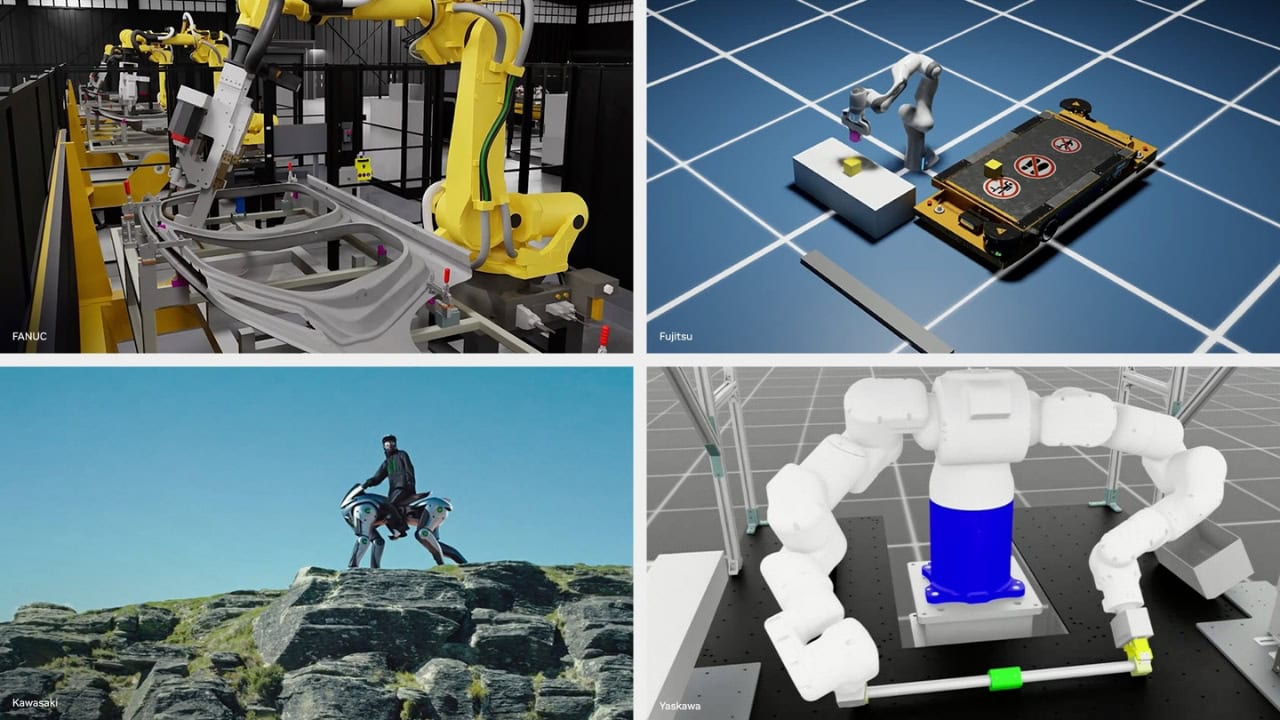
NVIDIA has quietly locked much of Japanese industry onto its technology, and the scale is what stands out. The company announced that a sweeping roster of Japan’s robotics and manufacturing leaders is building on its physical AI platforms, from FANUC and Yaskawa to Sony, Honda, Hitachi, and Kubota. So a single American firm now sits at the center of Japan’s push to reinvent its factories.
Cosmos 3 Edge, the highlight product, is a compact four-billion-parameter model that lets robots and vision systems understand their surroundings, reason in real time, and decide their next move directly on the machine. Crucially, it runs on edge computers rather than distant servers, so a robot thinks locally. Developers can adapt it to a specific robot or environment in about a day, which lowers the barrier considerably.
The term underneath all this is physical AI, and it simply means bringing intelligence into machines, factories, and infrastructure. Where earlier AI generated text or images, physical AI moves things in the real world. Japan is a natural home for it, given decades of leadership in robotics, precision engineering, and manufacturing.
Fujitsu is building a shared control platform with FANUC, Yaskawa, and Kawasaki, while SoftBank develops its own physical AI platform on NVIDIA tools. Kubota is exploring autonomous farming, Kawasaki is applying the technology across shipbuilding and healthcare, and GROOVE X is putting NVIDIA chips inside its companion robots.
Jensen Huang framed it as destiny, calling this a once-in-a-generation opportunity and noting that Japan invented modern manufacturing, so it can now reinvent it. The flattery is strategic, though, since every one of these partnerships deepens reliance on NVIDIA’s chips and software.
That dependence is the real story worth watching. As robotics becomes the next AI battleground, NVIDIA is ensuring the machines think using its silicon, which is precisely the position rivals and nations are scrambling to escape.


