1
Operators need telco-trained models, guardrails, simulation and distributed AI infrastructure to move from network automation to new AI-era services.
The telecom industry’s agentic AI conversation often starts with network operations. That makes sense. Most service providers are still working their way up the autonomous network maturity curve, and the immediate value is in reducing complexity, improving efficiency and giving engineers better tools to manage increasingly dynamic networks.
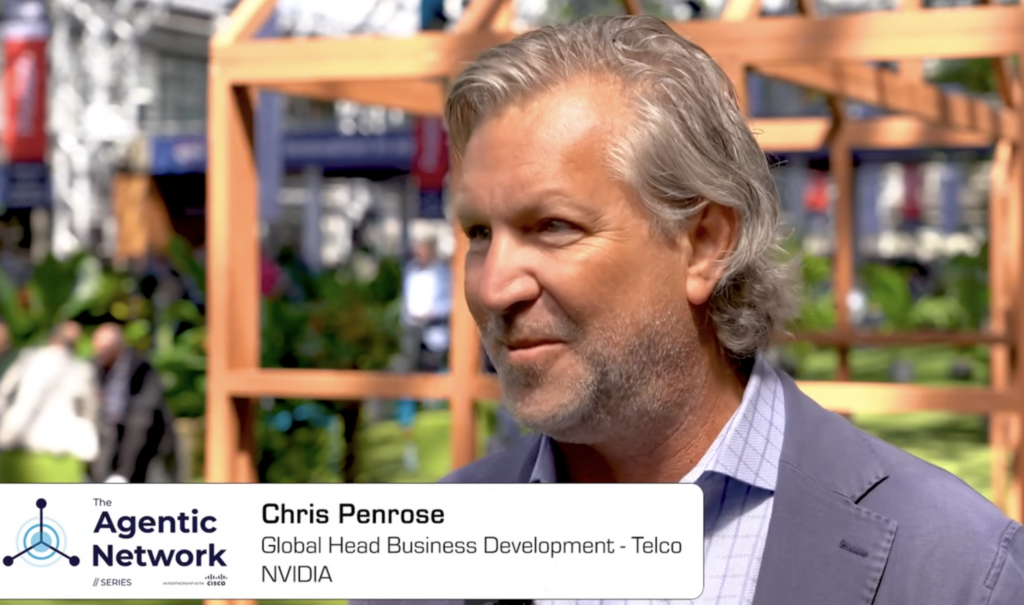
But NVIDIA’s Global Head of Business Development for Telco Chris Penrose sees a larger architecture taking shape. Speaking at DTW Ignite in Copenhagen, Penrose described NVIDIA’s work with telecom operators and partners as a full-stack effort to accelerate the autonomous network journey. The point is not simply to add AI to existing workflows. It is to build the models, guardrails, simulation environments and distributed compute infrastructure operators will need to trust AI in live networks and monetize AI services beyond connectivity.
“We kind of look at a full autonomous network stack that people are going to need,” Penrose said. That stack starts with foundational models that “speak telco and understand the telco language,” then moves into agentic workflows, secure sandboxes, simulation and digital twins.
That framing tracks with NVIDIA’s DTW Ignite 2026 announcements. The company positioned telecom autonomy around data, domain models, secure agent runtimes and simulation, arguing that automation is no longer the end state but the starting point for autonomous operations. NVIDIA also pointed to SoftBank’s use of NeMo Safe Synthesizer and NeMo Anonymizer to generate privacy-preserving telecom datasets for fine-tuning large telecom models and building specialized network agents.
The trust problem is central. Telecom networks are deterministic, high-consequence systems; AI is probabilistic. Operators are not going to let an AI system make changes to a live network just because the recommendation looks plausible. “Nobody’s going to trust you just to take an AI recommendation and just put it out in the network,” Penrose said.
NVIDIA’s answer is to de-risk agentic action before it reaches the production network. Penrose pointed to NeMo Guardrails and OpenShell as ways to create a protected environment where agents can operate within security parameters. NVIDIA’s blog describes NemoClaw blueprints and OpenShell as tools that provide policy-based guardrails and sandboxed access to telecom systems, allowing operators to expand agentic operations while keeping behavior governed, auditable and predictable.
Simulation is the other piece of the trust architecture. Penrose said NVIDIA has worked with Infovista to accelerate market-wide simulations that once took hours, or even days, down to seconds in some cases. NVIDIA also highlighted work with VIAVI to improve RAN simulation throughput and with KDDI, Keysight and Samsung Research America on high-fidelity RAN digital twins using NVIDIA Aerial Omniverse Digital Twin.
This matters because the path to Level 4 and Level 5 autonomy runs through validation. Agents need to predict, recommend, simulate, validate and only then act. In Penrose’s words, the goal is to make AI usable “in a telco-grade environment with trusted partners,” because networks have to be resilient, reliable and secure.
The second half of NVIDIA’s telecom thesis is about revenue. Penrose described AI Grid as a way for operators to participate in the emerging token economy. As AI moves from centralized training toward distributed inference, telcos have relevant assets: land, power, central offices, switching offices, cell sites and customer relationships. “Telcos sit actually on some very interesting assets,” he said.
An AT&T, Cisco and NVIDIA collaboration gives that idea a concrete expression. Announced in March, the work combines AT&T’s dedicated IoT core, Cisco’s Mobility Services Platform and NVIDIA accelerated compute to bring highly secure, near-real-time AI inference closer to where data is generated. The initial use cases include video security, transportation, manufacturing and industrial automation.
Penrose described the AT&T/Cisco work as putting compute “right at the edge of the network” to enable real-time intelligence on IoT traffic, including video analytics. Rather than moving video back to a centralized location, operators can analyze it closer to the camera feed and layer intelligence on top of connectivity.
That is the broader decision in front of service providers. Do they want to remain at the connectivity layer, or do they want to combine connectivity and compute into differentiated services and outcomes? Penrose pointed to token-based plans in China as an early signal that tokens could become a new monetization unit, following the industry’s historic progression from voice to text to data.
The agentic network, as described by NVIDIA, is both an operating model and an infrastructure strategy. Operators need agents that understand telecom, guardrails that make them safe, simulations that make them trustworthy and distributed AI infrastructure that makes them monetizable. Autonomy improves the network. The AI Grid concept posits that the network can also become a platform for the next unit of digital value.


