
OpenAI is expanding ChatGPT Ads into more international markets while adding new targeting, measurement and optimization tools for advertisers.
The combination could make ChatGPT a more meaningful part of advertisers’ media plans.
Geographical expansion. ChatGPT Ads are rolling out to select countries across Europe, India, the Middle East and North Africa.
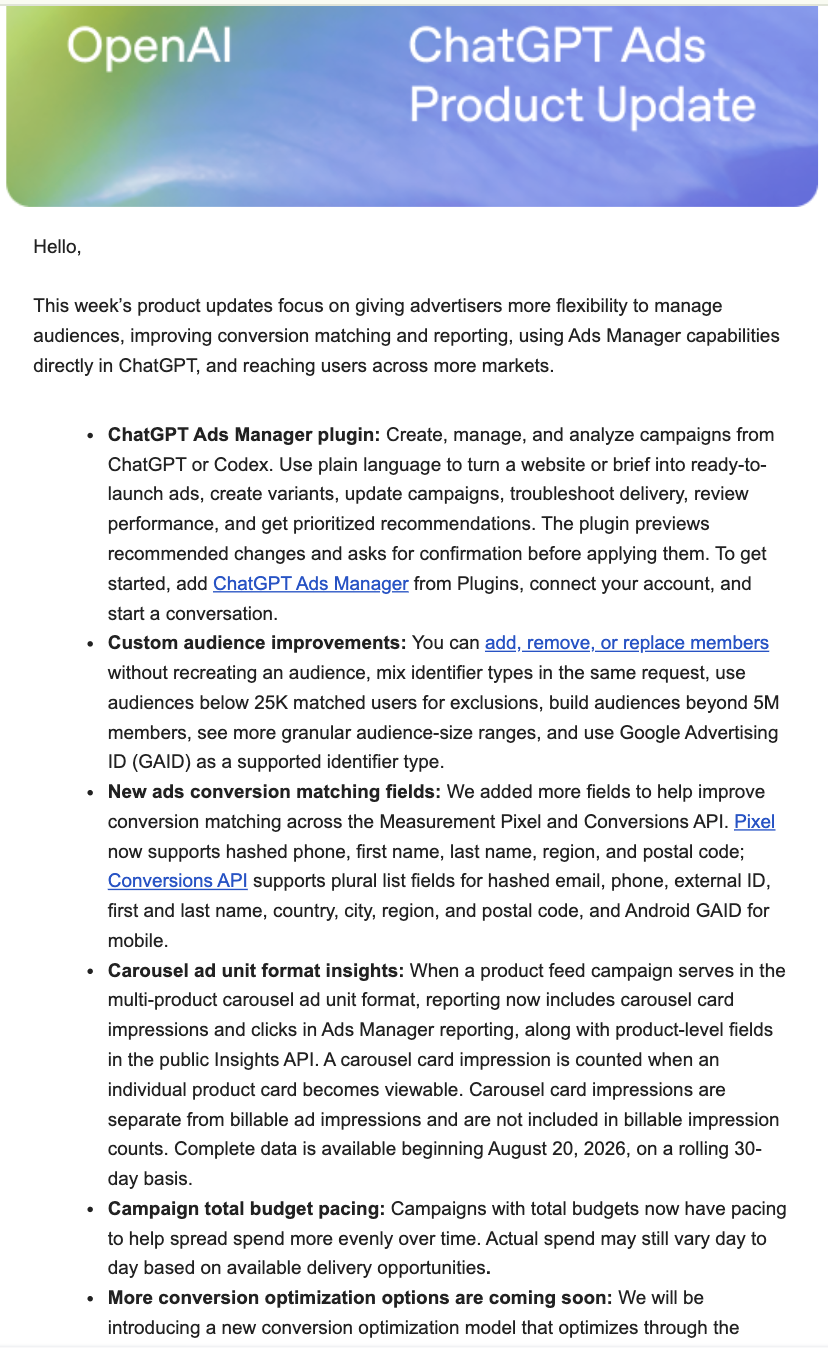
At the same time, OpenAI is introducing a batch of advertising updates spanning audience management, conversion measurement, campaign pacing, reporting and campaign creation.
Custom audience. Advertisers are getting more flexibility in how they build and manage custom audiences.
They can add, remove or replace audience members without rebuilding an audience from scratch, mix different identifier types in a single request and create audiences exceeding 5 million members.
OpenAI is also lowering restrictions around exclusion audiences, providing more granular estimates of audience size and adding Google Advertising ID, or GAID, as a supported identifier.
On measurement. OpenAI is expanding the data its Measurement Pixel and Conversions API can use for conversion matching.
The Pixel now supports additional hashed customer information including phone numbers, names, regions and postal codes. The Conversions API is similarly gaining support for additional identifiers and Android GAID.
Better matching could help advertisers connect more conversions back to their campaigns — a key requirement if OpenAI wants marketers to treat ChatGPT as a performance channel rather than an experimental media buy.
On reporting. Product-feed advertisers are getting more visibility into how individual products perform inside carousel ads.
Ads Manager now reports impressions and clicks at the carousel-card level, while product-level fields are available through the Insights API.
Importantly, OpenAI says those card impressions are separate from billable ad impressions.
Why we care. OpenAI’s updates makes ChatGPT Ads more scalable, measurable, and actionable. Expanded audience tools and stronger conversion matching should make it easier to target the right users and understand whether ads actually drive results, while new reporting and optimization capabilities give advertisers more control over performance.
And with ChatGPT Ads expanding across Europe, India, the Middle East and North Africa, advertisers can now test those capabilities across a much larger global audience.
What’s next. OpenAI plans to introduce a conversion optimization model that considers both click-through and view-through conversions.
Campaigns using the model will be billed by impression while the system optimizes delivery toward the advertiser’s selected conversion goal.
That pushes ChatGPT Ads further toward the automated optimization model that underpins much of modern performance advertising.
And one more thing: Advertisers can now use a ChatGPT Ads Manager plugin to create, manage and analyze campaigns from ChatGPT or Codex using natural-language instructions.
The tool can generate ads from a website or brief, produce variants, troubleshoot campaigns and recommend changes, with advertisers asked to confirm recommended updates before they’re applied.
The big picture: OpenAI’s latest updates aren’t centred on a single new ad format. They’re about building the less-visible infrastructure — targeting, measurement, optimization, reporting and workflow tools — that advertisers need before they can move meaningful budgets onto a new platform.
Dig deeper.


