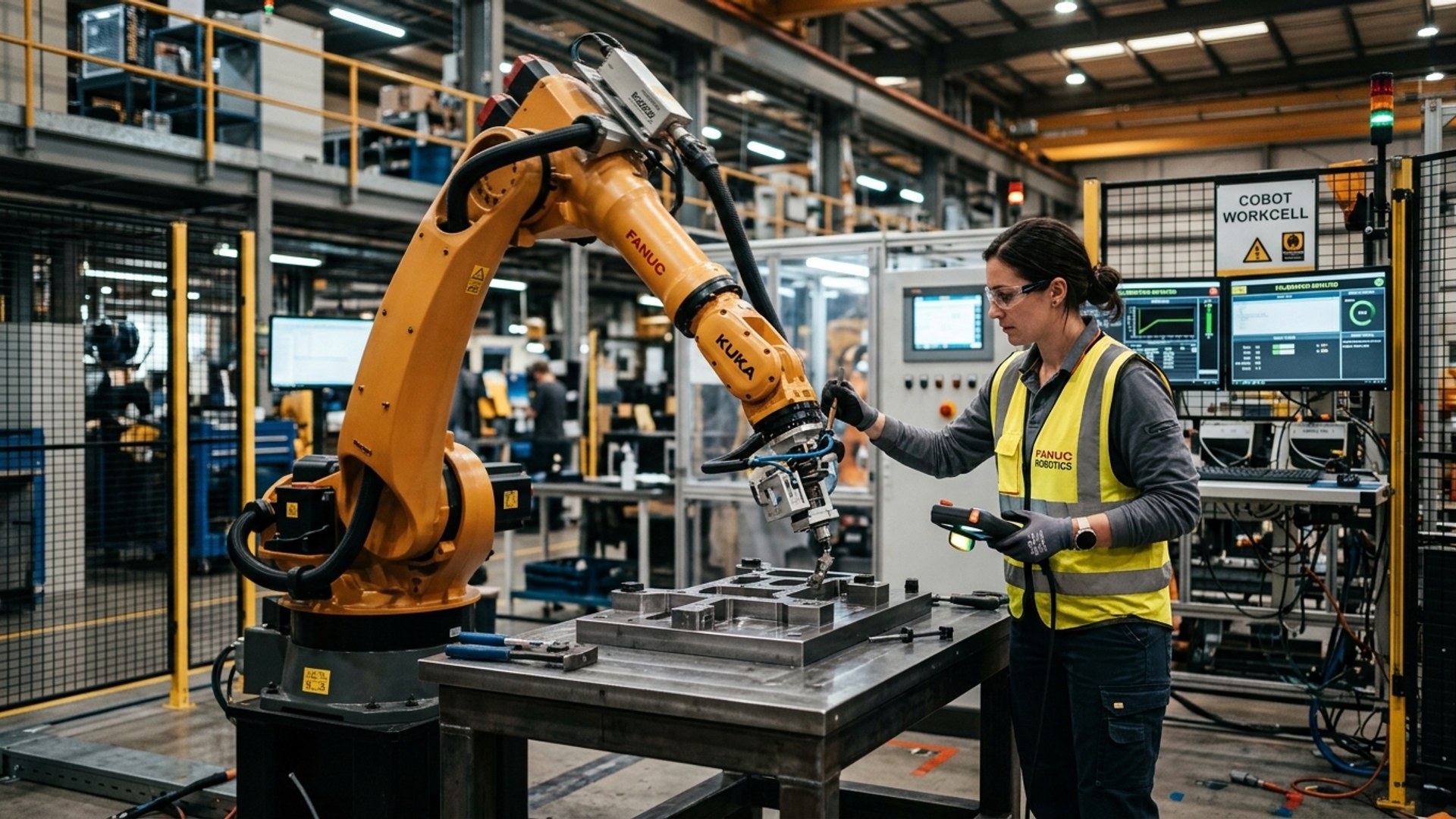
Palladyne AI and FANUC America announced a strategic collaboration on September 8, 2026, pairing FANUC America’s industrial robot portfolio with Palladyne AI’s physical AI software platform for manufacturing, warehousing, and logistics applications. The companies’ announcement, issued from Palladyne AI’s Salt Lake City headquarters and distributed over Business Wire, centers on Palladyne IQ, the company’s embodied AI software for industrial robots and collaborative robots.
Under the collaboration, the two companies plan to develop intelligent robotic capabilities intended to simplify deployment, increase adaptability, and expand the range of manufacturing and logistics applications that can be automated. The companies said the joint effort is aimed at reducing the complexity traditionally associated with robotic automation while enabling robots to be deployed faster and operate more intelligently.
Six Initiatives Span Optimization, Training, and Validation
The announcement lays out six strategic initiatives the collaboration will pursue. The first is optimization of Palladyne IQ on FANUC robotic platforms, adapting the software to run across the robot maker’s hardware. The companies also plan joint work on AI-driven motion planning and adaptive robot behavior, along with teleoperation and human-assisted learning capabilities.
The remaining initiatives cover simulation and AI model training intended to accelerate deployment, joint validation of customer use cases across manufacturing, warehousing, and logistics applications, and the development of standardized deployment workflows for system integrators and end users.
The announcement does not disclose financial terms, a development timeline, or named launch customers for the collaboration.
Palladyne IQ Brings Closed-Loop Autonomy to FANUC Hardware
The collaboration’s technical foundation is Palladyne IQ, which the company describes as closed-loop autonomy software using artificial intelligence and machine learning to provide reasoning capabilities for industrial robots and cobots. According to the Palladyne IQ product page, the software is organized around a four-stage cycle: Observe, which fuses sensor inputs such as vision, LiDAR, radar, and acoustic data through multi-modal sensor fusion; Learn, under which the company says robots can acquire new or complex tasks from as few as one to five demonstrations; Reason, which generates real-time motion plans at the edge; and Act, which controls the robot and end effector to complete tasks.
Palladyne AI says the platform is designed so robots perceive variations in the environment and adapt to them dynamically, rather than following rigid pre-programmed routines. The product page states the software supports low-code and no-code training, including a drag-and-drop Robot Action Planner and a Routine Canvas interface for building task routines, and that it runs autonomously at the edge without requiring a cloud connection. The company says the platform is compatible with most industrial robots and cobots sold today, and the collaboration with FANUC America represents a platform-specific optimization effort on top of that general compatibility.
Applications listed for the software include sub-assembly, pick-and-place operations such as sorting, kitting, and parts sequencing, assembly line quality inspection, component cleaning for maintenance, repair, and overhaul work, and media blasting for surface preparation. Target industries span industrial manufacturing, defense, automotive, aerospace and aviation, construction, infrastructure maintenance and repair, and energy.
Companies Frame the Effort Around Labor and Flexibility Pressures
In the announcement, the companies framed the collaboration around conditions facing manufacturers: skilled labor shortages, increasing product variability, and pressure to improve productivity and operational efficiency. The companies said they aim to help manufacturers, warehouse operators, logistics providers, system integrators, and end users deploy automation in a more scalable and repeatable way, and to help customers address persistent labor, productivity, and operational flexibility challenges.
Palladyne AI describes itself as a U.S.-based defense and industrial technology company delivering embodied AI-powered collaborative autonomy solutions, advanced avionics, precision-manufactured components, UAVs, and aerospace engineering services. FANUC America, which the announcement describes as a global leader in industrial automation and robotics, has announced a series of physical AI initiatives of its own this year, including collaborations with NVIDIA on simulation and edge AI infrastructure and with Google on AI agents for robot systems, according to the company’s press release archive. The Palladyne collaboration extends that pattern to embodied AI software supplied by a third-party robotics software company.
The companies said the combined work is intended to move industrial automation beyond rigid, single-purpose deployments toward more flexible robotic systems able to support a broader range of tasks and operating conditions, with joint customer use-case validation and standardized deployment workflows among the first concrete steps.


