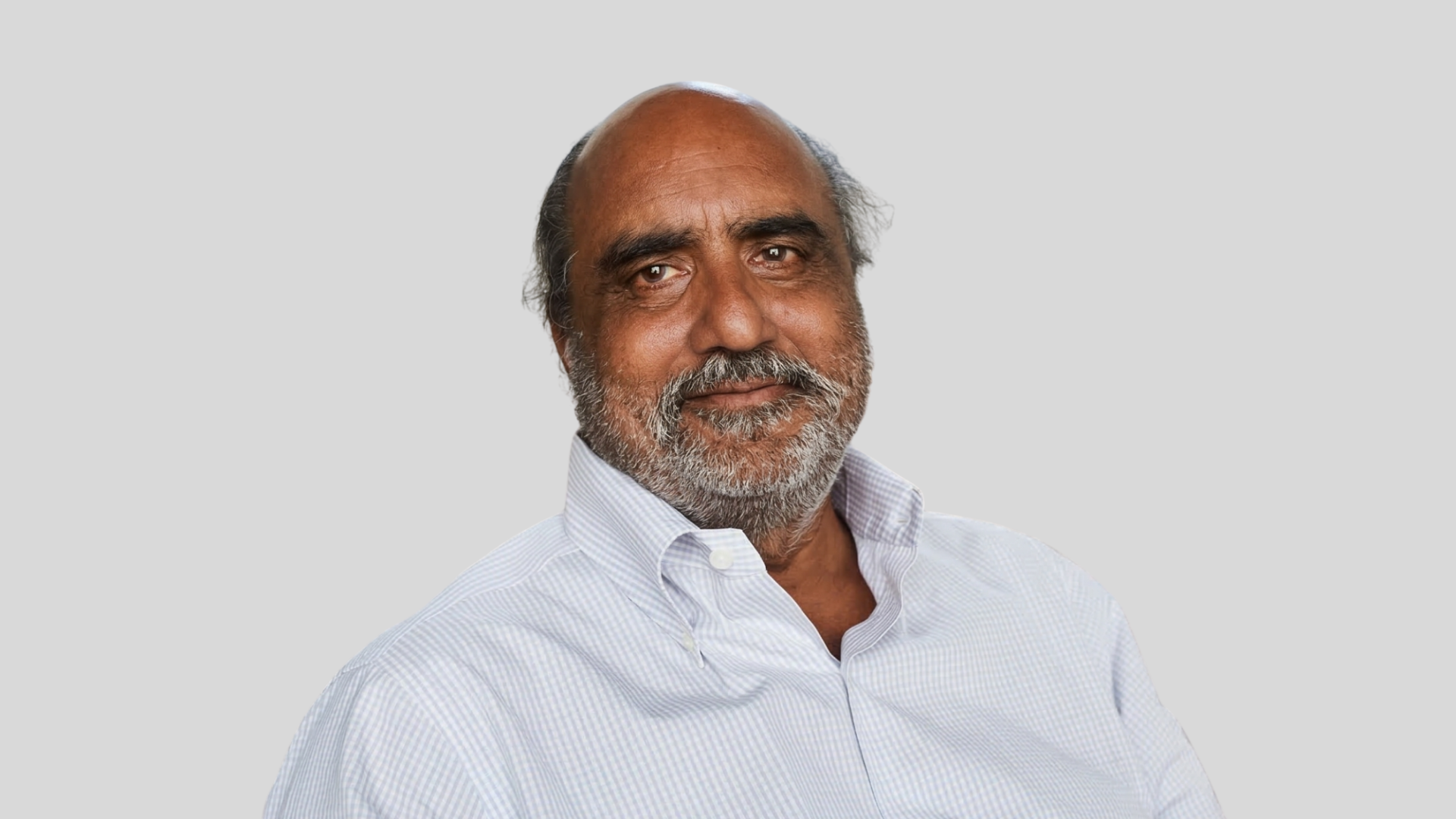
Par Chadha, Founder, CEO and CIO of HandsOn Global Management, is an entrepreneur, investor, and technology executive with decades of experience building and scaling technology-enabled businesses. Since founding HandsOn Global Management in 2001, he has focused on investments in workflow automation, big data, robotic process automation (RPA), cognitive technologies, and artificial intelligence across financial services, healthcare, insurance, and legal markets. He is also Co-Founder of Rule14 and previously served as Chairman and Executive Chairman of Exela Technologies, as well as Chairman of SourceHOV.
HandsOn Global Management (HGM) Limited is a technology-driven company operating at the intersection of strategic investment and business services, combining capital deployment with operational expertise to build and scale technology-enabled businesses. The company is increasingly focused on AI-driven healthcare services, including revenue cycle management, medical coding, ambient listening, and healthcare analytics, while also applying AI-powered automation and process optimization across enterprise workflows. HGM describes its model as a hybrid of an investment firm and diversified services provider, using acquisitions, technology integration, and operational execution to pursue long-term growth across markets including North America, Asia-Pacific, and the Middle East.
You founded HandsOn Global Management in 2001, well before artificial intelligence became a mainstream investment theme. What originally inspired you to establish the company, and how has its investment philosophy evolved alongside advances in workflow automation, data intelligence, and agentic AI?
The name HandsOn describes how I think about the organization. If you cannot be hands-on—if you are hands-off—you don’t belong in our organization. I expect the people who oversee businesses, including myself, to practice what I call servant leadership. Our job is to serve the people who work for us and help them become more successful.
Technology has changed tremendously, but the underlying question hasn’t changed very much: what does the technology allow the business to do better?
With automation, I have always looked at what I call flex capacity. If one employee can handle 100 transactions and automation allows that person to handle 250, you have created capacity for growth without adding the same amount of cost. It makes the business more profitable and scalable.
Now AI is taking that considerably further. We are moving into AI-based workflows where you have orchestration of many different tasks, with people in the loop and agentic AI in the loop. I think those types of companies are going to be in very high demand and will be some of the most disruptive companies.
So the technology has evolved, but our philosophy remains hands-on: understand the operating problem, understand where productivity can be created, and turn the technology into a business.
As both CEO and Chief Investment Officer, what characteristics distinguish an AI company with the potential to become a durable business from one that is primarily benefiting from short-term excitement around the technology?
For me, the distinction is whether you can turn the investment into a business. Otherwise, investment is just a cost.
There can be a lot of excitement around intellectual property or new technology, but somebody still has to use it. It has to solve something, have a value proposition, and ultimately generate revenue.
Take automation as a example. You also have to understand the function you are automating. Marketing, sales, purchasing, HR, finance, administration, tax reporting and security are very different functions. The automation has to be designed around what that particular business actually does. A gas station has very specific needs. A restaurant has very specialized needs.
The companies that last will be the ones where customers can see the difference—more profitability, more scalability, more capacity, or the ability to do something they could not economically do before. The technology is important, but ultimately it has to become a business.
HandsOn Global Management takes an active operational role in building, acquiring, and transforming companies. How does this hands-on approach change the way you evaluate AI investments compared with a traditional venture capital or private equity model?
I don’t believe in sitting at the top and simply telling people what to do. My approach has always been that the people who work for you have gaps, and your job is to help fill those gaps and make them successful.
That means when we look at an investment, we are thinking operationally. Who is going to run it? How is it going to be positioned? Who are the customers and partners? What is the value proposition? Can it become scalable?
I work hand in hand with management teams, but I also want the operating person to lead. I will make the introduction, let that person take over, stay copied, and be available. For us, owning an investment and operating a business are not two completely separate activities.
Many enterprises are experimenting with AI, but fewer have successfully deployed it across mission-critical operations. What separates organizations that move from isolated pilots to production-scale adoption?
A big part of it is whether the organization itself is prepared to change.
The technology can move faster than the people. We have people coming out of school who know AI, know agents, and can become productive very quickly. At the same time, people with five, ten or twenty years of professional experience can have difficulty shifting from their comfort zone into the new zone. We see the same behavior in the U.S., India, the Philippines and Europe.
That becomes an organizational problem, not merely a technology problem.
The companies that make the transition will be willing to change the workflow itself. Once you orchestrate different tasks with people and agentic AI working within the process, you are changing how the work gets done.
If companies don’t make that shift, somebody else will. I think it becomes do or die. The companies that disrupt will move forward, and the companies that don’t will get disrupted.
HGM’s healthcare initiatives include autonomous medical coding, voice and conversation intelligence, predictive analytics, and AI agents that operate across administrative and clinical workflows. Where do you believe AI can remove the greatest amount of friction from healthcare without compromising accuracy, privacy, or patient trust?
One of the biggest problems in healthcare is that we digitized individual functions, but we did not necessarily connect the enterprise. Claims, enrollment, care management, pharmacy, provider services, analytics and revenue cycle can still operate as disconnected systems. That creates duplicated work, inefficiency, higher costs and a poor experience.
I don’t think the answer is simply another application. Intelligence has to be embedded into the workflow. The opportunity is to bring data, processes and people together so AI can help understand what is happening, predict what comes next, recommend an action and automate the work that can appropriately be automated.
Administrative work is an obvious place to start. Providers still deal with manual processes, prior authorizations and administrative burden. If technology can simplify those workflows, you create more capacity for the professional and ultimately more time for care.
But trust matters enormously in healthcare. Security, compliance and governance have to be part of the architecture. Technology should simplify complexity, not add to it. The objective isn’t AI for the sake of AI. It is better care, lower costs, better operational performance and a better experience for the member and provider.
In regulated industries such as healthcare, financial services, insurance, and government, how should companies determine which decisions can be delegated to autonomous AI agents and which should continue to require human review?
I think accountability becomes the dividing line.
In regulated businesses, somebody ultimately has responsibility for what is being represented. In cybersecurity, for example, regulators can require management and boards to disclose information very quickly, and senior management may have to sign public statements. The problem is nobody knows everything, particularly that quickly.
AI can bring tools together, establish a baseline, organize information and make a process much more productive. But that does not make accountability disappear.
Healthcare is a good example. AI can predict, detect, recommend and automate, but those functions don’t all carry the same level of risk. The architecture has to recognize where automation is appropriate and where people need to remain in the loop. The more consequential the decision, the more important governance, explainability and accountability become.
I don’t see it as a choice between completely autonomous AI and completely manual work. The question is where AI can do the work effectively and where a person still needs to exercise judgment or stand behind the result.
You co-founded Rule14, a platform designed to find, monitor, analyze, and summarize information in real time. How have large language models and generative AI changed what is possible in data mining, and what foundational data challenges still need to be solved?
Large language models create an opportunity to make information-based work much more scalable.
We have businesses where hundreds of lawyers and other professionals work with content and information, and historically they have used more legacy tools than large language models. What interests me is how you can take platforms built for one purpose, package them correctly and use them for a very different purpose at scale.
It isn’t simply that a model can summarize something. You can change the economics of how large amounts of information are processed, packaged and delivered.
But I would not assume that because you have a large language model, you suddenly know everything. The underlying information still matters, and in the real world information can be incomplete or unavailable when you need it. The models make us much more productive; they don’t eliminate the need to understand what information you actually have.
HGM’s strategic ecosystem includes companies working across autonomous medical coding, ambient clinical documentation, intelligent workflows, payments, data processing, and AI development platforms. How do you create meaningful technical and commercial collaboration across a portfolio without forcing companies into an artificial ecosystem?
You use each company for what it does best.
I described this in cybersecurity as creating a little club. We are the provider of the service, and the other companies are experts in their fields. We use each one for its best capability. By combining with us, they get expansion into our customers, and we get the benefit of what they are very good at.
That is different from saying every company has to use every other company because they happen to sit in the same portfolio. The point is to bring capabilities together into something the customer can actually use.
Internally, I take a similar approach. I connect the right people and let the operating person lead. They work out what they can do together, what the budgets are and whether it belongs on the product roadmap.
The collaboration has to create value. Otherwise, there is no reason to force it.
You have led investments, acquisitions, and operational transformations across multiple regions and industries. What have you learned about adapting AI products to different regulatory environments, business cultures, languages, and levels of digital maturity?
Culture is important, and personal relationships are important.
When people only know each other through an office directory, telephone number or email, I call that a very impersonal relationship. That may work when everything is normal. But when you are building, expanding, fixing something or dealing with trouble, knowing the person on the other side becomes much more important.
Travel teaches you that markets are not all the same. You learn what people eat, what sports they follow, how their school systems work, what is culturally sensitive and what creates unnecessary walls. The more you know about the country, the people and how they live, the more you reduce the gap in the relationship.
Technology is similar. Different markets are at different points. Some countries are farther ahead than the U.S. in certain professional services, while we may be farther ahead in other forms of automation.
You cannot assume you can take one model, put it everywhere and expect the same outcome. You have to understand how that market actually works and build relationships with the people who are going to use it.
As agentic AI, cognitive automation, and physical AI continue to converge, which opportunities do you believe remain underestimated, and what advice would you offer founders building companies for this next phase of automation?
I think AI-based workflow is going to be in very, very high demand—the orchestration of a variety of different tasks with people in the loop and agentic AI in the loop. I believe those are going to be some of the most disruptive companies.
The disruption will also be broader than people expect. People tend to think automation affects the low end of the workforce. My opinion is that often it is the middle layer. Senior people can do more, so they need less middle layer. Coding, testing, data entry and data analysis are being automated, while workflows and dashboards reduce the need to manage some of those functions.
Then you have the physical side. Restaurants are becoming automated. Work that used to require people during harvesting and planting seasons is being replaced by autonomous machines, robots and drones. That landscape is changing very quickly.
There is going to be pain in that transition. Productive engines need fewer of us. But if we don’t improve productivity, we won’t be able to compete with much more populous countries with very different cost structures. If we get it right, I think this can be the start of a new American century.
For founders, I would focus on the workflow and the productivity you are creating. Build something that becomes part of how work actually gets done, understand where people still belong in the loop, and recognize that the organizations adopting your technology are also going through a major workforce transition.
Thank you for the great interview, readers who wish to learn more should visit HandsOn Global Management.


