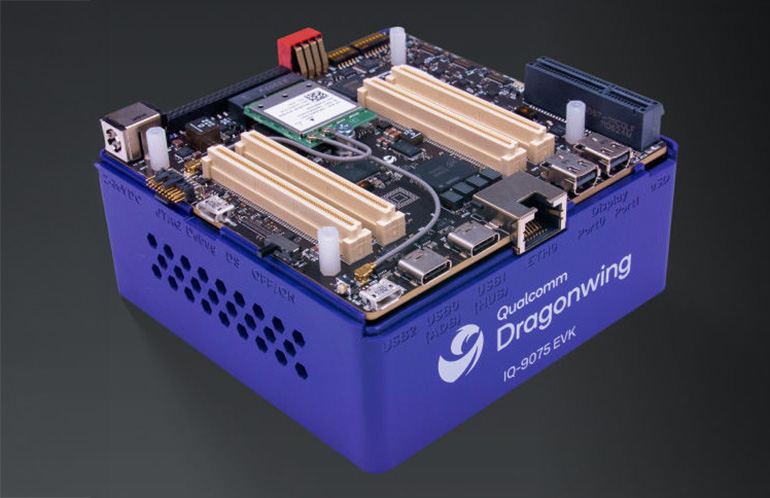
Qualcomm will integrate its Dragonwing platform with PickNik’s MoveIt framework. Source: Qualcomm
Qualcomm Technologies Inc. today said it has agreed to acquire PickNik Inc., which has developed robotics software including the MoveIt open-source manipulation framework. The companies said they expect to streamline MoveIt integration with Qualcomm Dragonwing platforms to give developers an easier path from AI models to planning, manipulation, and real-time control.
“Since our founding, PickNik’s mission has been to provide industries with a powerful, open platform that accelerates innovation and development of advanced robotics, well beyond traditional factories,” stated Dave Coleman, founder and chief product officer at PickNik.
“Joining Qualcomm Technologies will allow us to accelerate that mission, expand investment in MoveIt as a leading AI training platform for robotics and deliver even more value to developers while preserving the openness, community collaboration, and cross-platform support that have always been central to our approach,” he said.
PickNik advanced robotic manipulation with MoveIt
Founded in 2015, PickNik worked on the Amazon Picking Challenge and landed Google as its first customer. The Boulder, Colo.-based company‘s team had begun work on MoveIt as part of the Robot Operating System (ROS) project at Willow Garage.
In 2024, PickNik rebranded MoveIt Studio to MoveIt Pro to reflect its maturation into a professional-grade system with advanced runtime, decision-making, and orchestration capabilities.
This year, the company partnered with Motiv Space Systems to develop software for NASA’s Fly Foundational Robotics mission. It also released MoveIt Pro 9.0, which includes enhanced perception-to-motion capabilities, redesigned teleoperation, and a training data collection system.
Qualcomm provides tools for commercializing robots
San Diego-based Qualcomm provides Snapdragon processors, wireless system-on-chip (SoC) modems, and Internet of Things (IoT) platforms. In January 2026, the company introduced a general-purpose architecture stack to integrate hardware, software, and AI. Qualcomm said it supports vision-language models (VLMs) and vision-language-action models (VLAs).
In April, Qualcomm joined MassRobotics to offer Dragonwing to support resident startups. The company said its acquisition of PickNik strengthens its “commitment to fostering an open robotics ecosystem, providing developers with the tools, software, and frameworks needed to move more efficiently from research and experimentation to prototyping, deployment, and production at scale.”
“Robotics is one of the most exciting frontiers of physical AI, and software is the connective tissue that turns great hardware into great robots,” said Nakul Duggal, executive vice president and group general manager for automotive, industrial and embedded IoT, and robotics at Qualcomm.
“PickNik has earned tremendous trust within the global robotics community through its stewardship of MoveIt and its commitment to open-source innovation,” he added. “Together, we plan to make it easier for developers to build advanced robotic applications on Dragonwing robotics platforms while continuing to support the openness and collaboration that have made MoveIt successful.”
Qualcomm to continue open-source support
Developers, students, researchers, and commercial robotics organizations worldwide have used MoveIt to build robotics applications on top of ROS for applications including industrial automation, service robotics, mobile manipulation, and emerging physical AI systems. Qualcomm said that it plans to keep MoveIt 1 and 2 open-source under its existing license and community-driven roadmaps and resources.
In addition, Qualcomm said it will continue supporting MoveIt across third-party hardware providers. “MoveIt’s hardware-agnostic design is a key enabler of innovation, giving developers the freedom to choose the robot, compute platforms, and sensor components that best fit their needs,” it asserted.
Both PickNik and Qualcomm are founding members of the Open Source Robotics Alliance (OSRA). Qualcomm also said it intends to continue driving projects such as Space ROS in addition to open-source development of MoveIt and ROS.
“MoveIt is entering an exciting new chapter with the resources and support to help expand its impact,” said PickNik CEO Dave Grant.
 Register now and help us celebrate 20 years of RoboBusiness!
MoveIt integration with Dragonwing, Arduino to ease robotics development
In October 2025, Qualcomm acquired open-source hardware and software firm Arduino. Qualcomm plans to integrate its purchases, starting with integrating MoveIt with Arduino VENTUNO Q boards. Its stated goal is “to make advanced robotics, edge AI, and heterogeneous compute more accessible than ever.”
“This integration seeks to extend powerful motion planning and autonomy capabilities to target millions of developers, helping shorten the journey from prototype to production-ready robots,” the company added.
By integrating PickNik’s commercial MoveIt Pro platform with Dragonwing’s advanced AI, heterogeneous computing, connectivity, and real-time capabilities, Qualcomm said it will simplify and speed up robotics development for diverse environments.
At ROSCon Toronto this week, Qualcomm and PickNik are showing MoveIt Pro running on VENTUNO Q and Dragonwing platforms. The closing of their transaction, whose amount was not specified, is subject to customary closing conditions.
Qualcomm’s acquisition of PickNik is just the latest physical AI deal. In January, Mobileye acquired Mentee Robotics for $900 million. In June, Bear Robotics bought Kinisi Robotics.
Earlier this month, Qualcomm rival NVIDIA said it plans to acquire Hugging Face and keep its AI development platform open. This week, SoftBank Group reportedly planned to purchase the Robotics and AI Institute from Hyundai Motor Group, and Google unit Intrinsic released ROS-compatible capabilities.
The post Qualcomm to acquire PickNik Robotics and keep MoveIt open-source appeared first on The Robot Report.


