It’s time for another rabbit hole post. Or at least, a small rabbit hole post.
This one is spurred on by a random comment thread on the recent COROS Watch Bricking Post. The gist of things was a debate saying the COROS Dura had far better battery life, and thus all the ultra bike folks were switching to it. Setting aside COROS’s (clever) sponsoring/ambassadorships of a number of ultra bike-packing folks, I was curious what the data would say. Both units have solar panels, and both are the longest battery bike GPS units on the market (by a massive margin).
After all, I’d tested this off and on over the past few years – though not always directly. But I had plenty of COROS Dura data that I roughly know what the battery burn looked like in hot and sunny summer days, cool and overcast winter days, and basically everything in between. And I knew it for both navigation and non-navigation scenarios. Likewise, I had years of data from the Garmin Edge 1040 Solar, prior to mostly switching to newer devices. The Edge 1040 Solar was announced in June 2022, while the COROS Dura announced in June 2024.
Now, I don’t want to dive into features here (the Edge 1040 Solar would win in a landslide in literally every possible category), nor price (inversely, the COROS Dura would win in a landslide there, priced at $249 vs the $699 for the Edge 1040 Solar), or anything else that would distract from the item at hand (for the moment anyway).
Instead, I just want to look at the battery. In my past tests over the past few years, the general gist of it is as follows:
COROS Dura: Tends to burn at 2%/hour in all my riding conditions regardless of features enabled (e.g. navigation enabled), but can recoup about 1%+ /hour with solar power gains.
Edge 1040 Solar: The burn rate is kinda all over the map here, going from (also) 2%/hour to far higher depending on what you’ve enabled, and can recoup what seems like about 0.5%/hour (it doesn’t’ specify this exactly, but gives minutes instead, so it’s kinda wonky to see solar recoup amounts).
As always with most things, what you’ve enabled will drive battery burn. In the case of Garmin, they simply have more things to enable. And likewise, even when comparing Garmin to COROS for features they both have (e.g. ClimbPro-like things), Garmin’s feature is far deeper, and shows far more on the screen than COROS’s. So again, there are trade-offs to be made. Pretending those don’t exist would be silly, but we aren’t going to dive into them today. Simply acknowledge them, and move on.
The Settings:
Now, I tried to get these as close as possible for today’s 3hr+ ride. Here’s the gist of what the settings were:
Navigation: This was enabled for today, with a route created in Strava and pushed to both units, following navigation, with re-routing enabled. I would go rogue for about 45-minutes, forcing the devices to re-route. Navigation alerts would appear on both devices accordingly. That said, the COROS Dura failed (repeatedly) to re-route, despite having connectivity to both app and internet, so this probably (positively) assisted it for 45 minutes.
Sensors: Both devices would be connected to the same chest strap and power meter pedals. No other sensors were connected for this ride (I didn’t connect radar, cause I didn’t want to hear three different bike computers chirping radar alerts at me for three hours).
Data page: Both units were configured to show me 7 data fields on a single page, with the same HR/cadence/power/distance/time/etc data. That said, when units would automatically detect/show ClimbPro-like pages, Iet them ride with that to the top the climb, at which point I’d get back to the main data page I had configured.
Backlight settings: I set it for ‘Auto’ on the Edge 1040 Solar, and left it as defaults on the COROS Dura.
Bluetooth/Phone: Both were connected to my phone, with both configured to send LiveTrack sessions to my wife (which, both did). Note though, the COROS device did fail to update the LiveTrack for a nearly 45-minute long section, for no obvious reason. When I closed and re-opened the app on my phone, it started sending again. This probably (positively) impacted COROS Dura battery life a tiny bit.
Everything else: Best I could make it, everything else was set as defaults. I wouldn’t claim this as a scientific test, but then again, most people that do such things in this field rarely make it scientific anyway. But I tried to make it as equal as I could think of.
In any case, I also had a Wahoo ROAM V3 with me, but that burns battery like a blowtorch, so it’s not competing in today’s race. It was along for the ride to test out the expanded body temperature sensor bits I posted about earlier.
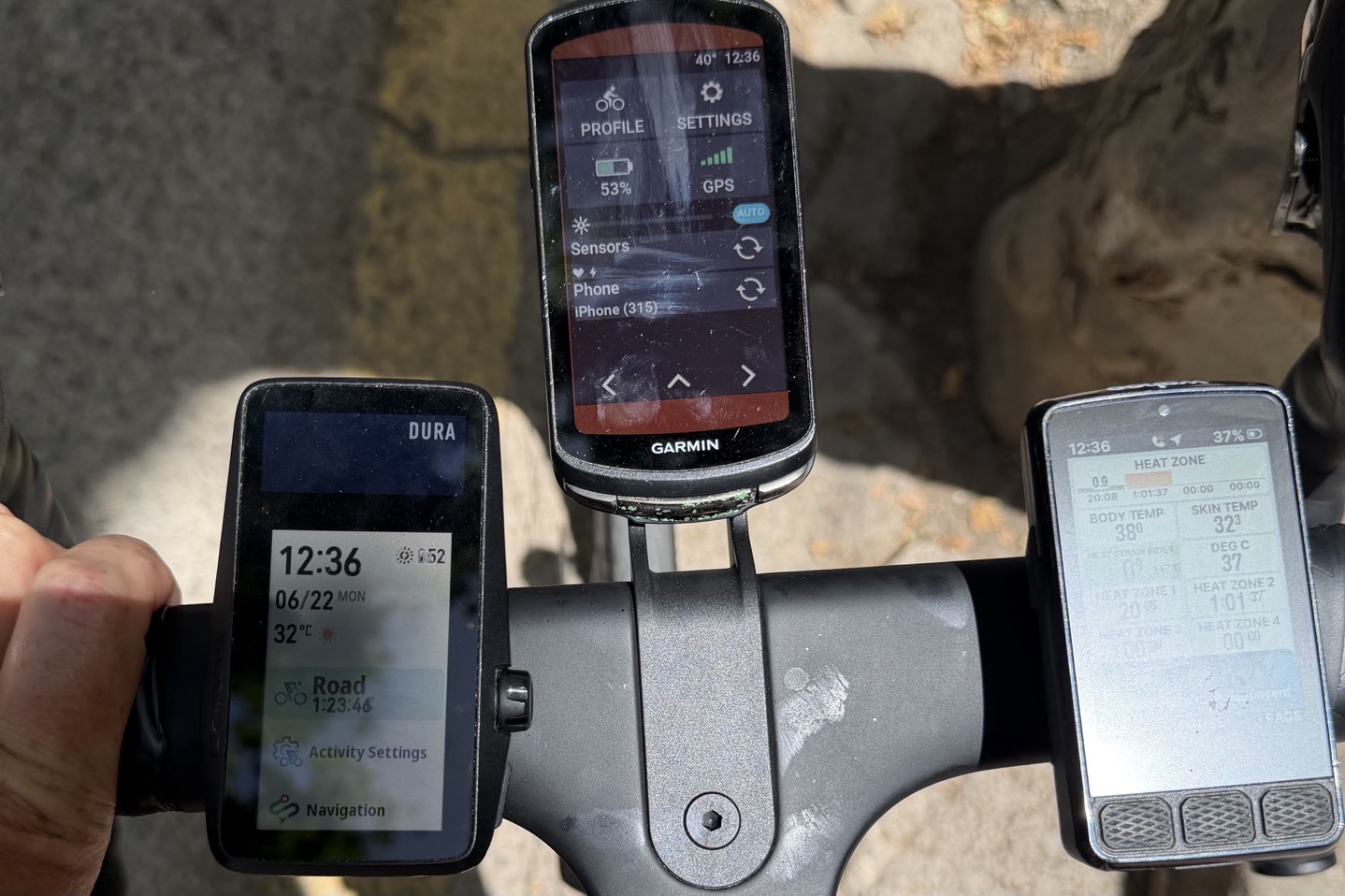
Here’s the starting point for all three units:
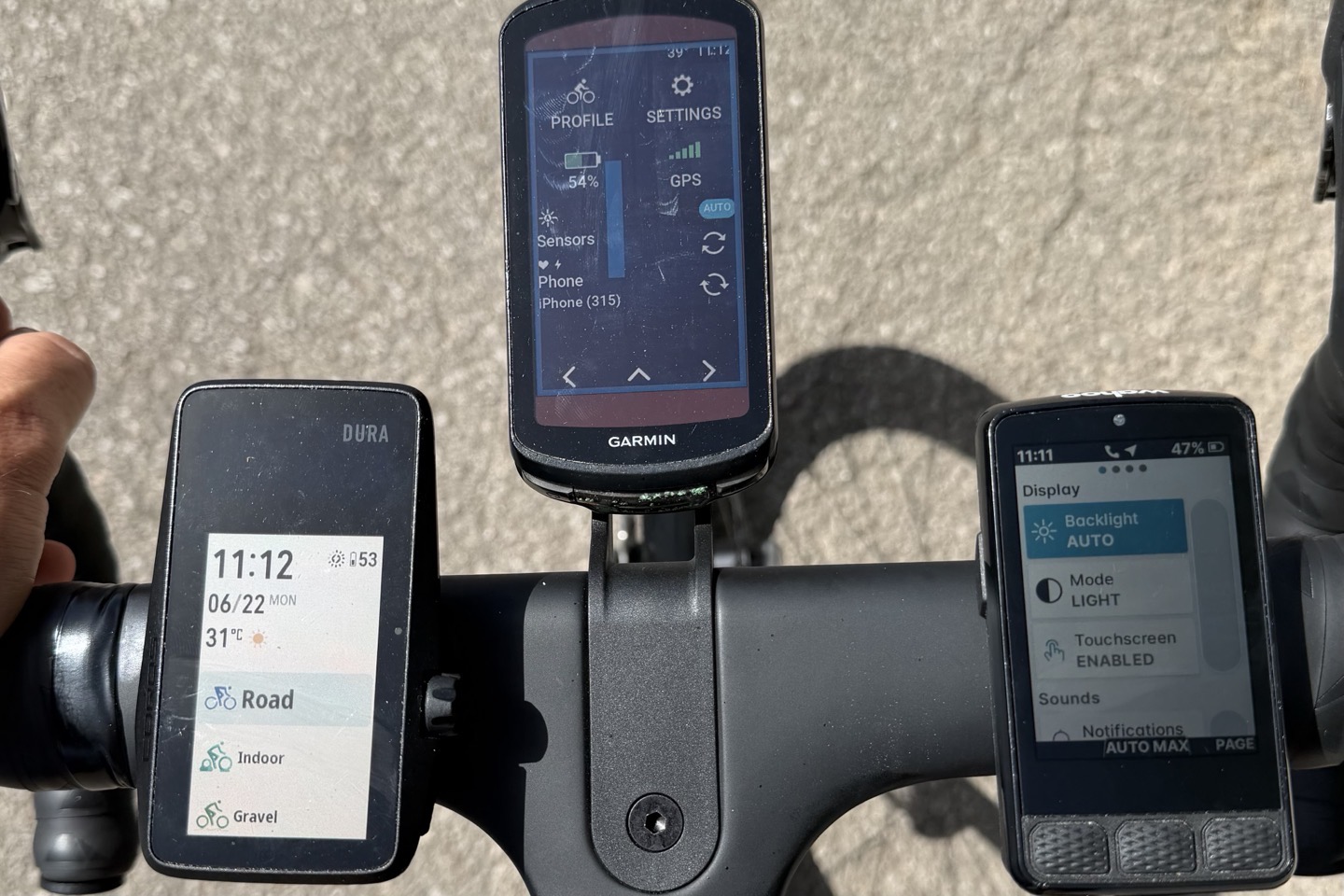
As you can see: The COROS Dura at 53%, the Garmin Edge 1040 at 54%, and Wahoo ROAM V3 at 47%. Oh, and in case someone asks what the green stuff is on the edge of the Edge 1040 Solar is (my wife asked), I don’t exactly know. It spent the winter in a metal bin that’s undercover but still outside, and had some batteries mixed in said bin. Something corroded or whatever nearby it. It’s just external cosmetic damage, but obviously, it’s still a 4-year old unit that’s “seen some things” in its life. It wouldn’t have any impact on the test.
The Ride:
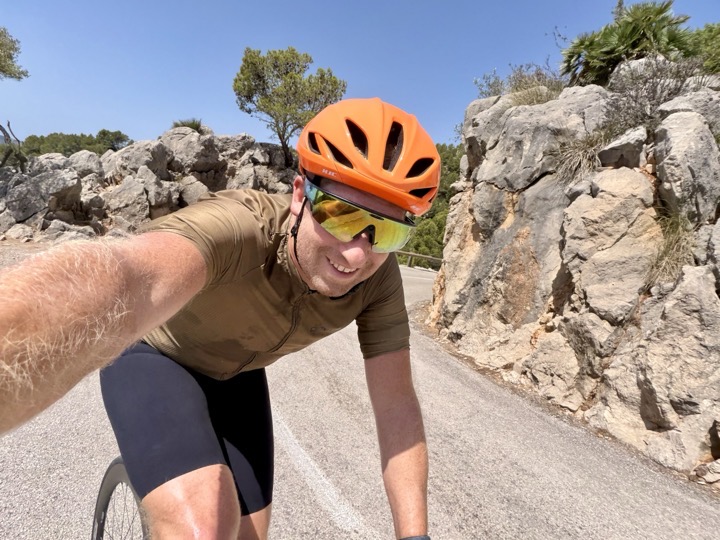
With that, out I went into a clear-blue sunny day. For context, the ride was in Mallorca Spain, in mid-June, on what was thus far the hottest day of the calendar year. The on-road temps from the Garmin & Wahoo devices were floating in the 42-46*C range, or 107*F-115*F. The COROS Dura showed about 1-2*C cooler. Those are the temps showing the ambient above-pavement/road temperature. Slightly cooler elsewhere.
Anyways, fast-forwarding to 83 minutes into the ride, and here’s how things look (below). The Garmin Edge 1040 Solar has lost 1%, the COROS Dura has lost 1%, and the Wahoo ROAM V3 has gobbled up 10%.
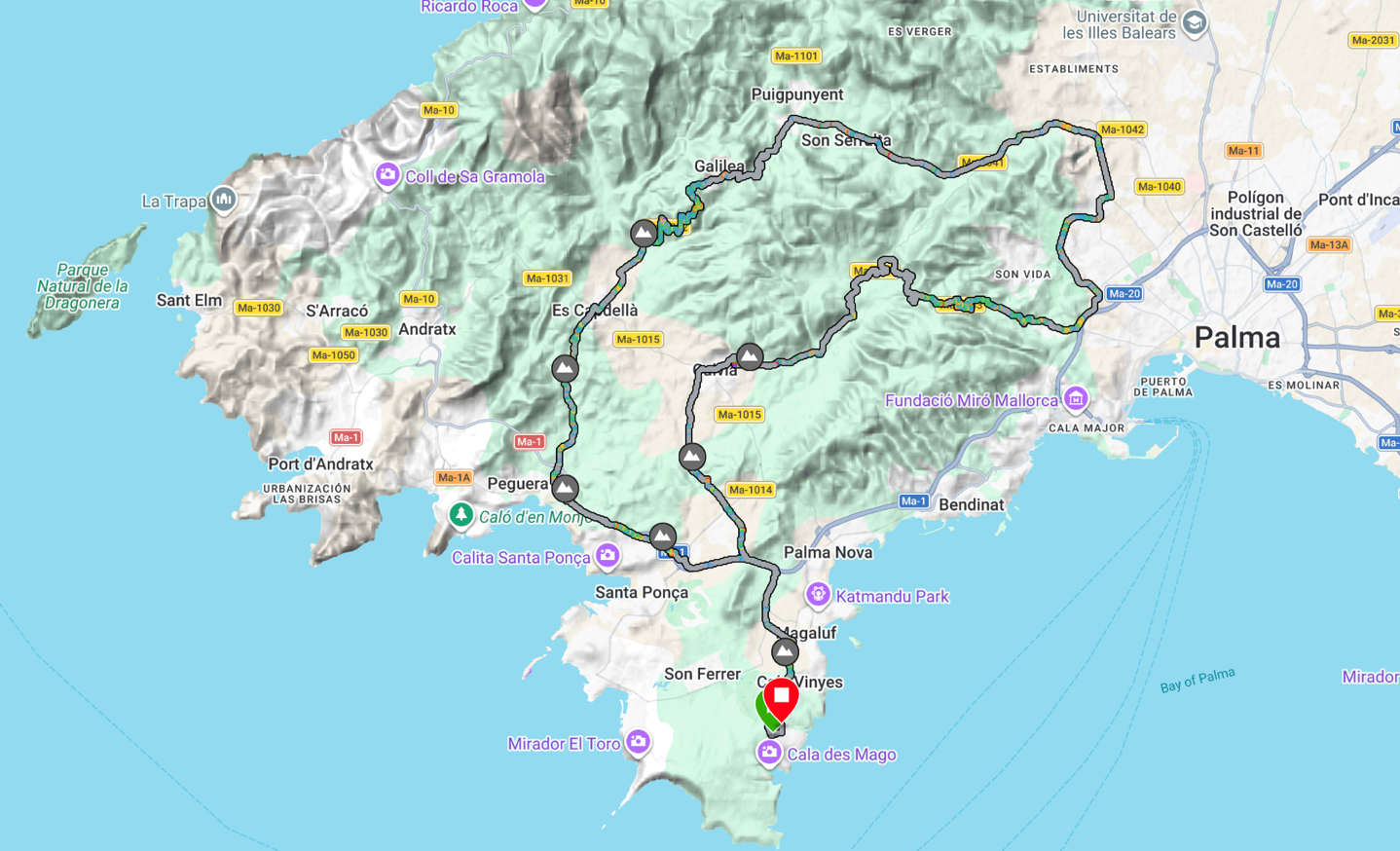
From there I kept on chugging. About 15 minutes after that, the COROS Dura lost the phone connection for a bit (so LiveTracking stopped for it),and then about 15 further minutes later, I purposefully went off-route (because I was going too quick for my planned 3-hour route, and needed to add an extra/bigger climb). As noted above, the COROS Dura failed to re-route, and even after I re-opened the phone, and it was showing live text messages coming in on the app, it would fail to re-route. There was no re-routing issues on the other units, though, both were consistently displeased with my choice not to just turn around. The route below through the mountains, done clockwise.
Now, some 3 hours and 15 minutes later, right before pressing stop, here’s how things stood. The COROS Dura was at 51% (from 53%), the Garmin Edge 1040 Solar at 51% (from 54%), and the Wahoo ROAM V3 at 11% (from…umm…47%):
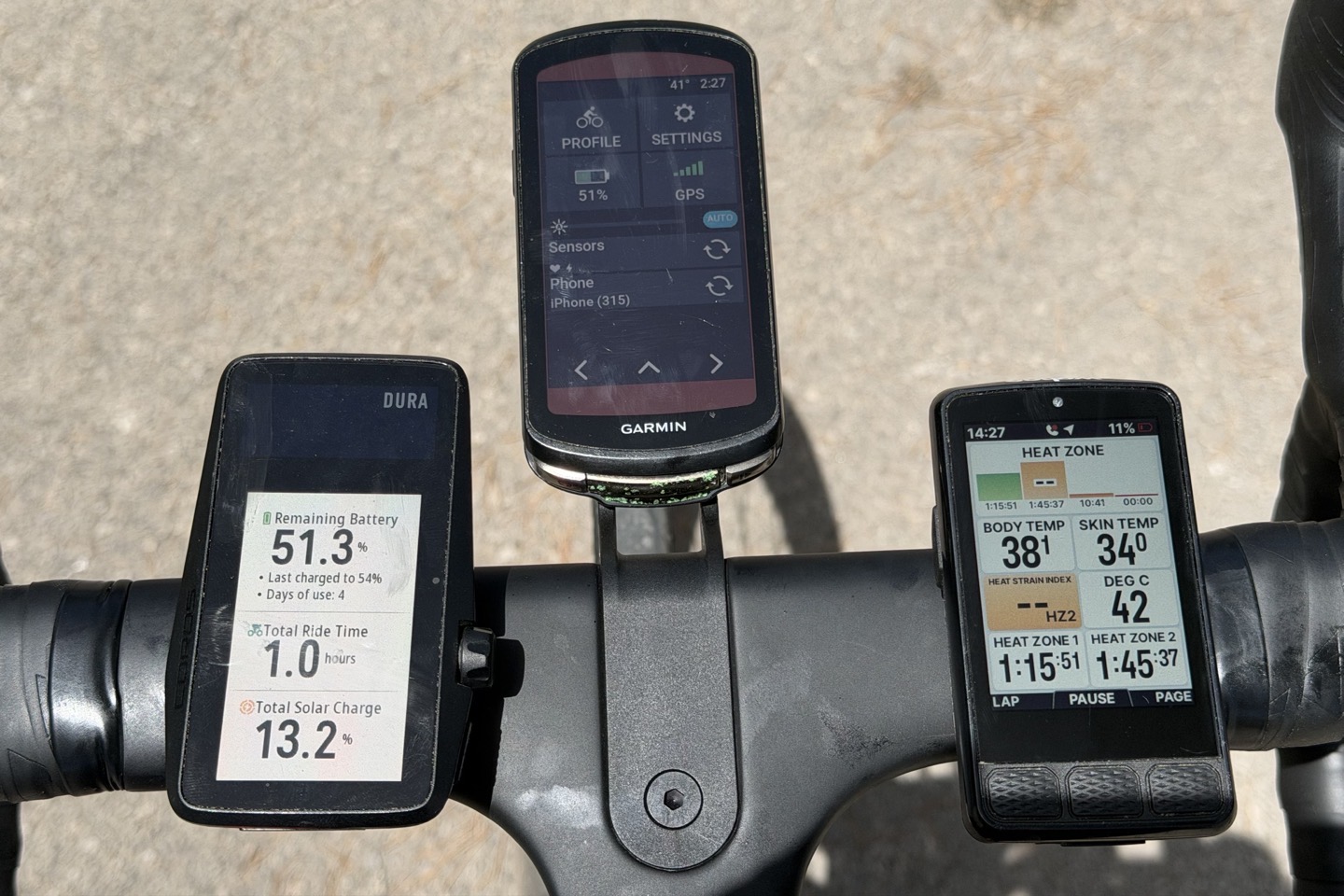
(The ‘Total Ride Time’ shown here on the COROS is prior to pressing save since last charge, so it includes a previous 1hr ride, but not yet my current 3hr ride)
What’s kinda neat on the COROS screen, is you can see more precise numbers on the charge. This is one of the ‘big’ challenges with battery burn testing, is that most of the time you only get whole numbers (e.g. 54% instead of 53.7%), so things get rounded a fair bit. When you’re looking at burn rates like Wahoo’s, it’s not a big deal. But when you look at devices with burn rates like COROS or Garmin’s Solar units, then it can be a significant difference in battery estimates. Literally just 1-2 minutes one way or the other can swing an estimate a massive amount.
That’s why, for battery burn tests, I like to have many, many hours (for watches, often 8-12 hours on a single go). But doing so on a bike in this weather isn’t super viable. If not due to the weather, then my back. 😂
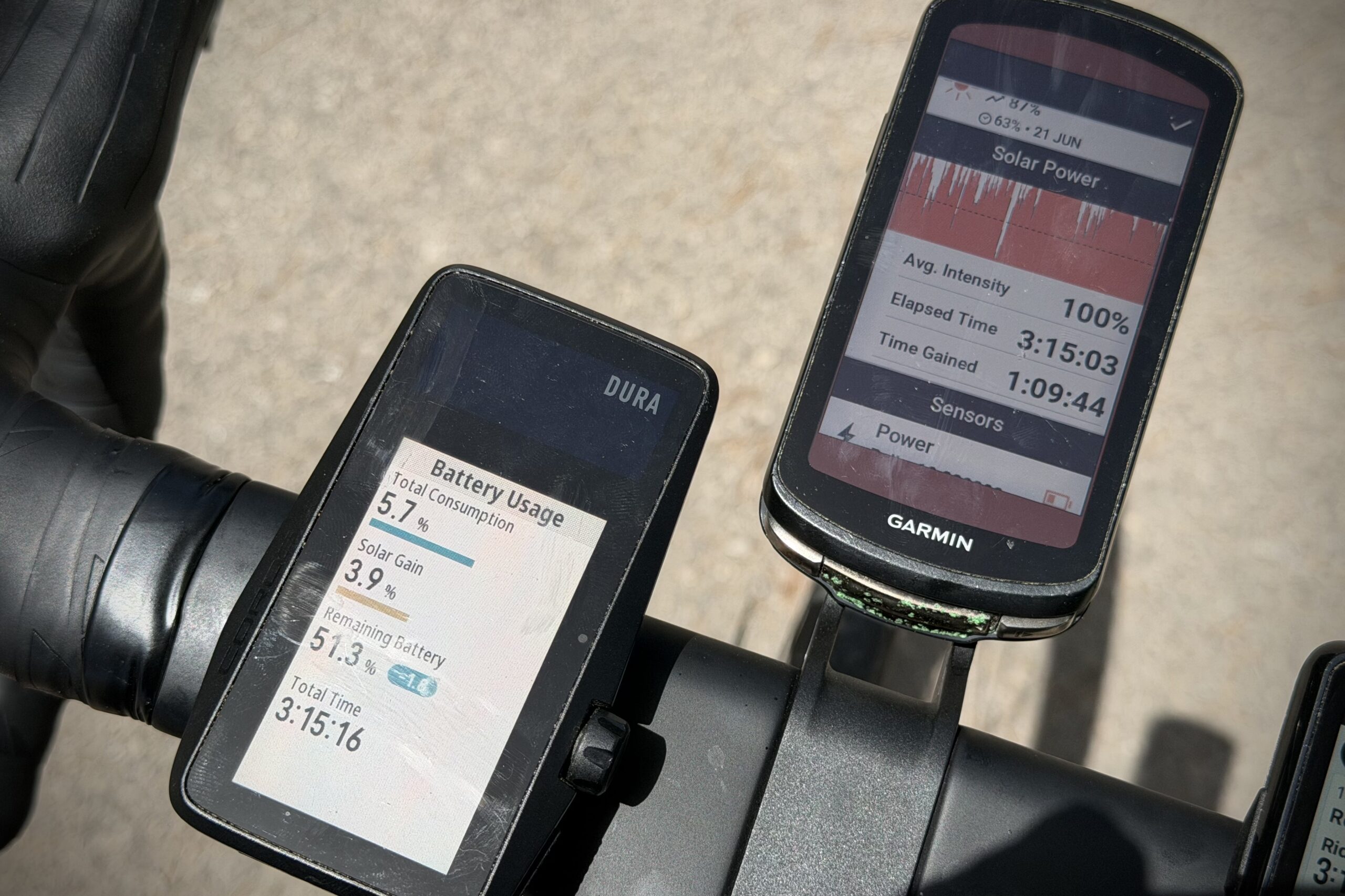
After pressing save, you can see more details on both. The COROS Dura lost 5.7% during the ride (consistent with what I’ve seen of about 2%/hour), but gained about 3.9% back in Solar gains. Thus, it lost a total 2% (or 1.8% to be precise, because it shows it).
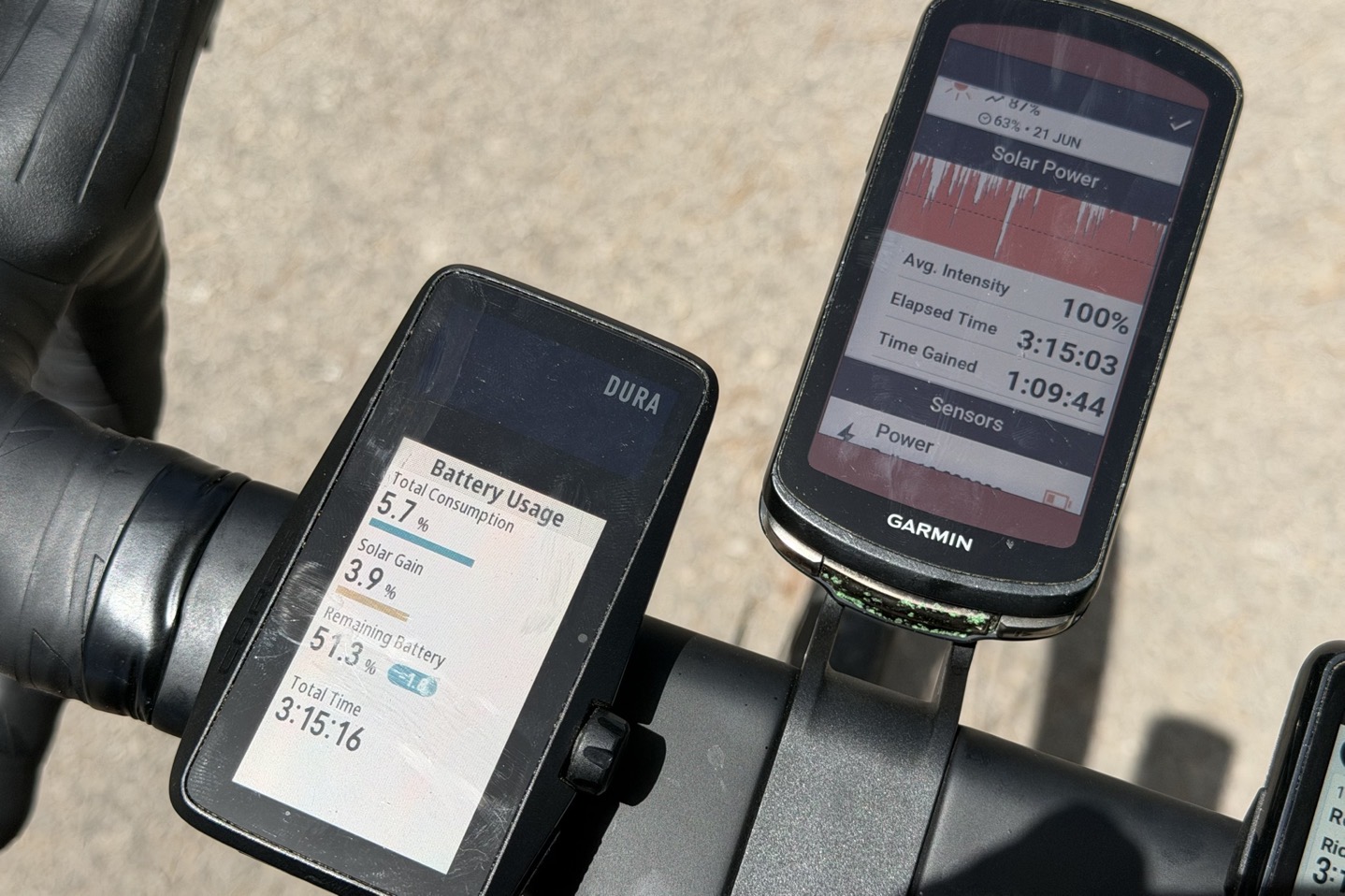
Meanwhile, the Garmin Edge 1040 Solar gained back 1hr and 9 minutes worth of riding time, or roughly about 1/3rd of the riding time back. As you’ve probably realized, Garmin shows the time gained in hours/minutes, whereas COROS shows it in % of battery. Neither do the opposite. Garmin also shows where the solar power was gained throughout the ride (that red chart). They show this during the ride too. The reason it says average intensity is 100%, is that’s based on a set baseline value, and then you can go above that on really sunny days (like today).
Unfortunately, COROS still doesn’t write the battery information to the file like everyone else does, so we can’t plot that easily. Garmin, Wahoo, Hammerhead, and many others all write that information to the .FIT file each time the value changes. This allows for nifty charts like this, using the DCR Analyzer:
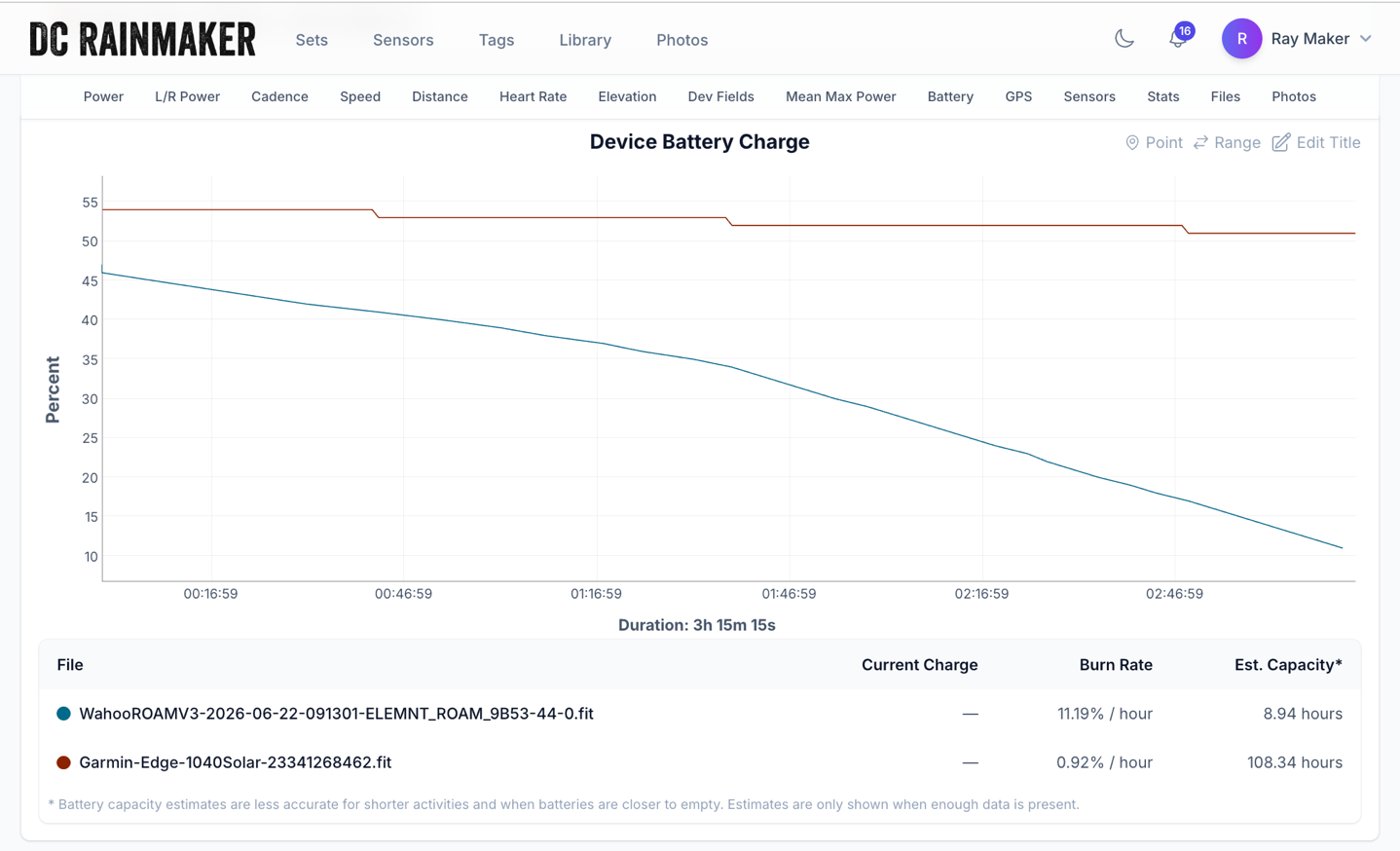
(The above chart shows the slight challenge of whole-numbers. As we can see, the Edge 1040 is basically dropping 1% every 1hr 20mins, so had I ridden another 30-40 minutes, it’d still show the same %, but ultimately show a longer battery estimate – perhaps 120-135hrs. The same logic would apply inversely to any unit as well, had it been stopped immediately after the whole number changed. I know people like a clickbait headline, but there’s often real-world nuance to how the test is calculated/done that can heavily sway it one way or another.)
It’s a shame COROS doesn’t write the data to the file, or even go one step further than Garmin and write the 0.x% value too. Since frankly, it’d make their devices look pretty good in almost every scenario. They tend to have some of the longest battery life out there (again, there are real-world trade-off reasons for that, but from a pure marketing standpoint, stick the battery data in the file for an easy win).
In any case, the simple answer here is that on this day, with navigation enabled, the Garmin Edge 1040 Solar was trending towards 108 hours per battery charge with *today’s* solar gains (.92%/hour), while the COROS Dura would have been on track for 156 hours with *today’s* solar gains (0.64%/hour). Note, for this simple calculation, I used the whole-number data shown on the main screens, rather than the 0.x% data shown, as Garmin doesn’t show that, so we don’t exactly know where it stands. Likewise, as noted earlier, remember the COROS Dura refused to re-route, and failed hold the LiveTrack session for about 45 minutes. I don’t expect that drove major changes there to battery life, but certainly would have shifted it up a tiny bit.
With that – go forth and enjoy your silly-long rides!
Found This Post Useful? Support The Site!
Hopefully you found this review/post useful. At the end of the day, I’m an athlete just like you looking for the most detail possible on a new purchase – so my review is written from the standpoint of how I used the device. The reviews generally take a lot of hours to put together, so it’s a fair bit of work (and labor of love). As you probably noticed by looking below, I also take time to answer all the questions posted in the comments – and there’s quite a bit of detail in there as well.
If you’re shopping for the COROS Dura or Garmin Edge 1040 Solar or any other accessory items, please consider using the affiliate links below! As an Amazon Associate I earn from qualifying purchases. It doesn’t cost you anything extra, but your purchases help support this website a lot.
And of course – you can always sign-up to be a DCR Supporter! That gets you an ad-free DCR, access to the DCR Shed Talkin’ video series packed with behind the scenes tidbits…and it also makes you awesome. And being awesome is what it’s all about!
Thanks for reading! And as always, feel free to post comments or questions in the comments section below, I’ll be happy to try and answer them as quickly as possible. And lastly, if you felt this review was useful – I always appreciate feedback in the comments below. Thanks!


