Smart water timers have a credibility problem, and it is always the same problem. You mount one on the spigot, build a schedule in the app, and by mid-July you are opening that app to cancel cycles because it rained overnight and the timer has no way of knowing. I have covered a lot of these. The valves are fine. The plastic holds up. What is missing is any connection between the schedule and what is actually happening in the dirt.
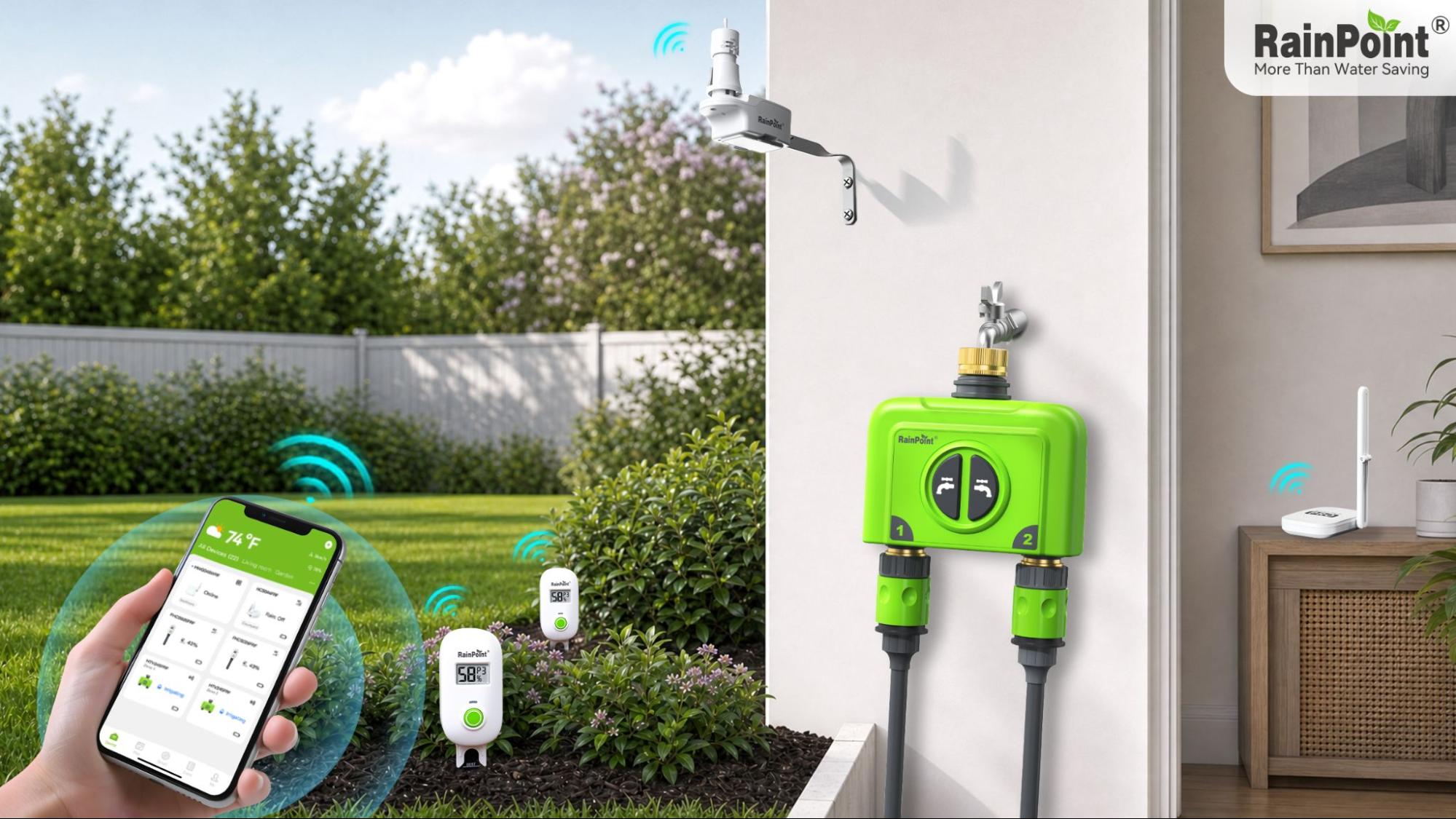
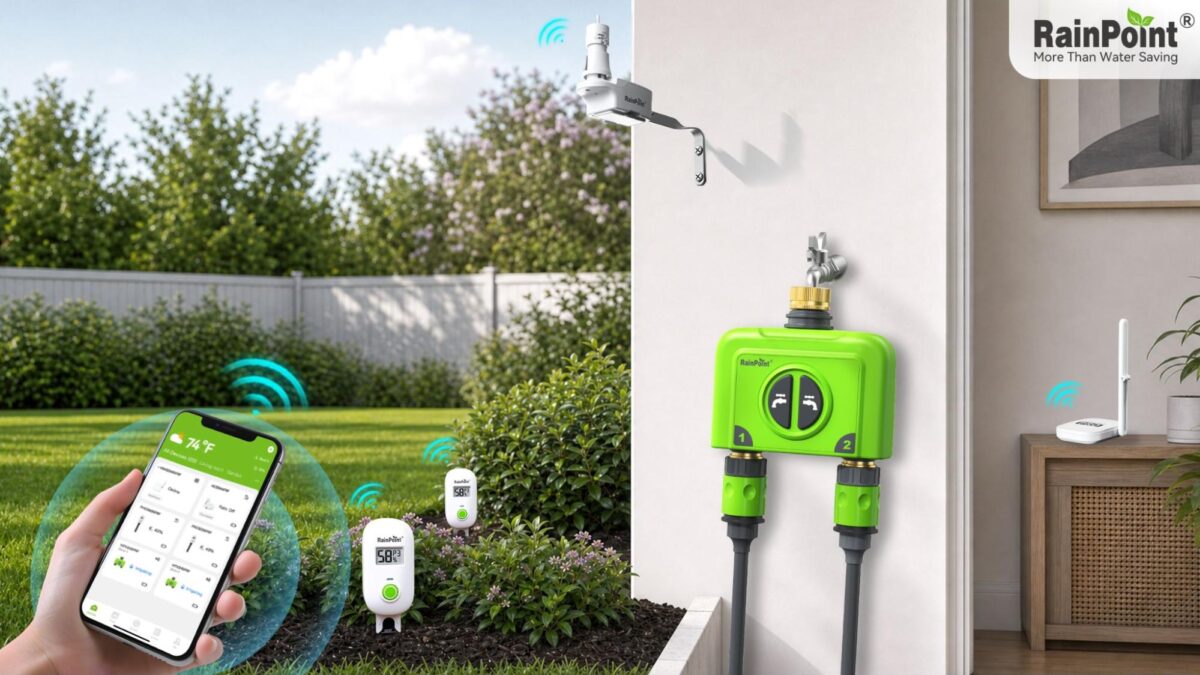
RainPoint’s Smart Watering Ecosystem is the first version of this that I have looked at in which the sensing isn’t sold separately as an upsell. It launched at CES 2026 and picked up a TWICE Picks award there. What you get is a gateway, a dual-zone Wi-Fi timer, a soil moisture meter, a rain sensor, and the RainPoint Home app, all in one box and all talking to each other.
The gateway solves the problem nobody mentions in the product photos
Your spigot is not near your router. Mine isn’t. This kills more connected irrigation setups than any firmware bug, and it is the reason people return these things.
RainPoint’s gateway uses an external antenna and claims a range of 250 meters. The gateway connects to the home network over 2.4GHz Wi-Fi, while its long-range connection to compatible RainPoint devices is designed to work through multiple walls and support up to 39 devices. The device count is aspirational for most yards. The range figure is the one I care about because a side yard behind a garage or a spigot at the back of a detached lot is precisely where a standard Wi-Fi timer drops off and silently starts failing to run.
You start with the sensors in the bundle and add more as you learn which beds actually need watching, which in my experience is never the ones you assumed.
Two zones and a soak mode
The timer runs two independent zones, each with up to six watering plans. There are three modes: normal irrigation, cycle/soak, and misting.
Cycle/soak deserves more attention than it usually gets. Rather than running one long cycle, it splits the watering into shorter bursts with pauses in between so the soil has time to absorb water. If you have clay, or any kind of grade, you have watched half a watering cycle run down the driveway. This is the fix for that, and it is not a feature you find on the cheap end of the category.
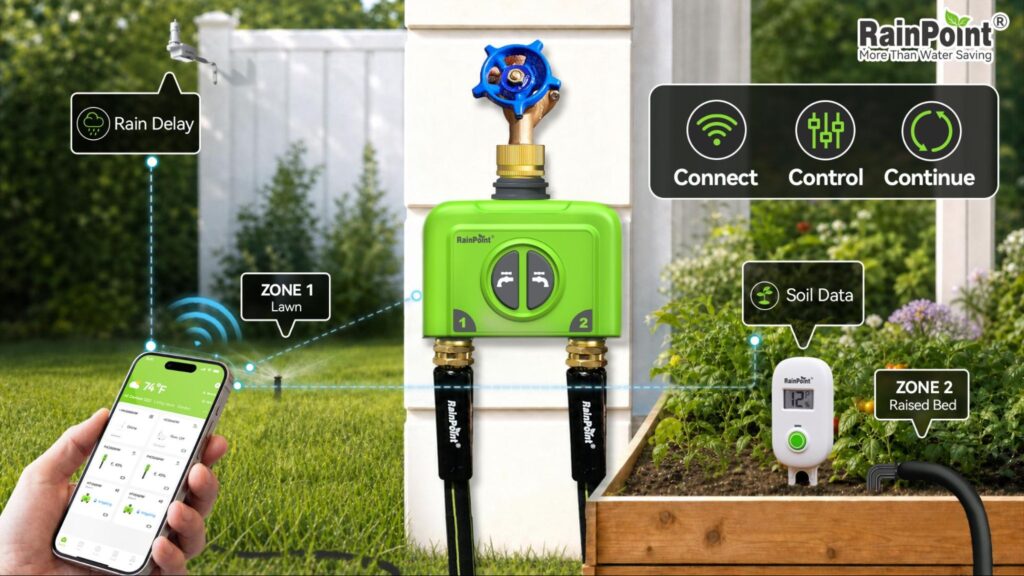
Two zones off one tap means your tomato bed and your lawn strip can run completely different logic. For a typical suburban lot, that is enough, though anyone with a large or oddly shaped property should assume the need for a second controller.
The soil meter is the reason the rest of it works
The moisture meter takes a reading every 3 minutes, displays it on an onboard LCD, and sends the data to the app so the system can act on it.
The spec I would flag for readers is the probe. It is capacitive, with a corrosion-resistant coating and waterproofing rated for indoor or outdoor placement. Cheap resistive probes, the kind that come with entry-level plant monitors, corrode within a season or two and then quietly report nonsense while you keep trusting them. Capacitive sensing avoids that failure mode. If you are going to let soil data drive your watering schedule, the sensor needs to still be accurate in year three, and this is the part of the spec sheet that tells you whether it will be.
The rain sensor handles the sky. It triggers automatic rain delays, helping prevent a scheduled cycle from running on a morning when it is already pouring
RainPoint calls the framework 3C, and I don’t hate it
Connect, Control, Continue. Connect is the network: hardware, sensors, app, plants, you. Control is the app oversight plus the system’s own adjustments. Continue is the long game, fewer pointless cycles and less maintenance across seasons.
I am generally allergic to brand acronyms. This one I will allow because it accurately describes the real arc of owning one of these. You install it, you hover over it for a few weeks, and then you stop thinking about it entirely. Reaching that third stage is the only reason to automate watering in the first place, and most products in this category never get you there.
Who this is for
If you have a lawn and nothing else, a single-zone timer could work best for you. This system starts to make sense when you have planting areas with genuinely different needs on the same water supply, or when you travel during the growing season and the alternative is handing a neighbor a hose and a vague set of instructions.
The app also keeps watering history, which is worth more than it sounds. Being able to see what the system actually did, versus what you told it to do, is how you find out whether any of this is working.
Some numbers I would not take at face value
RainPoint says the system can help reduce water use by 30% to 50%, depending on your watering habits and how much water was previously wasted. If you’ve been relying on fixed schedules or tend to overwater, the savings could be on the higher end of that range. As with any smart irrigation system, actual results will vary based on your garden, climate, and watering routine.
The system also supports Amazon Alexa and Google Assistant, letting you check irrigation status or control compatible functions with voice commands if that’s already part of your smart home setup.
Bottom line
The rest of this category is still selling you a nicer tap with an app bolted on. RainPoint is selling a loop: the soil reports in, the weather gets accounted for, and the valve opens, or it doesn’t. Whether the savings hit 30%–50% is beside the point. The system knowing why it is watering is the actual upgrade, and RainPoint got there ahead of the bigger names.
Madhurima Nag is the Head of Content at Gadget Flow. She side-hustles as a parenting and STEM influencer and loves to voice her opinion on product marketing, innovation and gadgets (of course!) in general.


