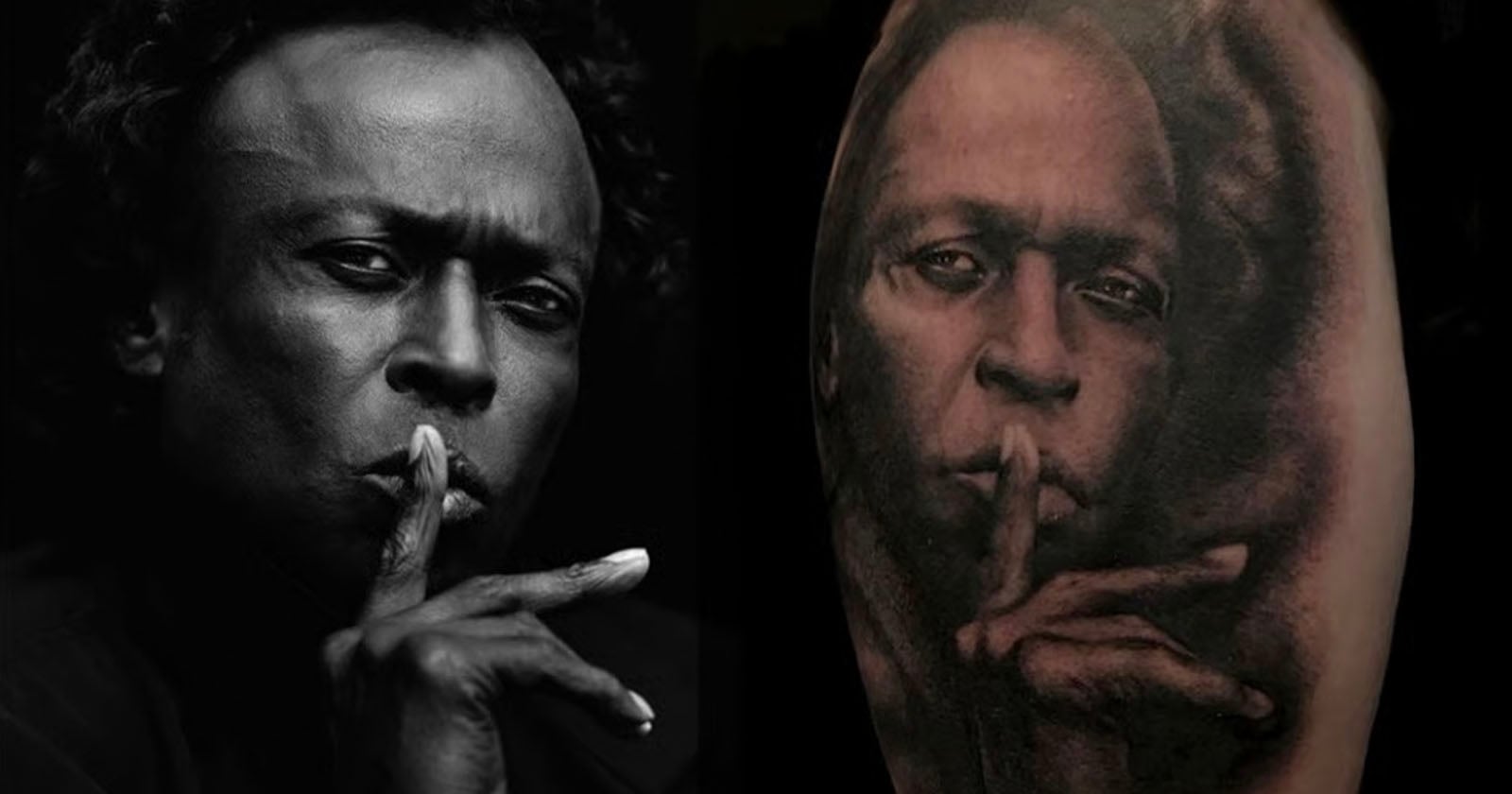
On June 9, Chief Judge for the Ninth Circuit Court of Appeals Mary H. Murguia issued an Order in the case of Jeffery B. Sedlik v. Katherine von Drachenberg, aka Kat Von D, et. al. granting an en banc rehearing by the full court.
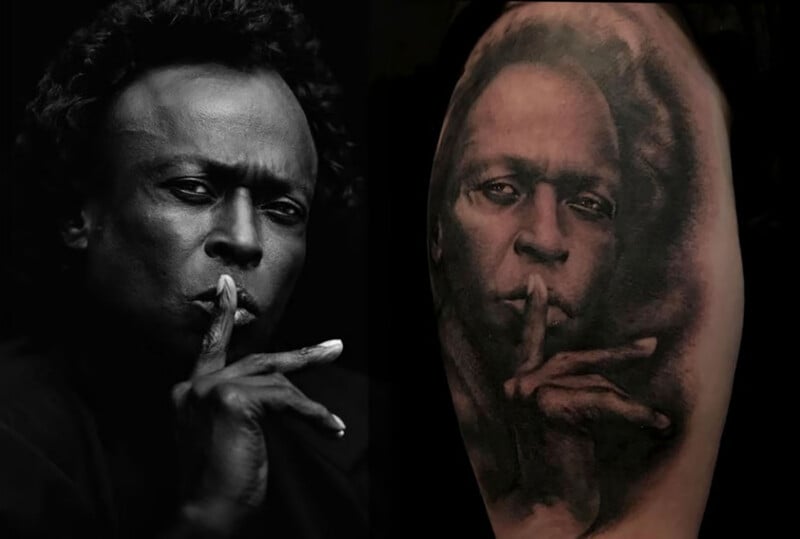
The crux of the underlying case is starkly shown in the image above: does the tattoo on the right by Von D an infringement on the copyright of the photograph of Miles Davis by Sedlik on the left. In the eyes of myself, ASMP, many in the photo community, and many in the copyright community at large, the answer is yes. Yet, that seemingly clear copy shown in the tattoo was found by a jury to not be “substantially similar” to the photograph, thereby superseding the clear writing of the law, precedent, and common sense.
This order comes after a district court decision and a three-judge panel decision by the Ninth Circuit found, in summary, that: (1) the decision of the jury could not be reviewed by the judge due to existing 9th Circuit precedent of the court-established “intrinsic / extrinsic test” for copyright infringement; and as such, that (2) utilizing this evaluation, the court was unable to review the jury decision for its legal sufficiency. To say that this ruling stretches the bounds of reason and credulity is putting it lightly.
It seems now that the Ninth Circuit may agree, as they have issued this order for en banc rehearing. In a nutshell, this rare move by the Court tells the litigants that even though a panel of three Ninth Circuit judges have rendered an opinion in the case, the question is unsettled enough that a hearing by the full 11-judge panel is warranted.
This is not a common occurrence: in 2024, for example, the Court received 625 petitions for en banc review, 29 cases were then voted on by the Court to see if they should be heard, and only nine cases succeeded in that vote. In some years, this number increases, but rarely are more than 20 cases a year granted such a special evaluation. The Court reserved this designation for those cases that indicate a clear split with other Circuit Courts around the country, cases that are likely to be reviewed by the U.S. Supreme Court, and if the issues presented affect many others similarly situated, among other considerations. This case checks all those boxes.
Why This Matters for Photographers and All Copyright Owners
Legal machinations aside, the photography community should be keeping an eye on the outcome. The most valuable and precious part of any creative’s business is the intellectual property, the copyrights. And without the protections of copyright law, the damage to creators, and the subsequent erosion of creative output, would be incalculable.
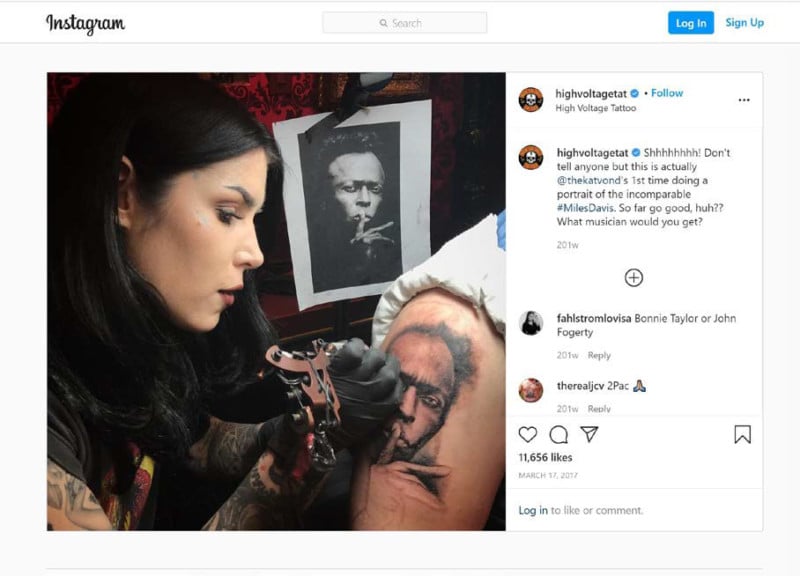
Take a minute and look at the image above, and put all your preconceptions aside. Are these two creations substantially similar? Did the tattoo copy the photograph? Everyone agrees on that point, and you can see Von D using the photograph at the actual time she was tattooing the work on her client below. It’s right there to see, in black and white.
Sedlik has my support and the support of ASMP in this case, and we drafted an amicus brief in this matter that helps illustrate to the Court why their ruling has significant importance and how it would affect creators.
After more than 40 years as a professional photographer, his works have been published thousands of times, in every type of media known, and he has never filed a case for copyright infringement in federal court despite being infringed, as all photographers are, many times over. This case is about principle, a principle that would allow a judge expert in the law to be beholden to a test that is not followed by other courts, creates an evaluation that prioritizes adherence to history rather than the judgment of common sense that you can see with your own eyes.
Sedlik understands why this is important and puts the outcome in unequivocal terms. As an artist and creator, “you can’t support yourself from your creations if anyone can just take your creations, copy them exactly whether in the same or different medium, and exploit them for their own commercial gain.” I could not agree with him more.
The Complexity and the Next Steps
The Ninth Circuit’s “intrinsic / extrinsic test” is a flawed evaluation. As noted by Judges Warlaw and Johnstone in their concurrence in this matter, the intrinsic test is wrong.
“This test and outcome distort copyright law,” they note, and further go on to say: “[t]he intrinsic test is a creation of our court; the Supreme Court has never said that the ordinary observer’s spontaneous impression of the ‘total concept and feel of the works,’ without any expert guidance, should be a dispositive factor in copyright infringement. Indeed, Supreme Court precedent suggests the opposite: that, to accord with the Copyright Act, a court should focus on carefully filtering out concepts and ideas.”
If two of the three judges on the panel felt the test and the law applied is wrong, that means something. That the Ninth Circuit as a whole granted this case the rare honor of en banc review means something. What that something is is yet to be determined, but one can only hope that what we all can see with our own eyes is something the Court will hold as a matter of law now, and moving forward. To do so will benefit all creators, tattoo artists included. To keep the status quo would continue to relegate the Ninth Circuit to the fringes of copyright law, an outsider court that allows infringement to occur despite what we all know to be true.
The opportunity here is great, and the stakes for all creators even greater. The time has come to cast the “intrinsic / extrinsic” test to the dustbin of history to help fulfill the goals and principles of U.S. copyright law, allowing those creators to do what they do best – create.
About the author: Thomas Maddrey is the CEO of the American Society of Media Photographers (ASMP), an 81-year old trade association focused on photographer’s rights, advocacy, and industry advancement for all visual creators. Maddrey was the attorney of record on an amicus brief submitted to the 9th Circuit in this matter, as well as additional opinion and commentary found at ASMP.org. The opinions expressed here are his own.


