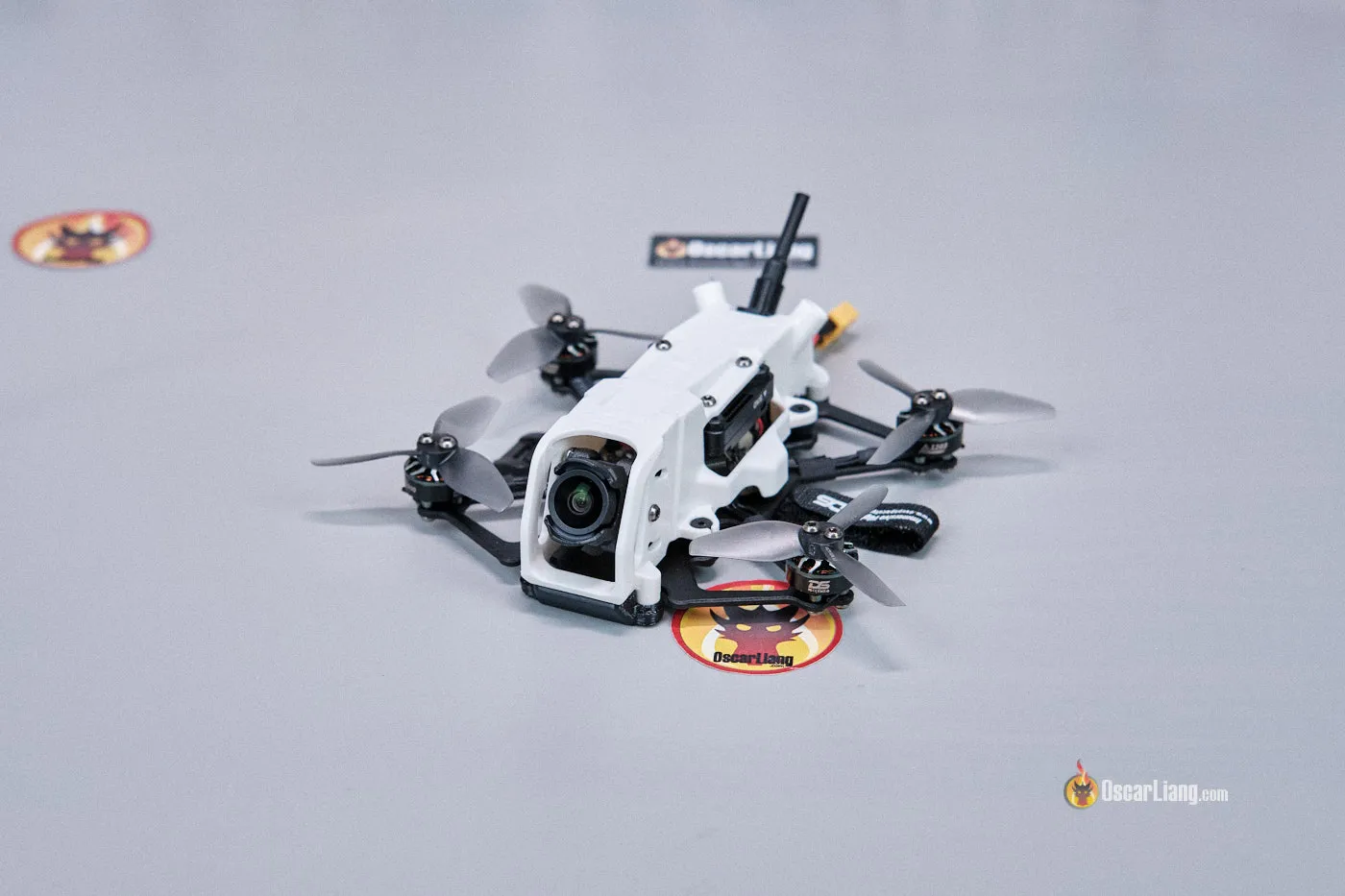
The DeepSpace DINO20 is one of the first open-prop micro FPV drones to feature the new DJI O4 Wide Air Unit. This is a 2-inch quad designed to run on 3S batteries. If you are looking for a sub-250g park ripper for freestyle flying, this is an ideal size and power class. But how does it perform with the new O4 Wide camera, and does it actually fly well? Let’s find out in this review.

The DJI O4 Wide is a fantastic camera/VTX system for micro FPV drones. You can learn more in my review: https://oscarliang.com/dji-o4-wide-air-unit/
Where to Buy
Get the DeepSpace DINO20 from:
Batteries are not included. I recommend the LAVA 3S 580mAh: https://betafpv.com/products/lava-ii-3s…
Don’t forget to get some spare props too: https://s.click.aliexpress.com/e/_c30Gaolz

Specifications
- Wheelbase: 113mm
- Supported VTX System: DJI O4 Air Unit Pro / DJI O4 Air Unit
- Motors: DS Aether 1203 8000KV
- Propellers: HQ T2.2×1.6×3
- Camera Tilt Range: O4 Pro: 0–35° / O4: 0–45°
- AIO FC: DeepSpace F405 All-In-One FC
- ESC: 20A 4-in-1, 8-bit, Bluejay
- Receiver: Integrated 2.4GHz ELRS
- Gyro: ICM-42688-P
- BEC: 5V 2A / 9V 2A
- Barometer: Supported
- Blackbox: 16MB
- Analog VTX OSD: Not supported
- Voltage Input: 3S LiPo / LiHV
- Recommended Battery: 3S 550–850mAh
- Battery Connector: XT30
- Claimed Flight Time: 5–11 minutes
- Dimensions: 148 × 120 × 39mm, excluding prop guards
- Dry Weight with DJI O4 Wide: 98.5g, excluding prop guards
- Dry Weight with DJI O4 Pro: 103.5g ±5g, excluding prop guards
- Weight with O4 Wide and 3S 550mAh LiHV Battery: 141g


Closer Look and Build Quality
It might not seem obvious at first, but the attention to detail is impressive. I really like how simple, clean, and well designed this quad is.


The wiring is extremely tidy, the soldering quality looks top-notch, and you get pretty much all the features you need, including a buzzer and a USB port extension at the rear. DeepSpace seems to have thought through all the little details, and the overall execution is very impressive. The simple layout should also make the DINO20 relatively easy to repair and maintain.


The DINO20 supports both the DJI O4 Wide Air Unit and DJI O4 Pro Air Unit. However, when using the O4 Wide, adapters are required for both the camera and VTX to install it inside the canopy.


The canopy is attached to the drone using four rubber grommets, providing soft mounting for the camera and VTX.

Some people might be concerned that the canopy could pop off during a crash, but DeepSpace has come up with a clever solution. There are two 3D-printed retainers at the front and rear of the quad that prevent the canopy from detaching during crashes.
To preserve the soft mounting, these retainers do not normally touch the carbon fibre plate. This means vibrations from the motors are not transferred directly to the camera through the retainers. It is a clever idea and very well executed.

To remove the canopy and access the electronics, you first remove the two retainers, which are held in place by four screws, and then release the four rubber grommets from the canopy. All necessary tools are provided, including two screwdrivers and a pair of tweezers. The tweezers make installing the rubber grommets much easier. Again, the attention to detail is impressive.
Weight
At around 98g, the DINO20 is on the heavy side for a 2-inch quad.
There are several areas where DeepSpace could potentially reduce weight.
For example, the O4 Air Unit is fitted with a heatsink. There are good reasons for this. Firstly, the O4 Air Unit is known to overheat quickly on the bench when powered on without airflow for too long. Secondly, the heatsink also doubles as a mounting adapter.

However, the heatsink weighs a whopping 7.5g, which is significant on a quad this small.

The canopy itself is also quite heavy. It feels extremely sturdy and durable, but I think a more weight-efficient canopy design could easily shave a few grams from the build.
Other small changes, such as shorter XT30 wires and more refined carbon fibre plate design, could also help reduce the overall weight.


Prop Guards
The DINO20 comes with prop guards that can be installed underneath the motors.
They could be useful if you want to fly indoors or close to obstacles, but I would avoid using them unless necessary.
As mentioned earlier, the DINO20 is already relatively heavy. Adding another 20g will make the quad feel more sluggish and will also reduce flight time.
For outdoor freestyle flying, I would personally leave the prop guards off.
Other Features
Another useful feature is the onboard buzzer, which is rare in micro quads.
This makes finding the quad much easier if you crash in tall grass or dense vegetation.
There is also a spot inside the canopy reserved for mounting a small GPS module. It should accommodate compact 12–13mm GPS modules such as the NewBeeDrone M10Q Micro or FlyFishRC M10 Mini: https://oscarliang.com/gps-review/#For-Compact-Micro-Builds
Flight Performance
The DINO20 hovers at around 19% throttle, so it feels surprisingly powerful for such a small drone.
Because it only runs 2.2-inch props, top speed is only around 100km/h (roughly 65mph). It is not super fast, but acceleration is still impressive and feels more appropriate for smaller parks and tighter freestyle spots.
Thanks to the small props, the DINO20 feels very nimble and responsive. At the same time, the additional weight from the 3S battery gives it enough momentum to throw around more like a larger freestyle quad, giving you more “hang time” when inverted, which makes it great fun to fly.
There is a little prop wash when recovering from dives or making sharp turns, but that is not unusual for such a small micro quad.
O4 Wide Camera Performance
The soft-mounted camera system works well.
I did not see any noticeable jello during normal flying, which is encouraging considering how sensitive the DJI O4 camera can be to vibration.
However, I noticed a small amount of wobbles in windy condition, even when simply cruising. My suspicion is that the relatively soft rubber grommets allow the canopy to move slightly when the wind pushes against it, which in turn moves the camera.
Without adding more grommets, slightly stiffer grommets might help improve this without compromising vibration isolation.
Flight Time
With a 3S 550mAh LiHV battery, I was getting around 5 minutes of flight time (mainly freestyle).
If you are just cruising gently, I think you can stretch it to 6 minutes.
I was not able to get anywhere near the claimed 11-minute flight time, even when using a 750mAh battery. Perhaps DeepSpace tested it indoor just hovering, or they were using a larger battery.
Noise
The DINO20 is not particularly quiet. You can still hear it from around 200 metres away.
That is partly the nature of running a powerful 3S setup on such small props. Compared with 1S or 2S micro quads, the heavier battery and higher power demand higher motor RPM, so more noise is expected.
The trade-off is noticeably stronger acceleration and better freestyle performance.
ExpressLRS Range
Range performance was excellent.
Even though the DINO20 uses an integrated ExpressLRS receiver, RSSI remained strong throughout my flights.
With just 250mW output power, I think several km of range (or more) is achievable.
Custom PID Tune
The stock PID and filter tune is quite conservative.
It flies reasonably well out of the box, but it feels slightly loose and there is definitely room for improvement.
I spent a couple of hours making my own custom PID tune, which tightens up the flight characteristics and improves the overall feel.
You can find my custom tune on Patreon: https://www.patreon.com/oscarliang…
How to Setup
Firmware:
- The FC target is DEEPSPACEF405RX, and it came loaded with Betaflight 2025.12.4. The original CLI diff can be found here.
- Onboard ELRS receiver target is: Deepspace 2.4GHz Nano 100mW RX, Firmware Rev 3.6.4
- ESC Firmware: Bluejay, 0.19, 48KHz (C-X-70)
Setup Steps:
- Bind the ELRS receiver – The best way perhaps is connect USB cable to the FC, wait 60 seconds until the receiver goes into WiFi mode (LED flashes rapidly). Then connect to the ExpressLRS RX WiFi network, enter 10.0.0.1 in your browser address bar, and enter your Binding Phrase on the webpage, click Save. For more detailed steps check out my tutorial: https://oscarliang.com/bind-expresslrs-receivers/
- Pair O4 Air Unit to Goggles 3: https://oscarliang.com/how-to-setup-dji-o4-lite/#Pairing-DJI-Goggles-3-with-O4-Lite
- Load the ExpressLRS preset according to your packet rate – Instructions: https://oscarliang.com/betaflight-presets/#Loading-RC-Link-Configurations
- Set up custom rates – My Rates: https://oscarliang.com/rates/#My-Rates
- Configure the Modes tab (arm switch, turtle mode, etc.): https://oscarliang.com/betaflight-modes/#How-to-Setup-Arm-Switch
- Set up OSD, you can copy my CLI lines: https://oscarliang.com/betaflight-osd/#My-OSD-Setup-CLI-Commands
- Power & Battery tab settings: Warning Voltage set to 3.5V for earlier remind, Amperage Meter Scale set to 145 for more accurate mAh reading.

Conclusion
The DeepSpace DINO20 is a very well thought-out micro FPV quad.
What I like most is its simple but effective design. There are no unnecessary features such as LED strips or other cosmetic additions that would only increase weight, complexity, and cost. Instead, DeepSpace has focused on the things that actually matter: a clean layout, good component selection, easy maintenance, solid build quality, a well-designed soft-mounted camera system.
Flight performance is also very good. The 3S setup gives it plenty of power, while the 2-inch props keep it nimble enough for smaller parks and tighter freestyle spots. It is not perfect, though. The DINO20 is heavier than I would ideally like, there is some room to improve the stock tune, and the soft-mounted canopy can introduce a small amount of wobble in windy conditions.
Get the DeepSpace DINO20 from:
There is definitely room for DeepSpace to improve the design further, particularly by reducing weight and improving the stock PID and filter tune.
Even so, the overall package is excellent. It is easy to work on, well made, performs well, and makes very good use of the DJI O4 Wide Air Unit.
If you are looking for a compact 3S BNF micro quad for freestyle flying with the DJI O4 system, the DeepSpace DINO20 is easy to recommend.
And if you already own one, make sure to check out my custom PID and filter tune, as I think there is still some extra performance to be unlocked from this little quad.


