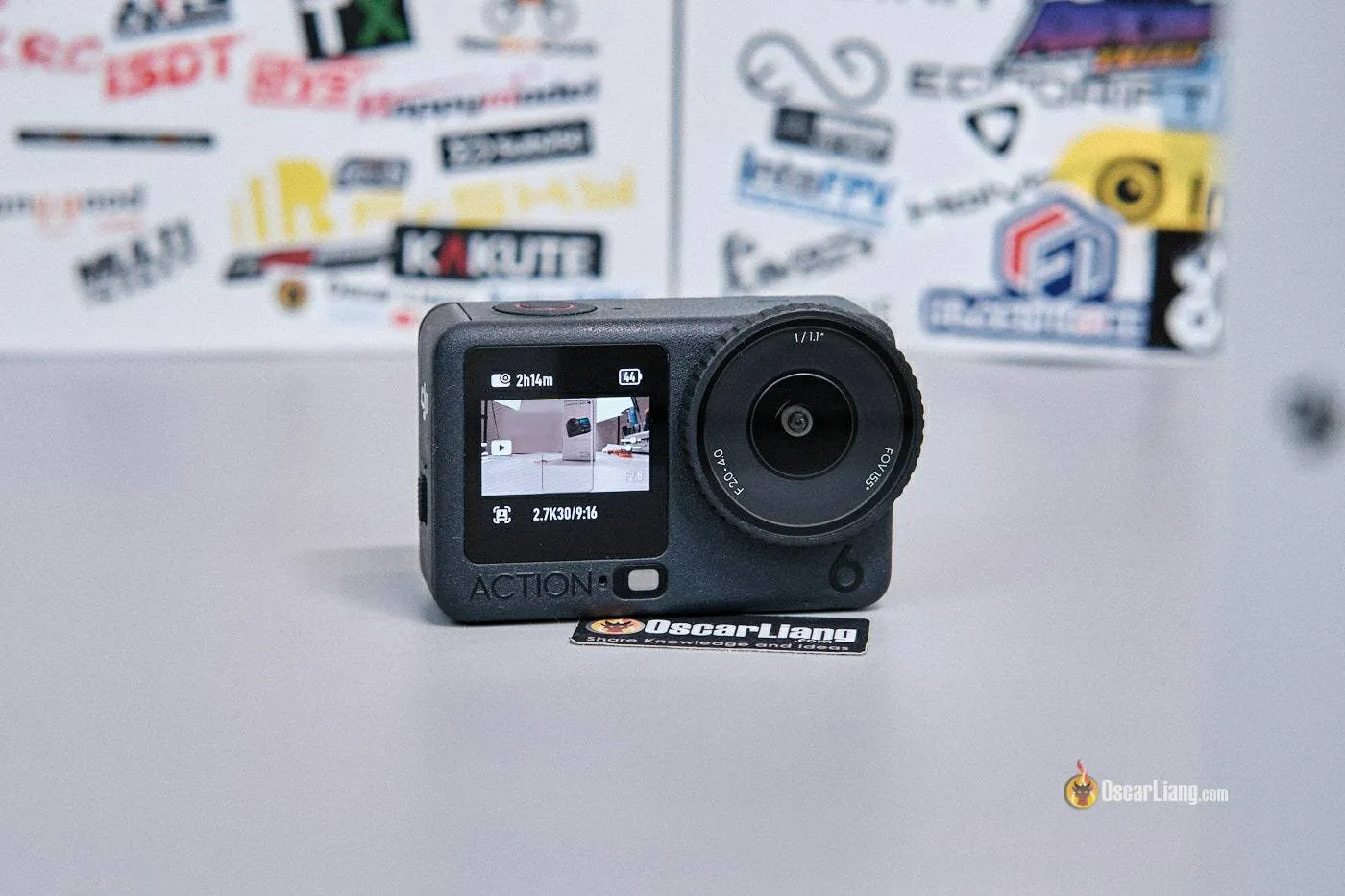
The best action camera is not always the best once it is strapped to an FPV drone, because FPV has very different requirements when it comes to weight, image quality, and stabilization. In this review, I will share my thoughts on the DJI Osmo Action 6 and how it compares with the GoPro Hero 13 specifically from the perspective of a FPV pilot: image quality, stabilization, low-light performance, and whether its headline features are actually useful for aerial filming.


Learn more about action cameras for FPV drones: https://oscarliang.com/action-camera/
Where to Buy
Get your DJI Osmo Action 6 camera from these vendors:

First Impression
The Action 6 looks like a modern action camera, but nothing groundbreaking compared with the GoPro. In fact, it has a very similar design and form factor. It has touchscreens on both the front and back, and both can display a live preview.

It weighs around 150g, which is quite a heavy payload for a typical FPV drone. You would need at least a 3.5-inch drone to lift it comfortably, but ideally you would want to use a 5-inch or larger drone if you do not want flight performance to be significantly affected.
If you are already using the DJI O4 Pro FPV system in your drone, you might wonder whether it is worth using the Action 6 at all.
For professional work, it is.
The Action 6 does provide noticeably better image quality than the O4 Pro. The sensor is larger, the field of view is wider, and the overall image feels cleaner and more refined.
For casual pilots, though, it probably makes less sense if you prioritize flight performance and flight time over absolute image quality.


The Benefits and Downsides of 8K for FPV
The Action 6 supports 8K resolution, but it also comes with limitations that make it less ideal for FPV.
First of all, the Action 6 supports native 8K capture in 16:9, so it does not seem to be upscaled.
However, there are some limitations:
- 8K is limited to 30fps
- Only available in 16:9
- It uses more storage and is more demanding on your computer to edit
For FPV specifically, I prefer 60fps most of the time for smoother motion in fast passes, and it also gives more flexibility for slow motion. Also, if you fly in low-light situations such as dusk, under trees, or in and out of buildings, lower resolutions tend to look cleaner and less noisy.
The difference between 4K and 8K can also be very subtle, especially if you are watching on YouTube. And most people do not even have a 4K monitor, let alone an 8K one, so unless you zoom in a lot, it is almost impossible to tell the difference in normal playback.
Because of that, 8K would not be my default resolution.
With that said, 8K can still be useful for reframing and cropping in post while still delivering a solid 4K export. If you do client work and cinematic edits, 8K gives you extra headroom. So I might use 8K when I know I may need to zoom in or crop, but I would not use it for most of my flights.
Aspect Ratio Advantage
For content creators, the goal is always to use as much of the sensor as possible, because that lets you keep a wider FOV after stabilization.
That means using the closest-to-square aspect ratio available:
- DJI Action 6 – use 1:1
- DJI O4 Pro – use 4:3
- GoPro Hero 13 – use 8:7
This is where the Action 6 has a very obvious advantage over the GoPro. The square 1:1 aspect ratio gives you the most flexibility of all these cameras, especially if you want to reframe later for both horizontal (16:9) and vertical (9:16) content.
And because the 1:1 mode is not available in 8K, I actually prefer to use 4K.
Handling and Weight on a 5-Inch FPV Drone
One thing I always pay attention to is how an action camera changes the way the drone flies.
In FPV, even small weight differences up front can affect how a quad tracks and recovers, especially during sharp transitions. If you are flying cinematic lines, you can compensate for that. But if you are flying aggressive freestyle, you will definitely feel it.
Mounting an action camera on the quad almost always makes it feel more sluggish and less responsive.
The DJI Action 6 (150g) is heavier than the Action 5 (145g), but lighter than the GoPro Hero 13 (155g). However, the differences are not huge, so on a 5-inch quad you probably will not notice a significant difference in flight feel between the two.
Image Quality in Good Lighting
On a sunny day, the Action 6 looks excellent.
This was never really in doubt. It is newer than both the O4 Pro and the GoPro Hero 13, and the hardware advantage shows. The image is clean, flexible for editing, and high quality. Compared with O4 Pro footage, it looks noticeably better. Compared with GoPro, the comparison is a bit more nuanced, because GoPro still has strengths in sharpness.
You will not be disappointed by either the Action 6 or the Hero 13 when it comes to image quality.
There are some slight differences in character, though:
- Action 6: noticeably better dynamic range, especially in skies and darker shaded areas under trees or around buildings
- Hero 13: often retains more close-up details in good lighting, such as ground texture and signs, and can look slightly sharper overall
So in bright lighting, the GoPro can still look extremely good — sometimes even “sharper” depending on the scene.
But once the lighting becomes mixed or more challenging, the Action 6’s strengths become more apparent.
Low Light Performance
This is where the larger sensor in the Action 6 really starts to justify itself.
In very dark conditions, even the O4 Pro can struggle badly, and the image can become noisy and grainy. With the GoPro, at ISO 1600 you can already start to see unpleasant noise. The Action 6, on the other hand, can deliver usable footage even at ISO 3200, and in some cases ISO 6400 still looked acceptable without becoming overly noisy. That is impressive.
It does not mean it is magically clean in the dark, but it does mean that the Action 6 has a real edge over the GoPro for FPV pilots who shoot in low light, at dusk, or in urban night environments.
My Practical Recommendation for FPV Pilots
Choose DJI Osmo Action 6 if:
- You often shoot mixed lighting or low light
- You want better dynamic range and easier “good results” out of the box
- You publish vertical + horizontal content and want maximum flexibility from one flight (using the 1:1 aspect ratio)
- You want 8K headroom for cropping/reframing (note only supports 16:9 and 30fps)
- You want an overall more versatile camera
Choose GoPro Hero 13 Black if:
- You mostly shoot in good lighting
- You prefer a look that can feel sharper with more close-up micro-detail
- You’re already familiar with GoPro cameras, ecosystem and workflow
Action 5 vs Action 6
Judging purely by image quality, especially using mostly auto settings, both have pros and cons.
The Action 5 image tends to be brighter, and adjusts exposure more aggressively and dynamically when lighting condition changes. Color tends to be slightly colder. When compared side to side to the Action 6, it feels to have a stronger filter.
The Action 6 image looks more “raw” and closer to real life. Image sensor is bigger so better dynamic range and low light performance.
If you normally use auto settings, the Action 5 might be a better choice for people who don’t want to do post editing and color grading, you can just post the footage straight out of the camera.
If you normally use manual camera settings, and prefer to color grade your footage and want the best possible image quality, the Action 6 would be the ideal choice.
Best Settings for FPV
Here’s the camera settings I normally use for FPV:
- Resolution: 4K 1:1
- Shutter speed, the usual cinematic rule applies here – shutter speed should be about double the frame rate. E.g.:
- 24fps → 1/48
- 30fps → 1/60
- 60fps → 1/120
- Use the appropriate ND filter to prevent over-exposure
- ISO: 100
- White Balance: 5600K (daylight)
- Sharpness and Noise Reduction: as low as possible
Final Verdict
Both the DJI Osmo Action 6 and GoPro Hero 13 Black are excellent action cameras in terms of image quality. For FPV drones, you really cannot go wrong with either.
For pure image quality, though, the DJI Action 6 looks like one of the best FPV action cameras available right now. It offers excellent image quality, strong low-light performance, better dynamic range, a very useful 1:1 shooting mode for both horizontal and vertical content, and plenty of flexibility for color grading.
If I were shooting paid FPV work or cared a lot about night footage, I would absolutely consider it.
Get your DJI Osmo Action 6 camera from these vendors:


