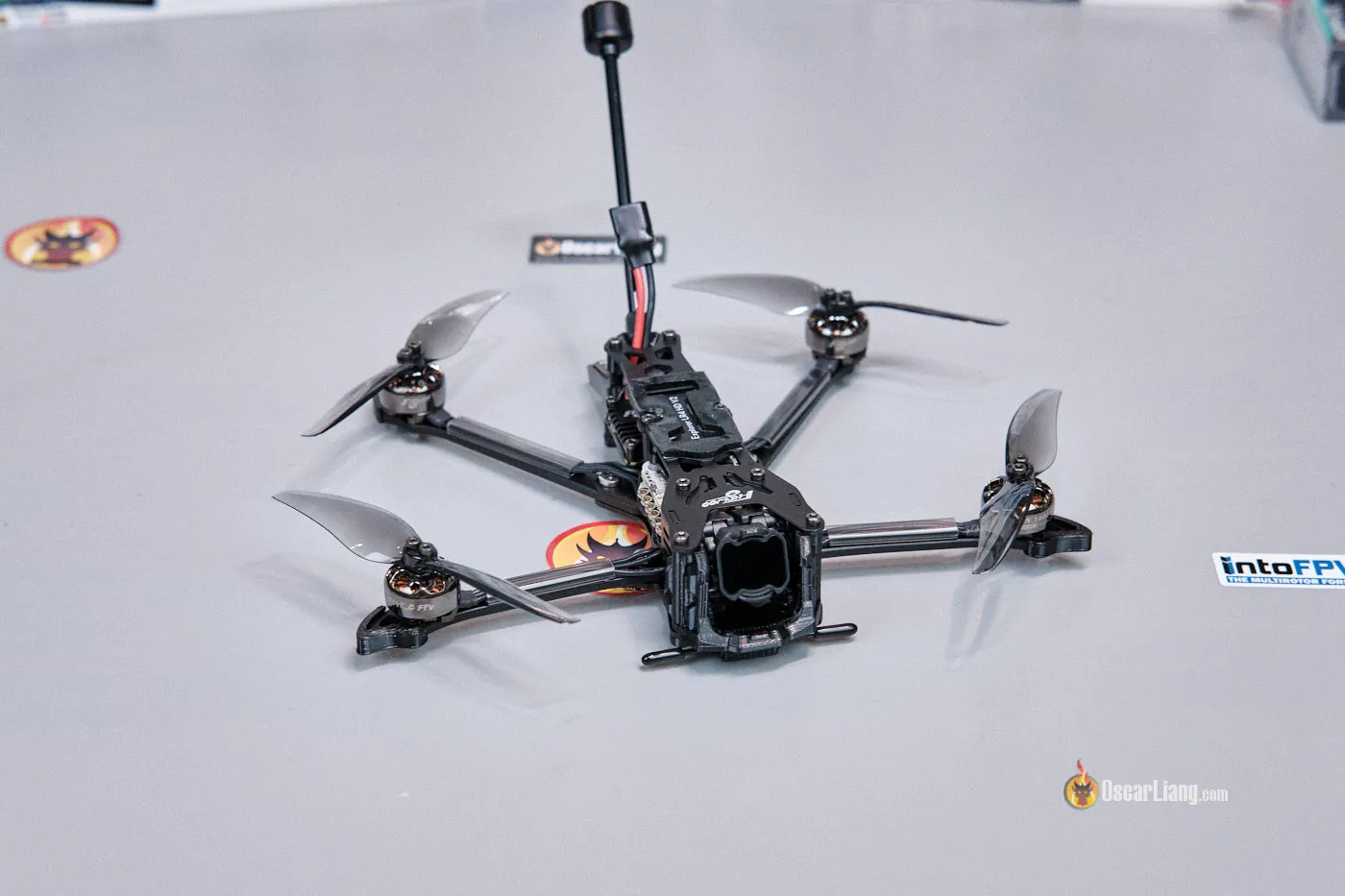
Every time I travel, I take my Flywoo Explorer with me. It’s one of my favourite micro long-range FPV drones. One issue with the previous version was weight. The DJI O4 Pro is relatively heavy, while the lighter O4 Lite just didn’t quite deliver the image quality I wanted. Now DJI has released the O4 Wide Air Unit, and I think it hits the sweet spot for the Explorer. It’s noticeably lighter than the O4 Pro, while image quality is much improved over the original O4 Lite.


In this review, I’ll test the Flywoo Explorer LR4 V2 with the DJI O4 Wide and let you know how it performs and whether it’s worth getting.
Learn more about long-range FPV flying in this guide: https://oscarliang.com/long-range-fpv-flying-mini-quad/
Where to Buy?
You can purchase the Explorer LR4 O4 Wide Edition from these vendors:
Spare propellers (GF 4024×2): https://s.click.aliexpress.com/e/_c4cAqCHF

Specifications:
- Frame: Flywoo Explorer LR4 V2 Frame Kit
- Flight Controller: Goku F722 Mini
- ESC: Flywoo 45A 32bit 4-in-1 ESC
- FPV System: DJI O4 Wide Air Unit
- Receiver: ExpressLRS Flywoo EL24E 2.4GHz RX
- Propellers: Gemfan 4024×2 Bi-blade
- Motors: Flywoo Nin V2 1404 2750KV
- GPS: GOKU GM10 Mini V3
- Battery Connector: XT30
- Weight:
- 166g (without battery)
- 230g with a BetaFPV Lava II 4S 680mAh LiHV
- 262g with BetaFPV Lava 4S 850mAh LiPo
- 361g with a 4S 3000mAh Li-ion

What’s New?
It appears Flywoo has mainly swapped the DJI O4 Pro for the O4 Wide. The rest of the hardware is basically unchanged, including the FC/ESC stack, motors, propellers, GPS and buzzer.
Wondering how the O4 Wide compares to the O4 Pro and original O4 Lite? Check out my review: https://oscarliang.com/dji-o4-wide-air-unit/


I was hoping Flywoo might implement some of the improvements I previously suggested, or at least make a few more changes to the Explorer LR4 V2, since the design has now been more than a year old. But I can also understand why they kept using the same design. It’s already a proven platform, and reusing the same components and manufacturing processes helps reduce production costs.
The weight difference is still worthwhile, with the O4 Wide shaving around 5g off the build:
- Explorer with O4 Pro: 171g
- Explorer with O4 Wide: 166g
It’s also good to see that the O4 Wide camera is properly soft-mounted inside the frame using 4 damping balls. The O4 Wide uses the 1469D gyro, which is known to be highly sensitive to vibration. If it is not properly isolated, this can cause stabilization issues in Gyroflow or RockSteady. I documented the problem here: https://oscarliang.com/dji-o4-pro-gyro-stabilization-issue/
Here’s a side-by-side comparison between the O4 Wide and O4 Pro versions. As you can see, I’ve already made many modifications to my O4 Pro Explorer, which I documented here: https://oscarliang.com/upgrade-flywoo-explorer-lr4/

I’m also using a naked O4 Pro, which saves nearly 14g: https://oscarliang.com/wallefpv-naked-o4-pro/
After all my modifications, I reduced the weight of my O4 Pro Explorer to 154.5g, which is actually lighter than the new stock O4 Wide version. I’m sure many of the same weight-saving modifications could also be applied to the O4 Wide model. In their original forms, the O4 Wide version is still slightly lighter than the O4 Pro version, and cheaper too.

Design & Build Quality
I recommend checking out my review of the O4 Pro version as well, since both models share almost identical hardware apart from the FPV system: https://oscarliang.com/flywoo-explorer-lr4-o4-pro/. In this review, I’ll mainly focus on the new things.


Most of those differences are underneath the top plate.

First, Flywoo has added a plastic plate above the flight controller. I think this is to protect the components on the FC from the LiPo strap rubbing against the board. This is actually quite thoughtful. A battery strap repeatedly scraping against the FC can potentially knock off tiny surface-mount capacitors or resistors.
The O4 Wide camera is soft-mounted using four rubber damping balls.


However, the camera tilt angle is not adjustable.
On the previous O4 Pro version, you can adjust it, although the adjustment range was quite limited, with a maximum angle of less than around 15 degrees. I found that slightly too low, especially if you want to fly faster while keeping the horizon in the centre of the camera frame.
On the new O4 Wide version, Flywoo has increased the camera angle to around 20 degrees, which allows you to fly quite a bit faster, but you no longer can adjust it.
Final thing, the O4 Wide Air Unit is installed inside a CNC cooling case. I tested this case separately, and it’s one of the best options on the market in terms of cooling performance: https://oscarliang.com/dji-o4-wide-adapter-case/#Cooling-Performance


Battery Choices
Flywoo offers several 4S batteries for the Explorer:
I haven’t tested these batteries yet, so I can’t comment on their performance.
If I must recommend a battery, the BetaFPV Lava II 4S 680mAh LiHV would be my top choice. I have tested it and found it to perform extremely well, light weight and little voltage sag. Here’s the testing results: https://oscarliang.com/whoop-toothpick-lipo-battery/#4S-LiPOLiHV
Get the BetaFPV Lava II 4S 680mAh LiHV here:
If you want the longest possible flight time, Li-ion packs are the obvious choice. Depending on conditions and flying style, they can typically provide around 25–30 minutes of cruising. On the other hand, LiHV packs are much lighter so the quad feels noticeably more nimble and responsive. You can still get around 7–8 minutes of flight time with a 680mAh pack, which is plenty for many types of flying.
Flight Performance
I tested the Explorer in 18mph Wind, and it handled the conditions surprisingly well.
It feels slightly more agile than the previous O4 Pro version thanks to the 5g weight reduction.
It’s not particularly fast, with a top speed around 100km/h in my testing, but raw power is not what this quad is designed for. The Explorer is much more focused on efficient cruising and long-range capability.
There is some shakiness when flying fast in windy conditions, but once I processed the footage in Gyroflow, those vibrations were smoothed out very effectively. It even did a good job of hiding some of the visible propwash. The camera soft mount seems to work effectively.
The Explorer is also extremely quiet. When cruising, you can barely hear it from 100 metres away.
With a 4S 680mAh battery, I can get up to 8 minutes of flight time, while keeping the entire setup under 250g.
You can still do some basic freestyle with it.
There is noticeable propwash, and it’s relatively slow to catch itself during manoeuvres such as a Split-S dive and inverted moves, but that’s understandable given the relatively small motors.
Not Made for Crashing
I was having so much fun flying it that I got a little carried away.
I was flying fast and low under some trees, when a ninja branch suddenly appeared and took me out. The quad was only around three feet above ground, but I was travelling fairly fast and the impact broke one of the arms.

A typical 5-inch freestyle quad, or even 3-inch freestyle builds, would probably survive a medium crash like that without much trouble.
The Explorer, however, has extremely thin arms and is simply not designed for crashes.
That’s a good reminder not to treat it like a freestyle basher. If you want it to last, stick to open-space cruising and avoid unnecessary risks. 🙂
If you want a micro quad for freestyle, I’d recommend the Seeker3: https://oscarliang.com/deepspace-seeker3/
Disappointing GPS Performance
GPS performance on my unit was disappointing.
It took 2 minutes 40 seconds to acquire 8 satellites. And during flight, the satellite count was usually only around 9 to 10 at best. The number was also quite unstable, frequently fluctuating between 5 and 8 satellites, and occasionally the quad even lost GPS reception entirely when flying under trees.
This is clearly not ideal if your flying relies on GPS features such as GPS Rescue or Position Hold. You definitely don’t want the quad losing GPS reception during a return-to-home mission, as that could potentially cause serious problems.
I suspect the issue is related to the GPS placement. The module is mounted directly underneath the VTX antenna. GPS performance appeared even worse when I increased the O4 VTX output power to the maximum 700mW. Reducing VTX power seemed to improve things slightly, but this is still not ideal for a drone designed specifically for long-range flying.
The GPS signal cable is wrapped in copper tape, presumably to reduce interference from the VTX, but in my experience it barely makes any difference.
The most effective solution I found, is simply to move the GPS module to the front of the quad, well away from both the VTX and receiver antennas.
After moving the GPS to the front, I was able to acquire 8 satellites in around 35 seconds, compared with 2 minutes 40 seconds in the original configuration. Even more impressively, the maximum satellite count increased from an average of around 8 to as many as 29.
That’s a huge improvement. For a quad designed around long-range cruising, reliable GPS performance should really be a priority.
What Else Could Be Improved
Apart from relocating the GPS, I would also consider mounting the ExpressLRS receiver antenna vertically if you want to maximize control link range.
The Explorer does come with a custom PID tune, but the filter settings appear to be mostly untouched. That means there is probably still room to improve both filtering and PID settings. I’m currently working on a custom tune. Once it’s finished, I’ll post it on my Patreon: https://www.patreon.com/c/oscarliang
You can also check out all the modifications I made to the original Explorer V2 here: https://oscarliang.com/upgrade-flywoo-explorer-lr4/
How to Setup
Preparation
If you bought the Explorer with the O4 Wide already installed, there isn’t much left to do:
- Take the quad out of the box
- Push the antenna into the TPU mount
- Install the propellers using M2×7 screws, making sure they are in props-out configuration.
That’s basically it.
Firmware
The flight controller (FC) board target is FLYWOOF722PROV2, and it comes preloaded with Betaflight firmware version 2025.12.2. For stock CLI Diff, see here.
Here’s the FC pinout diagram.
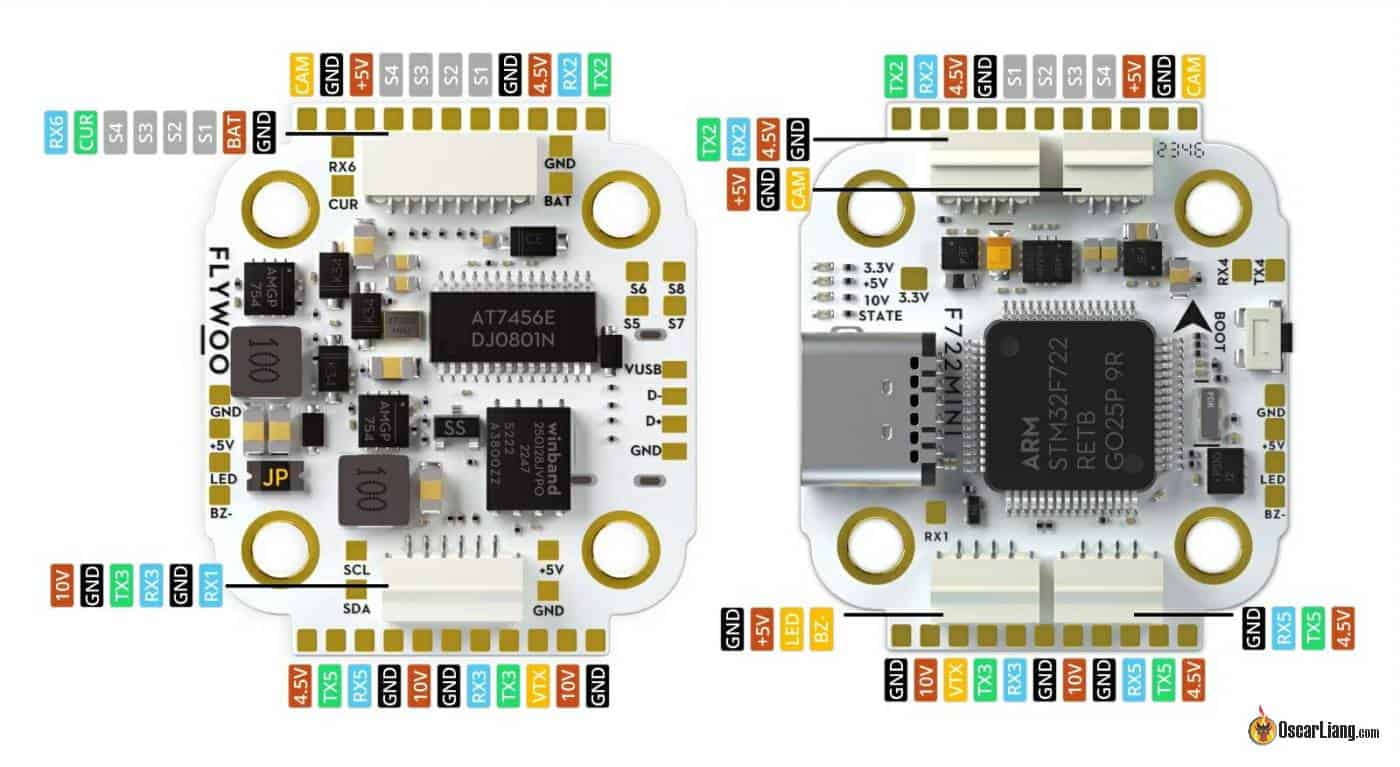
ESC Firmware: F4A_4IN1 – AM32 2.16. Here are the default ESC settings.

ELRS Receiver Firmware Target: Flywoo EL24E 2.4GHz RX, firmware version says “merge 481945 CE_LBT”, not sure what version this is but it binds fine with my radio which is on ELRS V3.
Betaflight Setup
Rescue mode is enabled in the Failsafe tab, so if you lose signal the quad should fly back to you (if GPS has good signal). However, please go through the settings to make sure they work the way you want. Here’s my tutorial: https://oscarliang.com/setup-gps-rescue-mode-betaflight/
Also, Altitude hold, position hold, and magnetometer features are included in the Betaflight firmware build, so you can enable them out of the box without reflashing Betaflight.
Final Thoughts: Love It, But Still Room for Improvement
The 4-inch Flywoo Explorer has to be one of my favourite FPV drones of all time. I absolutely love how compact, lightweight, efficient and quiet it is.
The new O4 Wide version makes even more sense because it is cheaper, reduces weight while still offering much better image quality than the original O4 Lite.
However, this is not a freestyle quad. It is relatively fragile and not designed for crashes, aggressive flying or risky moves.
If you enjoy cruising around open spaces, exploring new locations, flying quietly without annoying people, and getting exceptionally long flight times, the Explorer is very hard to beat.
Buy the Explorer LR4 O4 Wide Edition here:
That said, the stock configuration still has room for improvement. The biggest issue on my unit is GPS performance, followed by the receiver antenna mounting. If you genuinely intend to fly long range, I would address those issues first. Once that is done, I still think the Flywoo Explorer LR4 V2 with DJI O4 Wide is one of the most compelling compact long-range FPV drones available.


