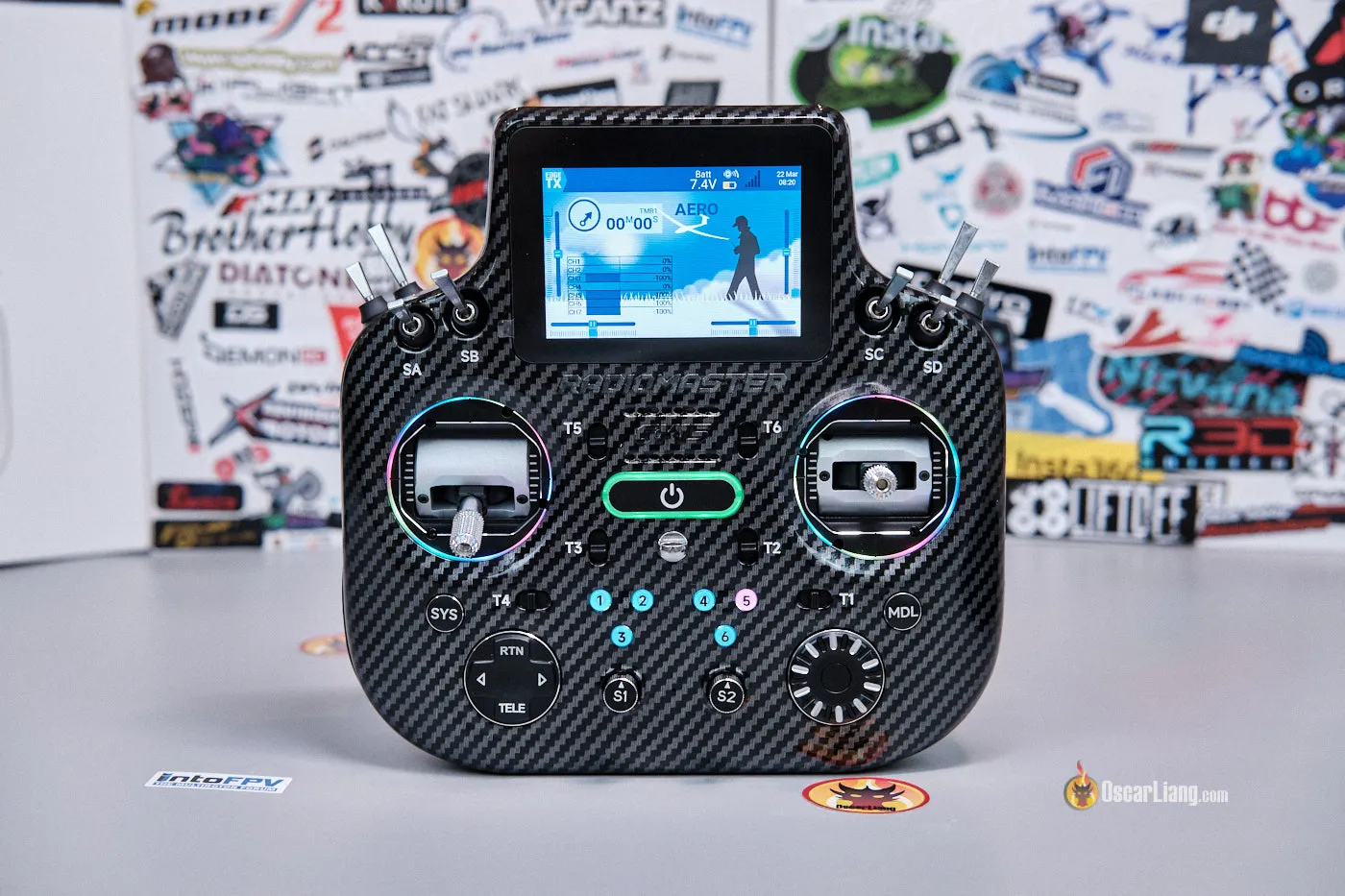
RadioMaster has been releasing two to three new radios every year, but that does not mean every new radio is automatically better or that you should buy one. Each model is designed for a particular group of users or niche, and the new GX15 is a good example of that. It is an interesting concept, but it certainly will not be for everyone. It packs a lot of modern features into a full-size form factor. However, there are a few design choices I don’t entirely agree. Let’s take a closer look in this review.

New to FPV? Learn the basics of radio transmitters in our buyer’s guide: https://oscarliang.com/radio-transmitter/
Where to Buy?
Get the GX15 radio from:

Specifications
- Colours: Black / Transparent Charcoal / Red / Gold / Blue
- Voltage Range: 6.6–8.4V DC
- Current Draw: 850mA at maximum output power
- Internal RF: ExpressLRS 2.4GHz
- Channels: Up to 16 channels, receiver-dependent
- Radio Firmware: EdgeTX, version 2.12.0 or newer
- Built-in Flash Storage: 512MB
- Cooling Fan: Yes
- Built-in Microphone: Yes, for future expansion
- Built-in Motion Sensor: Yes
- MicroSD Card: Up to 32GB, FAT32, not included; inserting a microSD card disables onboard flash storage
- Display: 3.5-inch IPS touchscreen, 480 × 320 resolution
- Battery: 7.4V 2S LiPo / two 3.7V 18650 Li-ion cells / 21700 5000mAh battery, batteries not included
- Connectivity: USB-C
- Gimbals: AG02 CNC Hall-effect gimbals
- Gimbal Stick Thread: M4
- Firmware Upgrade: USB-C, UF2
- Module Bay: Full-size JR-compatible module bay
- Dimensions: 178 × 168 × 81mm
- Weight: 725g without battery

First Impressions: It’s Big and Heavy
The GX15 does not seem to have much in common with the GX12 despite being in the same family. In fact, its form factor is much closer to the TX15 and TX16S MK3—and it is actually slightly wider than both and would actually take more room in your backpack.

In the past, RadioMaster radios with colour touchscreens usually had the display placed below the gimbals. This time, they moved the screen to the top, which I think is a good decision because it is easier to see while holding the sticks, without your hands getting in the way.
This layout could be particularly useful for pilots flying aircraft with autonomous features such as waypoint missions or Return to Home, as you can quickly glance at telemetry data or other information on the screen. For FPV pilots who spend most of their time wearing goggles, however, the screen position matters much less during flight.
Together with the circular menu control and scroll wheel, the GX15 reminds me somewhat of the FrSky Tandem series. However, the GX15 has more rounded corners and a curvier overall design that gives it a distinctive appearance.
Personally, I am not a huge fan of the rounded shape. It feels a little too casual for my taste, and I tend to prefer more angular designs that look slightly more professional and serious. That is entirely personal preference, though.
More importantly, the radio feels surprisingly good in my hands, and the ergonomics are actually very good.

For some reason, the GX15 is noticeably heavy. At 835g with two 18650 Li-ion batteries installed, it is 165g heavier than the GX12 and 55g heavier than the TX15.

On top of the radio, just behind the screen, there is a USB-C port that handles both charging and data.
There is also a trainer port and a headphone/audio output jack.
The GX15 is compatible with all major FPV sims including Liftoff, uncrashed, and Tryp, though it may require stick calibration the first time you plug it in.
Internal Antennas
You might be wondering: where are the antennas?
The GX15 has no external antenna.
Instead, both antennas are hidden inside the radio. This gives the GX15 a clean appearance and makes it more travel-friendly, as there is no antenna sticking out that can get caught or snapped off inside a backpack—even though the radio itself is still quite large and heavy.
You can convert it to external antennas if you want. On RadioMaster’s shop, they offers SMA adapter kits that can be used for this type of modification.
Unless you fly long range or have a specific need for external antennas, I prefer the cleaner internal antenna setup.
Controls and Switches
The switches are very different from the GX12 and closer to the TX16S MK3 and other full-size radios.

The shoulder controls include:
- One 2-position switch (SF)
- Six 3-position switches (SA, SB, SC, SD, SE, SG)
- A momentary switch (SH)


The GX15 also includes two rear sliders with centre detents.

If you do not want the sliders, you can open the radio, unplug and remove them, then install the included replacement panels without slider openings.

In the centre of the radio, there are also 2 rotary knobs and 6 programmable buttons, which have become fairly standard on RadioMaster’s full size radios.
The 6 buttons feature RGB LED backlighting and can be fully programmed in EdgeTX.
Gimbals: AG02 or Hall Gimbals?

The standard GX15 comes with hall gimbals, while the GX15 MAX comes with AG02 CNC gimbals, which are currently the best gimbals RadioMaster offers. They feel smooth and solid, with almost no noticeable mechanical play at the endpoints. Even if you push the stick hard against the edge, the output remains consistent rather than wandering around slightly, which is common in gimbals with plastic frame.
Another advantage is that spring-tension adjustments are easily accessible from the outside. You do not need to take the radio apart just to change the gimbal feel.
Having premium gimbals such as the AG02 will not make you a better pilot overnight, and the cheaper, standard Hall-effect gimbals are already good enough for most people. I think of it a bit like cars: almost any decent car will get you from point A to point B, but some simply provide a nicer experience along the way. If you appreciate that premium feel and can afford it, there is nothing wrong with spending a little extra.
Ergonomics
Although the GX15 is one of the biggest and heaviest radios RadioMaster currently offers, it is actually very comfortable to hold. The ergonomics are surprisingly good.
In the hands, it feels similar to the TX16S MK3.
I can comfortably reach the full gimbal travel using either thumbing or hybrid-pinching grip, although you do need to stretch your fingers more than you would on smaller transmitters such as the GX12 or Pocket.


The switches are also well positioned, and I can reach them comfortably while keeping my fingers on the sticks.
However, if you plan to fly for long periods, I would definitely consider using a neck strap or lanyard to reduce fatigue (which is also included).
One thing worth mentioning is the balance. The radio is slightly top-heavy, and when hung from a neck strap it tends to tilt forward slightly. It is not a deal breaker, but it is worth knowing if you are going to use a neckstrap.
A heavier battery may improve the balance somewhat. If you want it perfectly balanced, you could also use a lanyard balance bar (purchased separately or 3D printed).
Display and Menu Controls

The colour touchscreen measures 3.5 inches, which is smaller than the 5″ display on the TX16S MK3. If you have large fingers or simply prefer a bigger interface, the TX16S may still be the better option.
The display is quite bright (up to 600 nits), and remains visible outdoors during the day. Under direct sunlight, however, you may need to shade the screen slightly with your hand to see it more clearly.
You can navigate the menus either by tapping directly on the touchscreen, which feels responsive and smooth, or by using the menu controls and scroll wheel located at the bottom of the radio.
EdgeTX
The GX15 runs EdgeTX version pre-2.12.2 selfbuild.
However, because the radio is so new, it has not yet been added as an official target in the latest EdgeTX release, V2.12.2 (official release). This means you may not be able to flash or update it until it’s added in future releases.
Additional Features
Apart from the top-mounted screen and circular menu controls, there are a few other notable features that set the GX15 apart from RadioMaster’s other full-size radios.
Built-In Gyro
The GX15 also includes a built-in gyroscope.
This means the radio itself can detect movement and orientation, allowing its motion to be used as an additional control input.
For example, you could potentially use it to control a camera gimbal or pan-and-tilt system, or simply treat movement as another switch input to trigger functions such as a voltage callout.
It is an interesting feature to have and experiment with, but personally I do not see myself using it very often.
Built-In Microphone
The GX15 also includes a microphone, which could potentially be used by future EdgeTX features, perhaps for voice commands similar to what we have already seen on the HelloRadio’s V14.
As far as I know, it’s not currently used. Still, it shows that RadioMaster is thinking ahead and leaving room for future functionality.
Louder Speaker
The GX15 has a noticeably louder speaker.
I did not notice a major improvement in sound quality, which may be limited more by the quality of the sound files themselves, but the maximum volume is definitely higher.
I also did not notice any buzzing or humming caused by RF interference, which is a good sign.
ExpressLRS Transmitter: 2.4GHz Gemini but Only 250mW
The GX15 comes with a built-in ExpressLRS transmitter module.
It supports 2.4GHz Gemini, meaning it can transmit two separate control links simultaneously to improve reliability. Learn more about Gemini in this guide: https://oscarliang.com/expresslrs-gemini/
Note that this is not Gemini Xrossband (Gem-X). The GX15 only supports 2.4GHz link, not 900MHz. For most pilots, this doesn’t really matter. 2.4GHz ExpressLRS already provides more range than most people ever need.
However, if you specifically want 900MHz or Gemini X for extreme long-range flying or additional redundancy across two frequency bands, the GX15 is not the radio for that.
For long-range pilots, the biggest limitation is probably the maximum 250mW output. All else being equal, 250mW provides roughly half the theoretical range of 1W.
That said, for most pilots flying cinematic FPV, freestyle, or racing, 250mW is still plenty and is unlikely to be a deal breaker. I once flew more than 2km using just 10mW at a 500Hz packet rate, so 250mW can potentially provide tens of kilometres of range with the right setup and conditions.
Want to know how I estimate range? Check out this guide: https://oscarliang.com/calculate-fpv-range/
Increasing RF power is not the only way to improve range. Before simply turning up the transmitter power, there are other factors worth considering: https://oscarliang.com/lq-rssi/

If you really need more RF power, or want to use a different control link such as Crossfire, you can install an external RF module in the GX15’s JR module bay.
Battery Options
The GX15 has a rear battery compartment and comes with a battery holder for two 18650 Li-ion cells.

Note that batteries are not included.
I recommend RadioMaster’s 3200mAh 18650 cells, which performed well in my testing: https://oscarliang.com/best-18650-li-ion-battery/#Results-and-Recommendations
Get these 3200mAh batteries here:
The battery bay can also fit RadioMaster’s 2S 6200mAh LiPo battery pack if you want longer runtime.
Power Consumption & Battery Life
Although the internal ExpressLRS module is limited to 250mW, power consumption can still be relatively high when Gemini is enabled because the radio is effectively powering 2 RF chains simultaneously.
Here are my measurements of the TX15’s current draw (screen brightness at minimum unless stated otherwise), with Gemini enabled. Voltage input: 7.4V.
- RF module off: 0.32A
- RF module off, screen at max brightness: 0.44A
- 10mW: 0.50A
- 25mW: 0.54A
- 50mW: 0.58A
- 100mW: 0.67A
- 250mW: 0.94A (cooling fan kicks in)
- 250mW with screen at max brightness: 1.08A
Estimated Runtime (with 3200mAh battery):
- 10mW: Under 7 hours
- 100mW: Under 5 hours
- 250mW: Under 4.5 hours
USB-C charging up to 10W, which means it would take roughly 80 to 90 minutes to fully charge 3200mAh Li-ion battery from empty.
Which RM Radio Has the Best RF System?
| Radio | 2.4GHz | 900MHz | Gemini | Gemini X | Max Power |
|---|---|---|---|---|---|
| GX15 | Yes | No | Yes | No | 250mW |
| GX12 | Yes | Yes | Yes | Yes | 1W |
| TX15 | Yes | Yes | No | No | 1W |
| TX16S MK3 | Yes | Yes | Yes | Yes | 1W |
RadioMaster’s current lineup can be a little confusing, but the important thing is that all of these radios have an external module bay. If the internal RF system does not meet your needs, you can always add something like a Nomad module which offers 1W power and all the advanced features of ELRS.
Final Thoughts: Why I Am Not Switching to the GX15
Get the GX15 radio from:
I am a little confused about where the GX15 fits in RadioMaster’s lineup.
Maybe I am being overly critical, and some pilots will appreciate the GX15 far more than I do, but as someone who mainly flies FPV quads and wings, I cannot find a compelling reason to switch to it.
- For portability, I would rather use something like the GX12, V12 MAX, or T20S. Yes, the GX15 has no external antennas, which makes packing slightly easier, but the radio itself is still huge and heavy.
- For ELRS capability, if I wanted the most powerful features and performance, I would choose a radio with 1W output, Gemini X support, and external antenna, such as the TX16S MK3 or GX12.
The GX15 sits somewhere in between – it’s a large radio with capped performance. It does not have one standout feature either that makes me want to switch, apart from having the screen on the top and a few other minor improvements mentioned in the review.
What could have made it much more interesting would be something genuinely ground-breaking. For example, using the top-mounted screen as an FPV monitor so you could fly without goggles or let spectators watch the live video feed. That would have been a much stronger selling point than simply rearranging existing components or changing the shape.
That said, the GX15 is still a very solid radio. The ergonomics are outstanding despite its size, the AG02 gimbals and switches feel fantastic, and the menu controls are easy to use.
It is a very capable transmitter, but depending on what you fly, you may find other RadioMaster radios more appealing. Check out my recommendations: https://oscarliang.com/radio-transmitter/#Radio-Recommendations


