
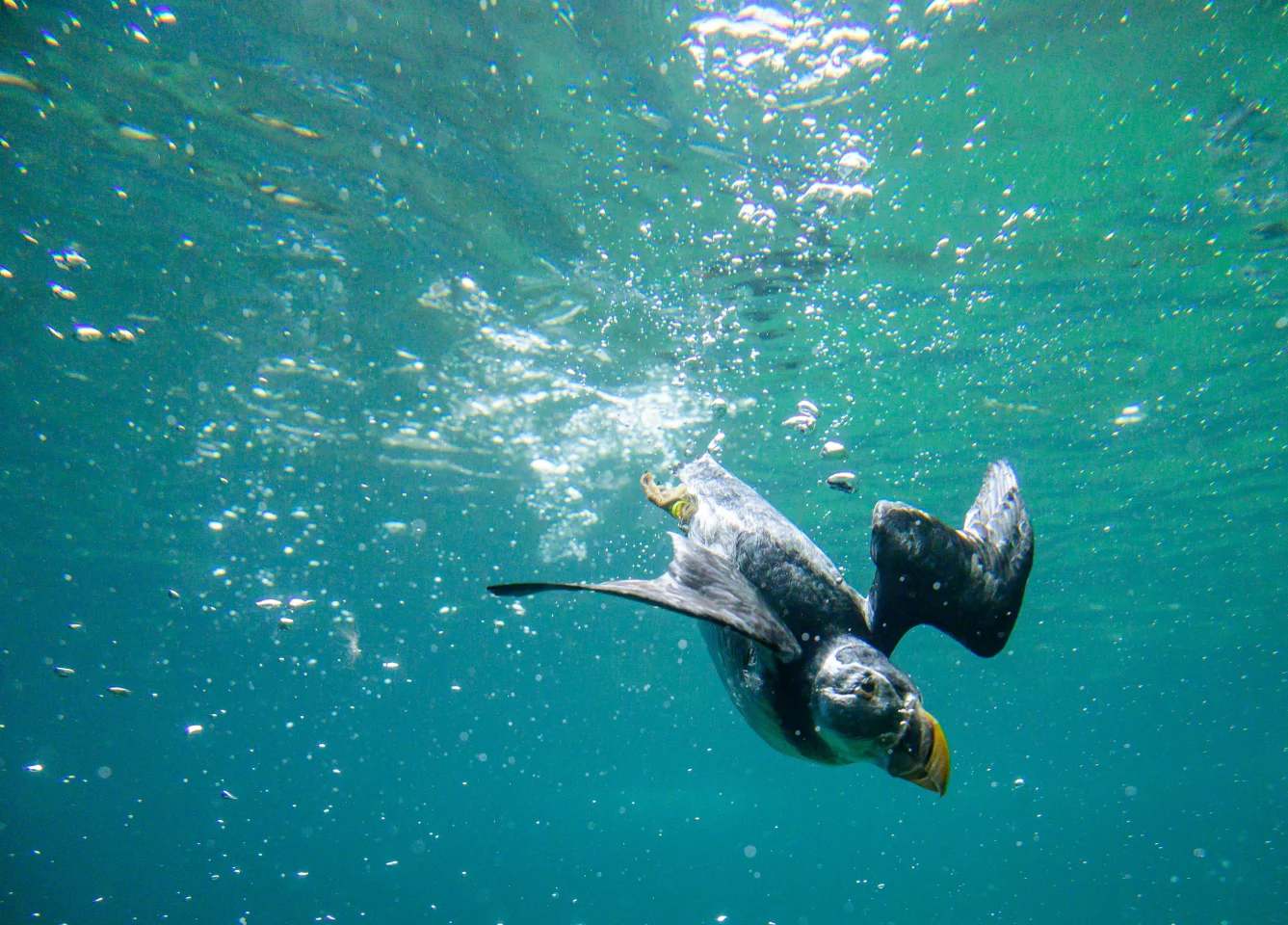
A robot that swims like a diving bird and then flies like, well, a bird, sounds like the setup for two different machines bolted together. But researchers at MIT and EPFL built one that does both with a single set of wings. No propellers, no legs, and no origami-style folding mechanism to switch modes.
Nature figured this out a long time ago. Around 100 bird species move fluidly between water and air, diving in after prey and then launching straight back into flight. The 250-g (8.8-oz) robot is, according to the team, the first bird-scale machine to complete that entire cycle – swim, dive, launch, and fly – using flapping motion alone. That’s not as easy as it sounds, because water is about 800 times denser than air, and few designs handle that jump in resistance without swapping hardware between mediums.
The trick lies in two design choices. The robot relies on flexible wings and tightly controlled flapping speed to cross that abrupt shift in density. Underwater, the wings passively bend up to 90%, which cuts the load on the motor and shortens the effective sweep of each flap. In air, the same wings can flap up to 11 Hz. Underwater, that number drops to between 0.1 and 6 Hz.
Puffin-Inspired Robot that Swims and Flies
The robot is also neutrally buoyant, meaning it neither floats up nor sinks down on its own. This detail matters a lot, since fighting buoyancy would burn through limited battery power fast.
Swimming and flying are one thing. But the real challenge – and the reason no bird-scale robot has managed this leap before – is the split second in between, when the robot has to shove itself out of the water with nothing but its wings. Get that transition wrong, and the whole concept falls apart.
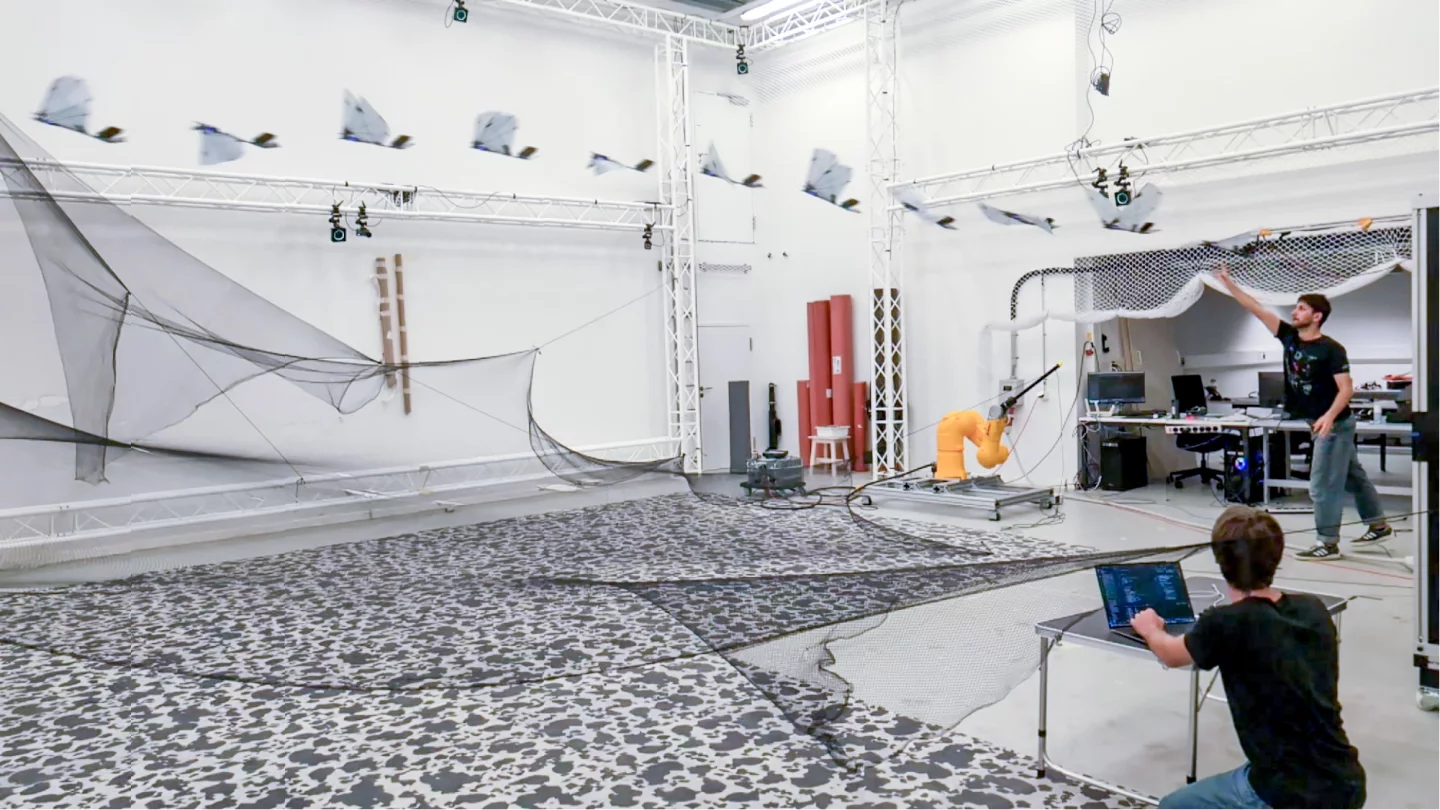
The robot manages it in under a second, using 8 to 10 wingbeats, but only within a narrow set of conditions. The wings need intermediate stiffness (not too rigid, not too floppy), the tail must sit short and close to the body, and the exit angle has to land near 70 degrees. Too flat, and the tail drags it down; too vertical, and the robot tips over and falls back in.
Raphael Zufferey – MIT
Beyond the engineering achievement, the robot doubles as a physical model for testing ideas about real diving birds. The team suggests that birds shrinking their wingspan underwater may be more about gaining speed than saving energy, a detail that’s hard to test on live animals but easier to explore in a controlled robotic version.
The researchers also note that heavier diving species likely rely on their legs to launch, something this robot skips entirely. Both real birds and the robot appear to operate in a similar aerodynamic efficiency range, described by a ratio called the Strouhal number, which falls between 0.2 and 0.4 for both.
According to the team’s data, once a trip stretches past roughly 15.5 m (51 ft), flying simply burns less energy than swimming. So if the destination is far enough, this mechanical bird would rather climb out, fly over, and dive back in later – the same logic that makes a person choose to walk around the edge of a lake instead of wading through waist-deep water.
Raphael Zufferey – MIT
The system isn’t autonomous yet. Tests so far have relied on manual launches and simple timer or trigger-based activation. The researchers say the next priorities are autonomous navigation, better performance in salt water, and longer range and endurance. If those pieces come together, the robot could find use in environmental monitoring – sampling lakes, rivers, coastlines, and marine ecosystems, essentially an amphibious drone with gull-like ambitions.
At around US$300 in materials, using parts anyone can source, the robo-bird is cheap enough to replicate. The team has released open CAD files, so anyone with a 3D printer at home can build one.
“Our dream vision is for oceanographers, marine biologists, and members of coastal communities to launch this robot from a boat, or from shore, and it would fly close to the area of interest, such as an iceberg or a port facility, or over a pod of whales,” says Raphael Zufferey, assistant professor of mechanical engineering at MIT. “It would dive into the water to take a measurement or collect a sample, and fly back to deliver the data at a fraction of the cost of traditional methods. Then it could go back out to dive for more.”
The research has been published in the journal Science.


