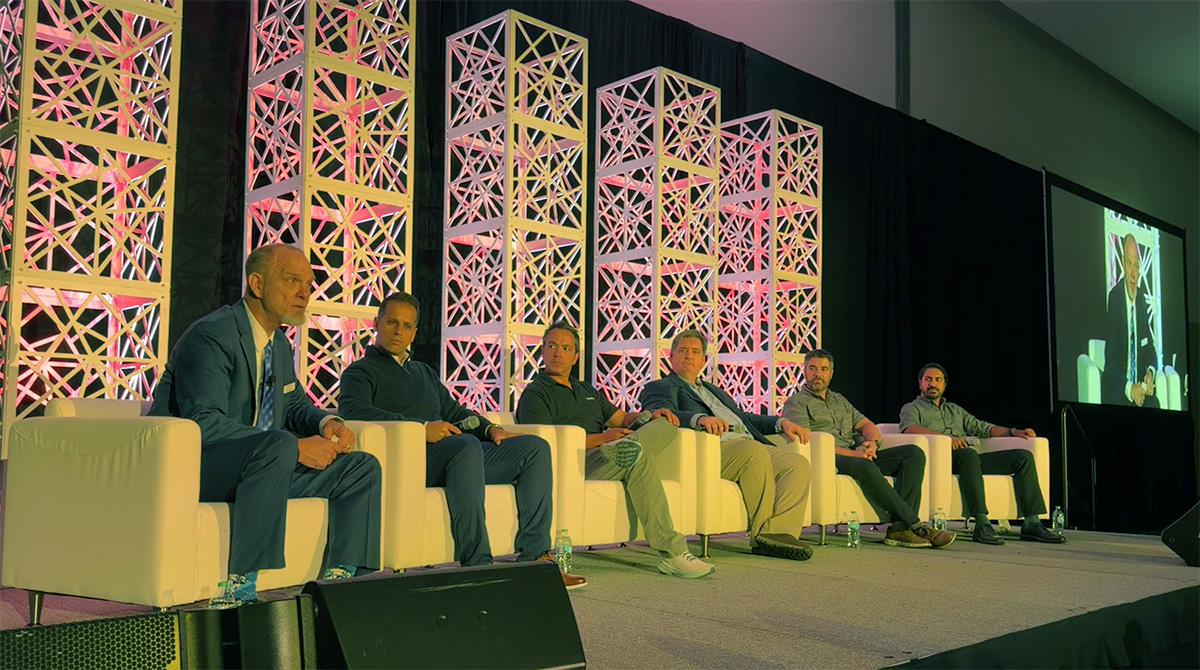
A panel of industry experts discussed the state of humanoid robot development at the 2026 Robotics Summit & Expo. Source: RealSense
While robotic arms have arguably been mastered for manufacturing, it’s another thing entirely to design and build a bipedal robot that can walk and manipulate objects. Plus, there’s the added complexity of that system working in a fast-paced environment with human workers, forklifts, and other machinery. At last month’s Robotics Summit & Expo, a keynote panel focused on the state of humanoid robots.
The session boasted a star-studded lineup:
- Al Makke, head of humanoid robotics for North America at Schaeffler
- Mike Nielsen, chief marketing officer at RealSense
- Aaron Prather, director of the Robotics & Autonomous Systems Program at ASTM International
- Alberto Rodriguez, director of robot behavior for Atlas at Boston Dynamics
- Pras Velagapudi, chief technology officer at Agility
- Mike Oitzman, moderator and senior editor at The Robot Report and Automated Warehouse
The Robotics Summit & Expo, held at Boston’s Thomas M. Menino Convention & Exhibition Center, included incredible keynotes, presentations, and panel discussions about the world of robots, from their design to their implementation. Presented by The Robot Report, roughly 3,900 attendees filled the presentations and explored the exhibit hall, seeing everything from component manufacturers to tennis ball-shooting robots.
 Submit your session idea for the 2026 RoboBusiness
Humanoid developers look beyond the demos
For Boston Dynamics, its North Star for its Atlas program has been enabling it to function as a general-purpose machine for physical labor. Rodriguez said that one of the things the company has seen while deep diving with many customers is that, except for very few applications with very large and stable scale, the norm is that almost all jobs are one of a kind.
“Our roadmap is building the technology that is necessary to promote that general-purpose case at the levels of hardware, at the levels of the models and architectures that are driving the behavior, and also very importantly at the level of the deployment strategy,” he said. “For the integration strategy, if you fail on finding a general strategy for any one of those three things, it becomes too expensive.”
Rodriguez explained that Boston Dynamics has started with logistics in manufacturing, an application where the company and its parent Hyundai think there is a good balance between generality and complexity.
“You have to handle all the parts — for example, like going to a cart — but it’s still not close enough to the assembly line that you have to deal with the timing constraints and the safety constraint of having to work right next to other people,” he noted. “Last year, we brought Atlas as a sort of first exercise into a factory to do a first proof-of-concept demonstration of fully data-driven architecture driving behavior and sequencing scenario.”
“We brought it to CES this January for a whole week, just demoing, and next year, we’re going back,” Rodriguez added. “This year, we’re going back to the factory to show a more end-to-end demonstration of Atlas — a full learning pipeline, not just handling the behavior, but handling the entire workflow, connecting to the factory, and handling exceptions.”
He also noted that in Boston Dynamics’ journey to mass-production scale, the company has now secured enough customers (including Hyundai) that it has committed to deploy on the order of 25,000 humanoids in factories. Boston Dynamics has made an additional commitment to ramp up production capacity to 30,000 Atlas robots per year by 2028.
Agility (formerly Agility Robotics) has also moved past pilot projects. It has worked on Digit humanoid deployments with companies including Amazon, GXO, Schaeffler, Toyota, and Mercado Libre.
“We’ve really been expanding the commercial side and learning from that to figure out — what do we need to close the remaining gaps that allow us to scale?” said Velagapudi. “That’s a couple of different things: It’s discoveries around what we needed out of the safety case, which has been a huge piece of all of this with an incredibly powerful, dynamically stable robot. How can we move around these facilities and be able to work in closer proximity or without guarding around humans?”
Velagapudi also noted that Agility has spun up an ISO committee/working group with Boston Dynamics and others to study the safety issue and come up with a solution that it will incorporate into the next generation of its robot.
He added that Agility has been expanding beyond its initial applications of tote, case, and container manipulation. It is now moving toward item manipulation in the next year or so.
Robotics safety and standards efforts continue
The state of standards in robotic safety worldwide is evolving as fast as the robots themselves are. Prather explained that ASTM is aware of and involved in numerous initiatives.
“ISO has two new groups: safety chaired by Boston Dynamics, and then China is leading the data effort,” he said. “This is the next effort that we’re working with NIST on … a proposal for a humanoid test bed of about 10 tests.”
Prather detailed how the test beds would include capabilities such as locomotion and manipulation. Some producers will have these tests shipped to them, so they can use them internally. But another goal is to use these test beds for future competitions, so teams can actually put their robot to the test in front of the world at robotics events.
These tests are also intended to help the development of robotics standards, noted Prather. “Safety efforts are under way at ISO, ASTM, and NIST,” he said. “We are starting to work on the performance repeatability tests, and there are numerous other efforts going on.”
In response to a question about humanoid safety, Prather said he hoped that the first safety standards will be drafted within the next two years.
However, AI fundamentally changes the landscape, acknowledged the panelists. Traditional safety methodologies that are deterministic are less suited for complex systems that involve leaned behaviors. Some of the new engineering challenges here include:
- Accurately predicting failure behavior
- Repeatability of performance
- Risk assessment of human-robot interactions
- Validation of AI-based decision making
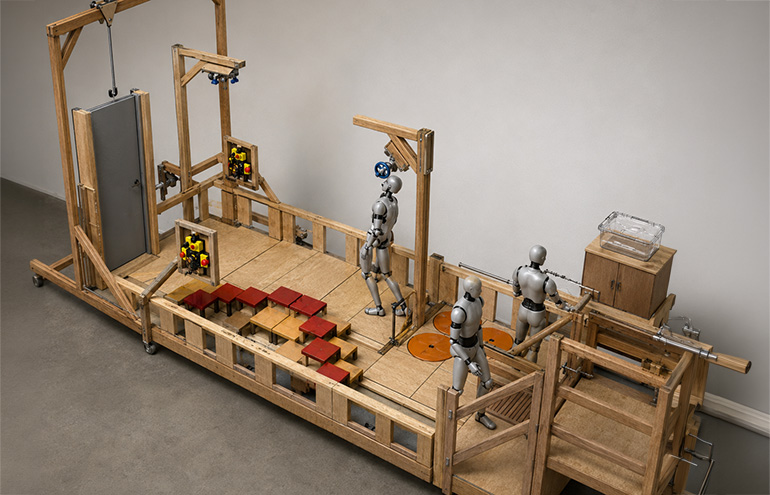
Rendering of a proposed apparatus for standardized testing of humanoid robot capabilities. Source: NIST, ChatGPT
Perception issues to be overcome
Nielsen told the crowd at the Robotics Summit that RealSense’s growth has been “extraordinary” and that things are moving very quickly.
“From a trend perspective, we’re seeing a few things simultaneously, and we’re able to do things a lot faster now,” he said. “One of those is partnerships with other tech vendors in both the silicon and the broader AI space, so we’re doing a lot of work right now around simulation. The sim2real gap is closing.”
“It’s been fantastic work, but there’s a lot of work to do,” said Nielsen. “There’s some really interesting activity right now with NVIDIA and a few others on developing … a universal vision model, which allows you to take a RealSense camera in any modality that you want to and applying those in Isaac, so you can land it in real time, including noise models.”
“The biggest gap that we see is taking a pure model and applying that in the real world and starting from scratch,” he noted. “Because if you don’t have real-world implications built into the model, then you’re really just using face and eyeballs.”
Nielsen also said his company is learning a lot from China, where the customers are moving extremely fast. He explained that the product life cycles in China iterations are on the order of 30 to 40 times faster than they see in other areas, because the tolerance for risk is higher.
“We’re seeing … envelopes being pushed from a mechatronics perspective, things like dancing robots, including what we saw on SportsCenter the other night,” he said. “That transition from robots that can move slowly to robots that can move and do judo then has the next step to it, which is how they do things autonomously, and [does] the autonomy stack?”
According to Nielsen, the perception requirements for humanoid robots are very different than for other systems.
“There’s some basic modalities where you need density of information at near speed or at near range,” he said. “The speeds are different, and they differ based on the z from the robot, because a swinging arm is a lot faster than a turning torso.”
“Things that fall are very different than things as a whole, so when we actually had an incident where one of our engineers was doing something he probably shouldn’t have done with a robot with a customer, and it fell on him,” said Nielsen. “So, these are very different failures we’re dealing with that have a huge reliance on perception — to figure out when they fail, in addition to the speeds, the distances, the density of information, and then the scene reconstruction.”
Rodriguez also raised an interesting point concerning downscaling higher-resolution imagery into a size more compatible with what neural networks can handle.
“One of the things that we’ve seen that’s been a dramatic change is that we get much more value from less pixels that are higher quality, but ultimately the behavior architectures that are driving most of what humanoids do today end up downscaling images to like 240 by 240 pixels, because that’s what we feed into neural networks,” he said. “We cannot feed giant images [into the neural networks], so ultimately what happens is that we remove a lot of information that has been captured.”
“Instead, we would be better off with higher-quality pixels that have higher dynamic range that have global shutter, for example — that don’t have problems when the torso is moving fast, that have high resolution in proximity, or focus in proximity,” said Rodriguez.
The $20,000 humanoid question
One of the industry’s more enduring questions revolves around the economics of humanoids: Can the cost of the technology ever come down to where a $20,000 price point is achievable? The panelists expressed cautious optimism about the concept, thanks to automotive-style manufacturing techniques, increasing volume of production, consolidation of sensors, better actuator design, and some degree of component standardization.
“There are very interesting pressures, obviously from some people on the stage, as well as from a bunch of other customers,” said Nielsen. “The sensor-stack costs can be really high, especially on AMRs, where it gets like super dangerous, because they’re carrying heavy stuff.”
“The total perception stack of a robot is about $20,000, nearly the price of what we’re talking about for the entire robot. It’s fundamentally untenable,” he added. “So, some of the work we’ve been doing is in collapsing the modalities. Sometimes you need sparse information, and sometimes you have to be able to read a bar code. Those are fundamentally different problems to solve for, but you don’t want to buy literally two different cameras to solve for those two kinds of problems. So that research is being accelerated at RealSense — fewer sensors is good, without losing 360-degree perception.”
Makke noted that at the 2025 Robotics Summit & Expo, a panel member said that they were a little bit pessimistic about the concept.
“I said, ‘I see your pessimism, and I raise you with optimism,’ and I still feel the same way, probably even more so,” Makke joked. “One thing has to happen, and it’s a chicken or the egg situation. You need a certain bill of material [BOM] cost to justify an ROI, so the volume increases.”
“You have to try out these low TRL [technology readiness levels] technologies, and you have to be willing to fail a little bit,” he said. “We have to commoditize some of the key components. Actuators are a big part of the BOM costs, motors are as well, and sensors and PCBs are as well.”
Makke said that if he had to guess on a timeline for that sort of pricing, he would say in the next three to five years.
The post Robotics Summit panel explores the state of humanoid robot design appeared first on The Robot Report.


