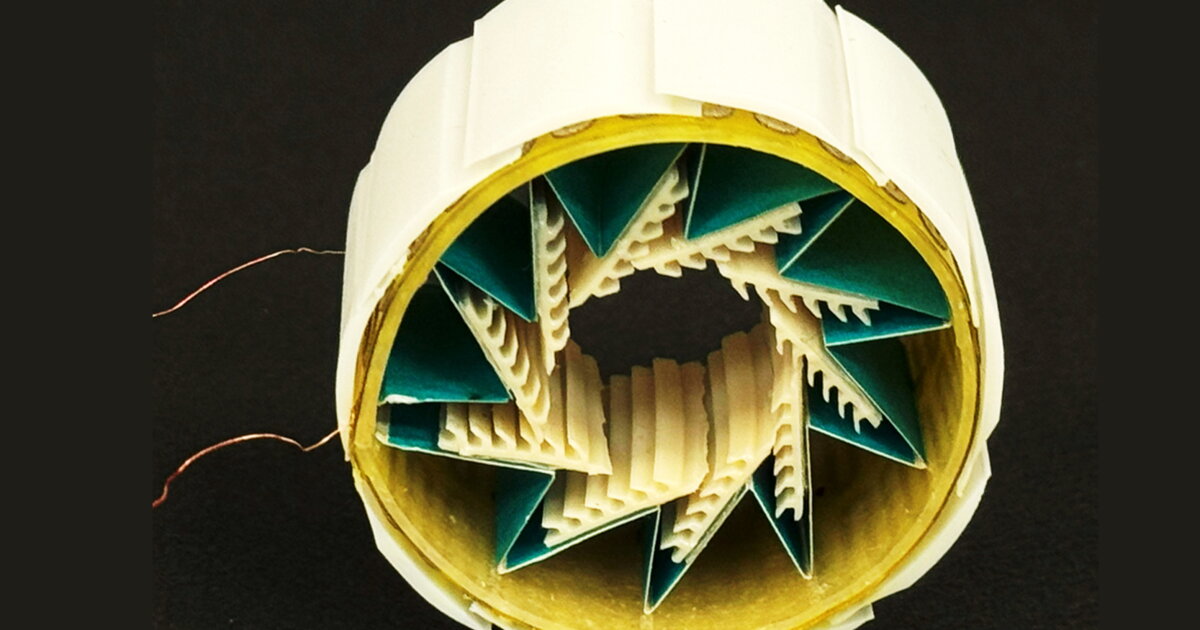
Nature has long served as a source of inspiration for scientific innovations. Many animals have evolved defensive features such as skins, shells, and scales to protect themselves from predators. Because protective mechanisms are essential in both biological organisms and engineered systems, a lot of these features have already been adopted in modern technologies. Recently, researchers from the Department of Mechanical and Aerospace Engineering at North Carolina State University drew inspiration from the armadillo and its unique self-defense mechanism.
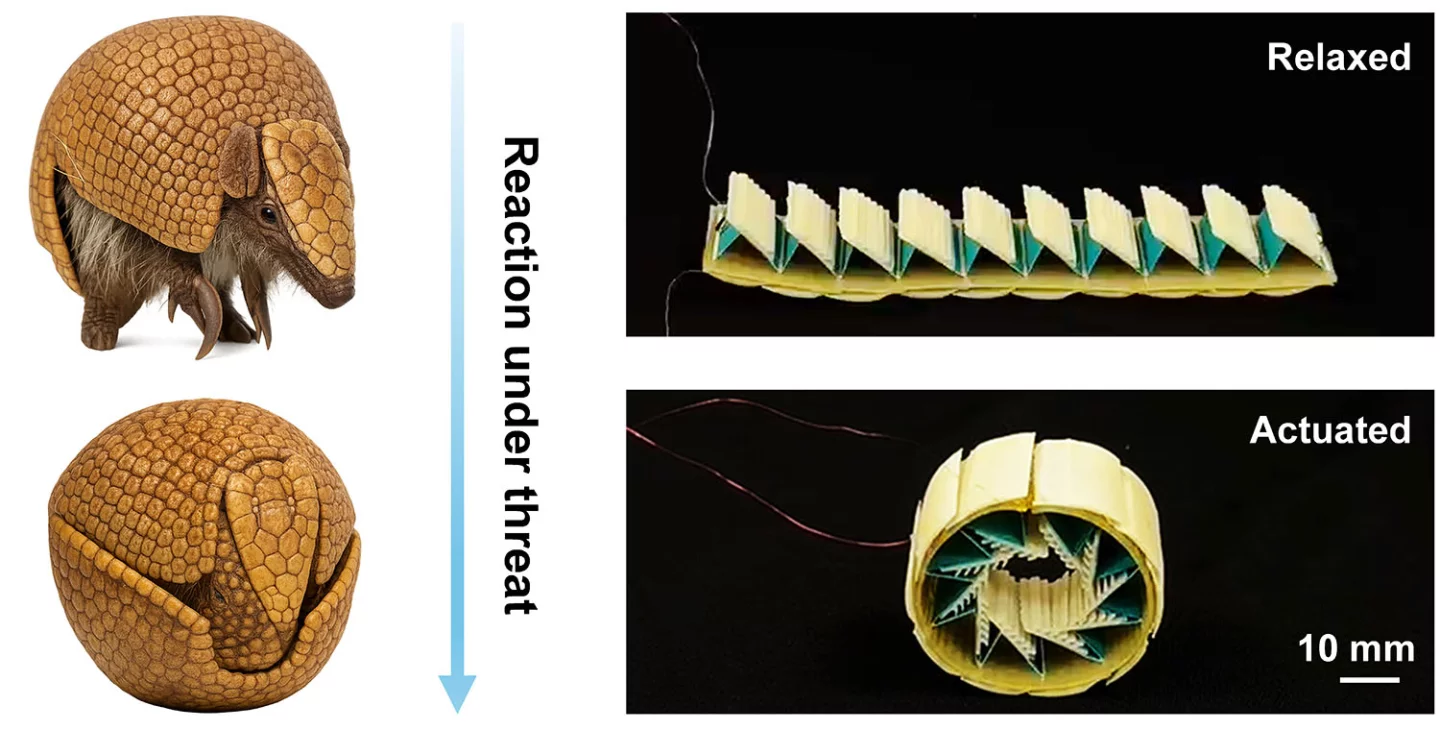
When an armadillo senses danger, it quickly activates its muscles and reconfigures its whole body into a rigid, enclosed sphere. Its armor-like outer plates act as a shield, while its spine supports the body from inside, keeping it in a spherical shape. Using this concept, the team developed a protective shell for fragile electronic devices that can automatically activate when a threat is detected. The technology is called the morpho-interlocking protective module (MIPM).
This approach is relevant to space exploration, search-and-rescue missions, and personal protective wearable technologies, where electronic devices – such as robots – have to be lightweight, flexible, and at the same time resistant to damage.
Jianyu Zhou, NC State University
Most previously developed bioinspired protective systems have lacked one crucial component: integrated sensing-actuation loops, which means they could not automatically and independently respond to external threats. Addressing this limitation became a key challenge for the researchers.
At the core of the technology is a three-layered structure, where each layer serves an important function.
The outer layer consists of multiple segments made from 3D-printed resin. Ten of those segments are capable of withstanding approximately 10 newtons of force. The middle layer is the most complex, as it contains the sensing and actuation system that detects a threat and triggers protective mode. It consists of four elements: a liquid-crystal elastomer (LCE); a strain sensor made from an elastic polymer embedded with silver nanowires; a layer of Kapton tape that expands when heated; and finally, a thin conductive fabric layer that serves as a heater. The inner layer, or endoskeleton, is made of heavy-duty paper folded into a series of ridges.
When the strain sensor detects a force, it sends a signal to a control unit, which activates a power source and sends it to the heater layer. As the heater warms, the LCE layer contracts while the Kapton tape expands, forcing the entire MIPM structure to bend and curl into a protective sphere – just like an armadillo’s defensive shell.
Unlike real armadillos, the endoskeletal components of the robotic system cannot be fully bonded along the origami-inspired interface, because curling requires some space between the segments to ensure their movement. This became another challenge for the research team, which was ultimately met.
After testing, the system was shown to perform effectively, but it’s important to note that those results were obtained under controlled conditions. To prepare the technology for real-world conditions, there is still some work that needs to be done. This includes ensuring that sensors remain stable in extreme temperatures, high humidity, and dusty environments. Besides that, the team is also planning to improve wireless connectivity, such as Bluetooth, to enable reliable communication between sensors and control systems.
A paper on the research has been published in the journal Science Advances.
Source: North Carolina State University


