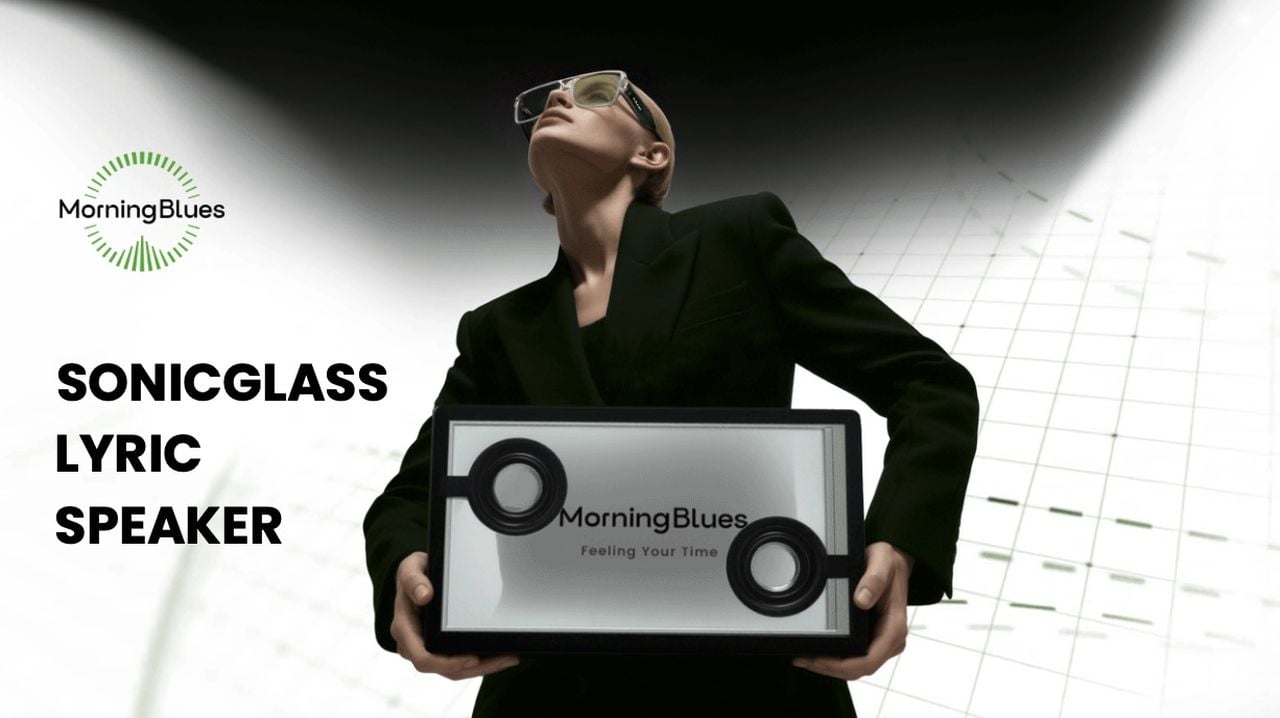
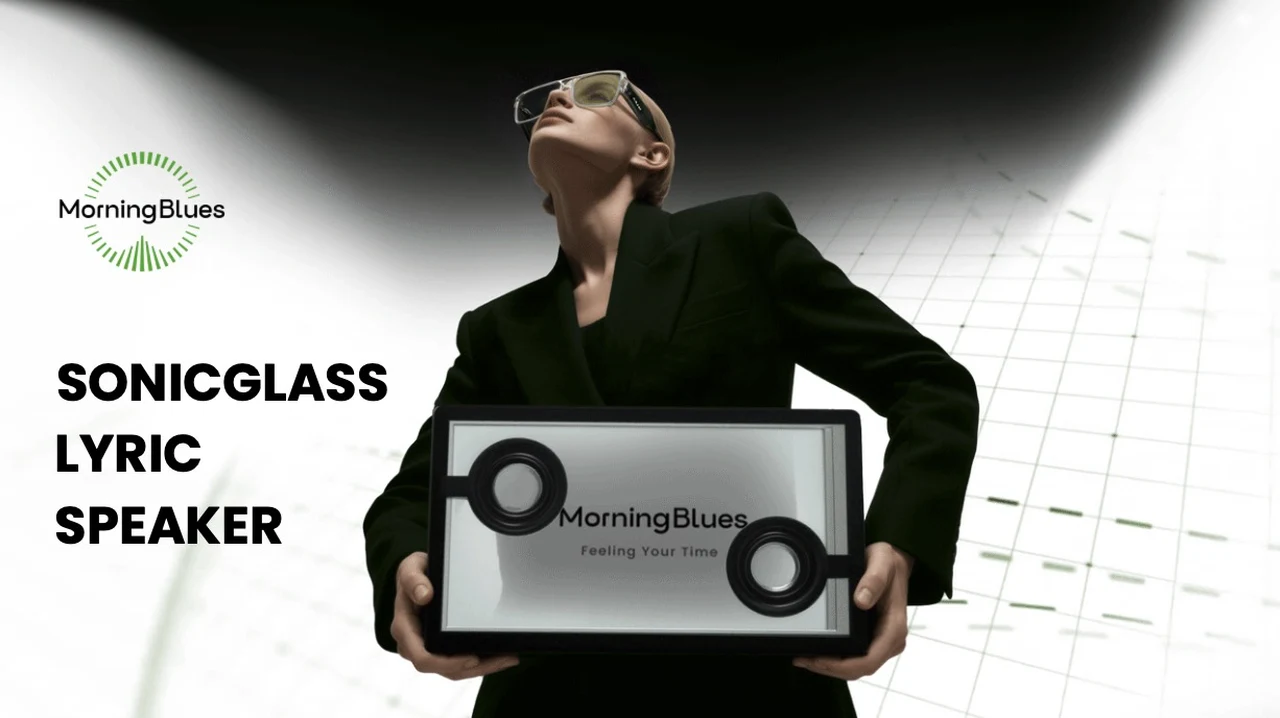
The SonicGlass A1 lets you watch its drivers move while a transparent display plays floating licensed lyrics and AI-generated music videos. It is MorningBlues’ boldest attempt yet to make music something you watch as well as hear. Most speakers hide their workings inside an opaque box.
The SonicGlass A1 does the opposite. Its drivers are mounted on a sheet of high-clarity tempered glass, so you can watch the cones pulse in time with the music and see straight through the cabinet behind them. MorningBlues calls it the world’s first transparent glass driver, and it anchors a speaker the company is taking to Kickstarter on 18 June 2026, with super early-bird price from $649, around 35% percent (items are limited) below the planned retail price.
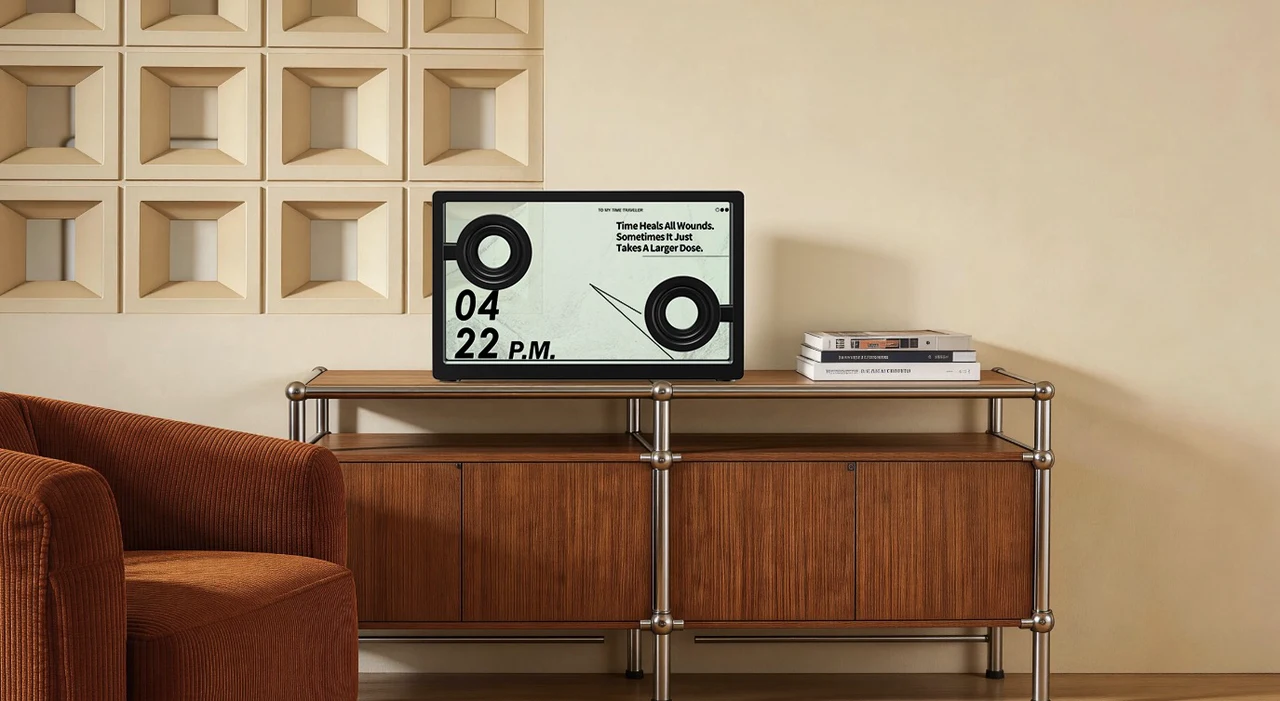
Behind the same glass sits a high-resolution display that turns the speaker into a canvas for officially licensed floating lyrics, AI-generated music videos and ambient art. It works as a stereo speaker, a digital art frame and a home karaoke stage, sometimes all at once. Offering a unique and innovative audio device for your home and a talking point at any party.
Meet MorningBlues, the Brand Trying to Make Music Visible

MorningBlues is a young audio company with an unusually specific thesis: that music should be more than something you hear, and that it should be something you can see, feel and connect with emotionally. Rather than competing on watts and frequency charts alone, the brand designs hardware that treats a song’s lyrics, mood and artwork as part of the listening experience.
This is not the company’s first attempt at the innovative hardware. Its existing range already includes the Gallery T2, a wall-hung “oil painting” display that pairs famous artworks with dynamic scene lyrics; the Record R1, a circular speaker that shows a real-time album cover and word-by-word lyrics; the VWS X1, a set of headphones with small OLED screens built into the ear cups; and the Cabinet S1, a bedside unit that doubles as a sleep-aid and wake-up light. The SonicGlass A1 is the most ambitious expression of that visual-music philosophy so far.
How the Transparent Glass Driver Works
The headline innovation is right there in the name. In a conventional speaker, the drivers, the cones and voice coils that actually move air, are bolted to an opaque baffle and sealed inside a box you are not meant to see into. MorningBlues inverts that. On the SonicGlass A1, a pair of full-range drivers are mounted onto a transparent tempered-glass panel, so they sit out in the open and you can watch them pulse in time with the music.
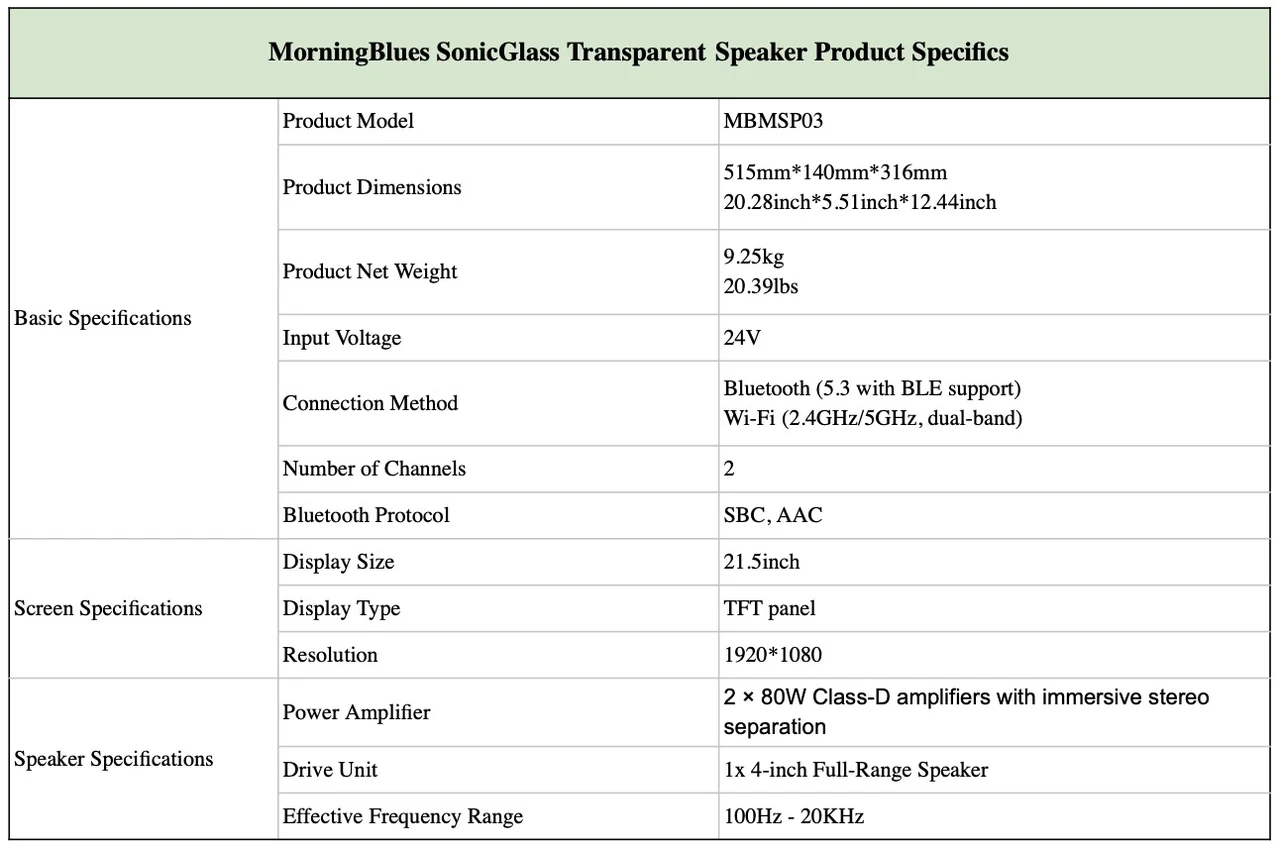
Look between and around them and you can see straight through the enclosure. That transparency is only possible because of the glass itself. MorningBlues specifies a high-transparency, oxidation-resistant tempered glass with a quoted 90 percent or higher light transmission, chosen so the panel stays clean, bright and free of the yellowing that can affect cheaper transparent materials over time. The same panel carries the visual layer, a 21.5-inch display running at 1920 by 1080, which is how lyrics, album art, video and ambient scenes appear to float within the glass rather than sitting on a screen bezel in front of you.
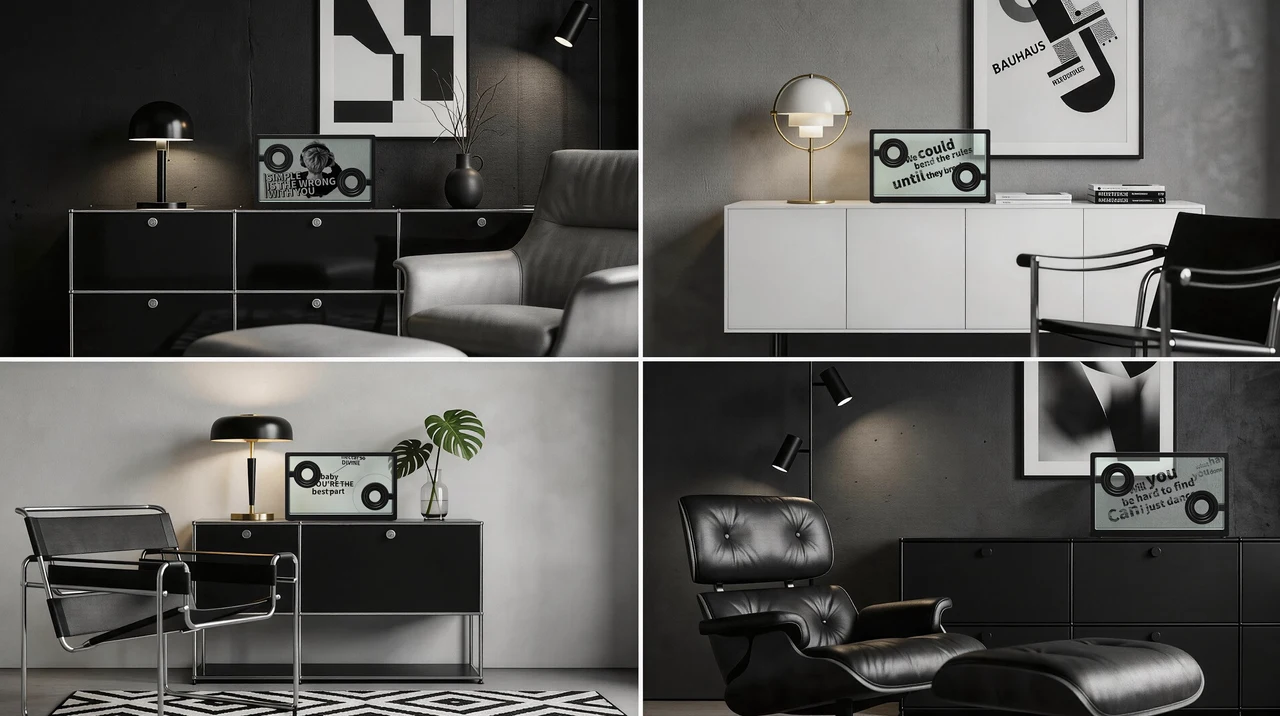
That visibility is also where the sound-quality story starts, because the diaphragm itself is glass rather than the usual paper or plastic. MorningBlues uses what it describes as a German Schott glass diaphragm, and the rationale is rigidity: the company puts glass at roughly 75,000 MPa against about 8,000 MPa for a typical paper cone, or close to nine times stiffer. A stiffer diaphragm flexes and “breaks up” less as it moves, which MorningBlues says means lower distortion, cleaner vocals and instruments and smoother high frequencies. Supporting it are a symmetrical suspension meant to keep the diaphragm moving evenly for faster, more controlled transients, a concave diaphragm geometry intended to smooth the frequency response and firm up the bass, and a high-flux neodymium motor for grip and dynamics. The pitch, in short, is that the transparency is acoustically purposeful rather than a gimmick, a driver engineered to sound better, not just to be seen.
Making that diaphragm is the hard part, and it doubles as MorningBlues’ answer to why transparent drivers are not already common. Forming glass just 0.2mm thick means hot-forming at temperatures approaching 800C, where the material wants to sag and distort, and any haze, residue or asymmetry that an ordinary speaker would hide behind a grille is left in plain sight. MorningBlues says it developed multi-stage thermal forming with graphite moulds, optical concentricity checks and low-yellowing UV adhesives to keep each driver both optically clear and acoustically accurate.
It is worth being precise about the claim. Design-led speakers have placed drivers behind glass or inside clear enclosures before, and transparent display panels are an established technology in retail and signage. What MorningBlues is claiming as a first is the specific combination: a working driver mounted on a transparent glass baffle, integrated with a transparent display, so the sound source and the visuals share the same see-through surface. The execution is strikingly unusual for a consumer speaker, and it is the reason the SonicGlass A1 looks like nothing else in the market.
The Sound Hardware Behind the Glass
A transparent speaker that sounded thin would defeat the point, so it is worth dwelling on the acoustics. The SonicGlass A1 uses dual full-range stereo drivers powered by two 80-watt Class-D amplifiers, for 160 watts of total amplification and proper left-right separation rather than the mono blur many lifestyle speakers settle for.
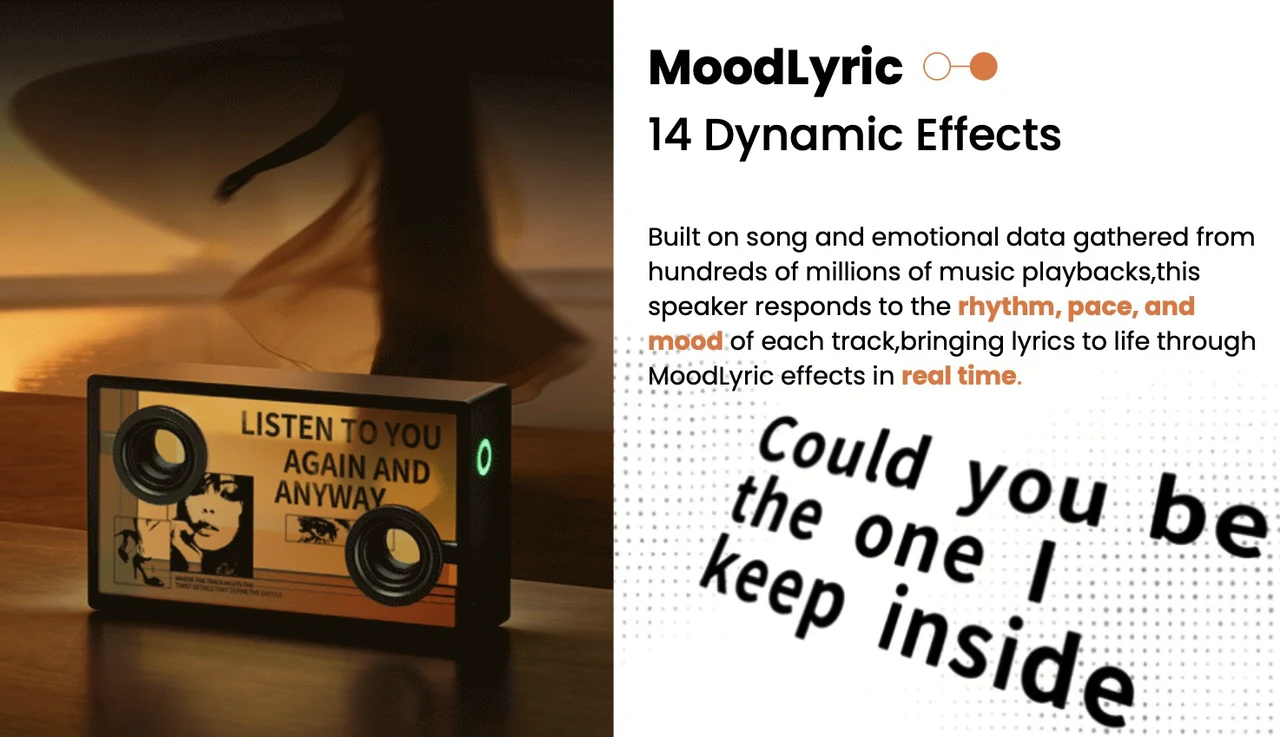
MorningBlues quotes an effective frequency range of 100Hz to 20kHz and pairs the drivers with a sealed acoustic cabinet, a design choice that trades a little bass extension for tighter, more controlled low-end and cleaner transients. There are three signature sound modes for tuning the output to different rooms and material, and the company describes the amplification as delivering immersive stereo separation. Connectivity is handled by Bluetooth 5.3 with BLE support and dual-band Wi-Fi on both 2.4GHz and 5GHz, with SBC and AAC codec support over Bluetooth.
The unit runs on a 24-volt supply, and it is a substantial piece of furniture: it measures roughly 515 mm x 140 mm x 316 mm and weighs about 9.25kg, so this is a centrepiece you place deliberately, not a portable speaker you toss in a bag. Dual drivers, genuine stereo amplification and a sealed enclosure are the kind of specifications you would expect from a design-conscious bookshelf system, which gives the floating visuals a credible foundation to sit on.
Floating Lyrics, MoodLyric and Respect for the People Who Wrote the Song
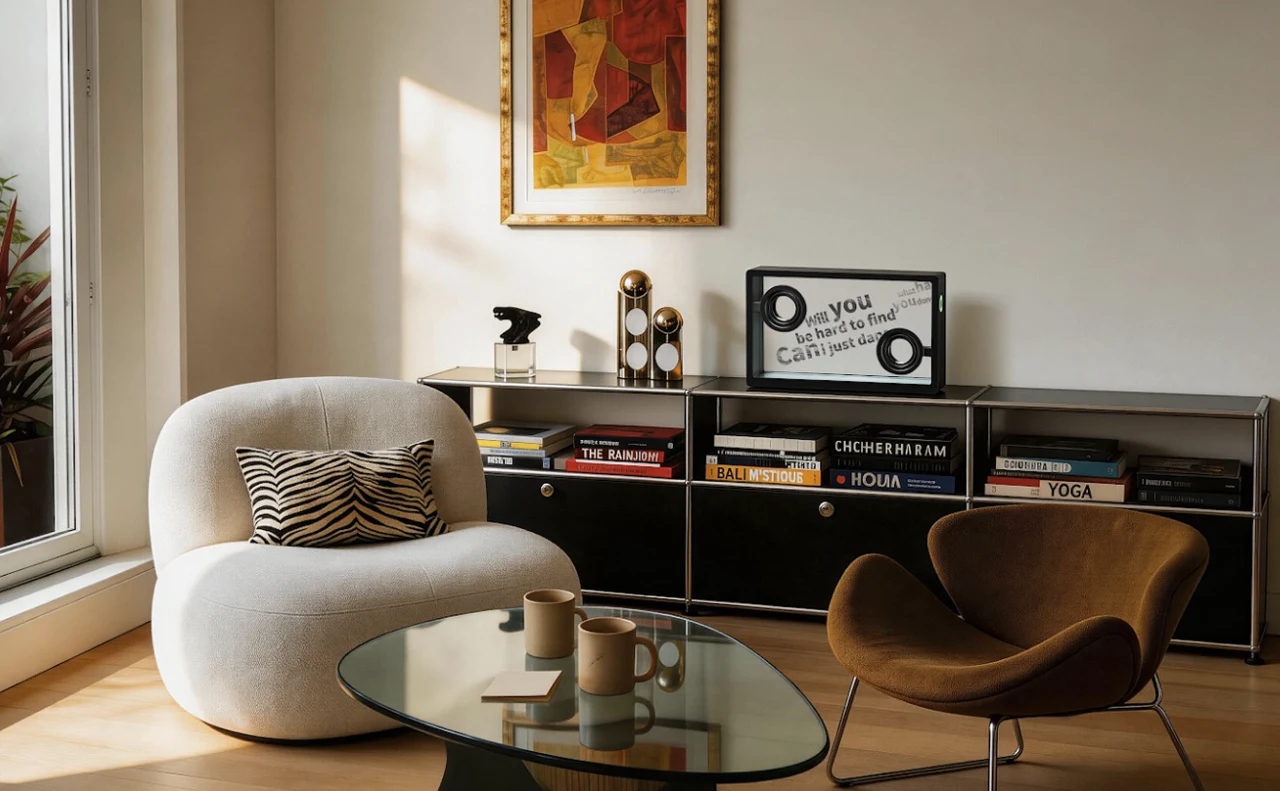
The feature that gives the SonicGlass A1 its character is its lyrics engine. Using a system MorningBlues calls MoodLyric, the speaker renders words on the transparent display so they appear to float inside the glass, synchronised to the track. The company says MoodLyric draws on song and emotional data gathered from hundreds of millions of playbacks to read the rhythm, pace and mood of each track, then animates the lyrics through 14 dynamic effects that shift with the music rather than scrolling past at a constant crawl.
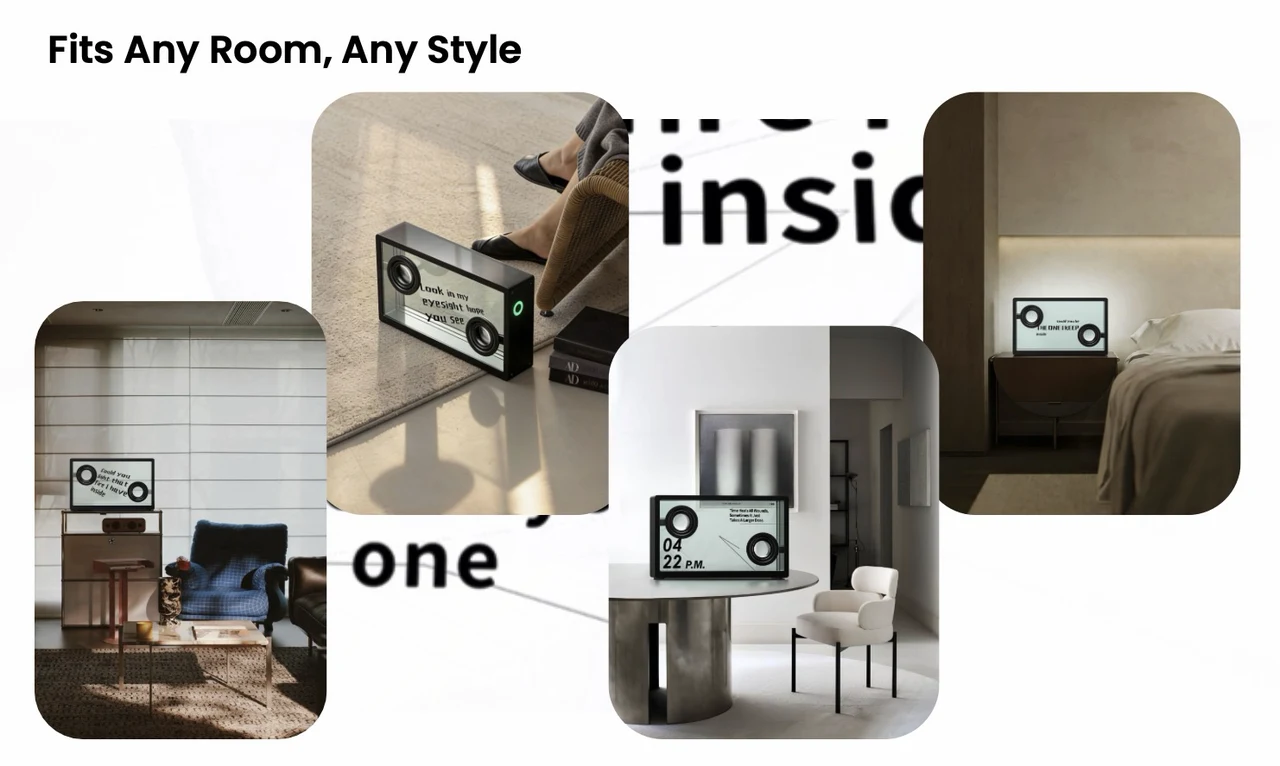
Crucially for anyone wary of the legal grey areas that have dogged lyrics on the internet, MorningBlues states that all lyrics shown are officially licensed through LyricFind. LyricFind is an established lyric-licensing company that secures rights from publishers and songwriters and passes royalties back to rights holders, and it supplies licensed lyrics to many of the largest music and search platforms. Building that licensing in from the start is both an ethical and a practical decision: it keeps the company on the right side of music publishers and signals to backers that the lyric display is a durable feature, not something likely to be switched off after a rights dispute.
The AI Layer: Genre-Matched and Personalised Music Videos
Where MoodLyric handles words, MorningBlues’ AI features handle imagery. The first, SceneSync, analyses a track in real time, recognises its genre and pairs it with an adaptive music-video style generated by AI, so a hip-hop track, a pop single and a rock anthem each get a visual treatment that suits them rather than a single generic animation for everything. The second is more personal, and more likely to be the feature people demo to friends.
MorningBlues’ newest AI feature, <strong>AI Music Radio</strong>, brings emotionally aware hosting to the SonicGlass A1. It senses time, environment and user scenario, then automatically generates natural, warm hosting lines before and after playback, including opening remarks, song background introductions, post-song comments and hourly time announcements. Users can switch recommendation styles on the fly through voice or text commands (for example, “Today is my birthday”), and the AI instantly adjusts its tone and musical atmosphere, creating an immersive listening experience akin to having a personal radio host.
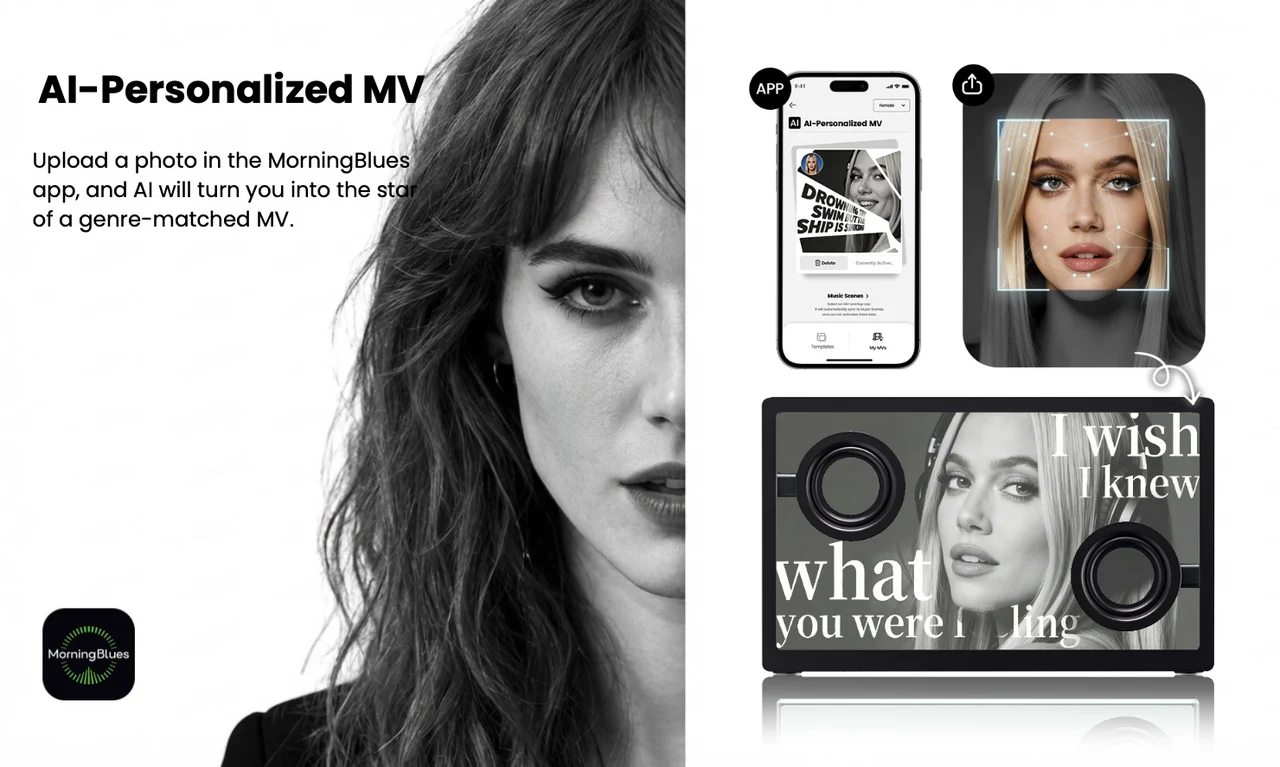
Through the MorningBlues app, you can upload a photo and have the AI place you, via face-swap, into the starring role of a genre-matched music video shown on the speaker. It is a clear bid for the share-this reflex that drives crowdfunding word of mouth, and it folds neatly into the karaoke use case: pair the SonicGlass A1 with a microphone and the floating lyrics, adaptive visuals and a stereo soundstage turn a living room into a small karaoke stage. The lyric licensing matters here too, since the words you are singing along to are the officially cleared versions.
A Speaker That Earns Its Place When the Music Stops
A 21.5-inch panel that only did something while music played would be hard to justify on a sideboard. MorningBlues has clearly thought about the other hours of the day when music might not be playing. The SonicGlass A1 includes a range of ambient display modes designed for different moods: pure music backgrounds, dynamic clock faces and an ASMR-style sleep mode with calming visuals and soundscapes.
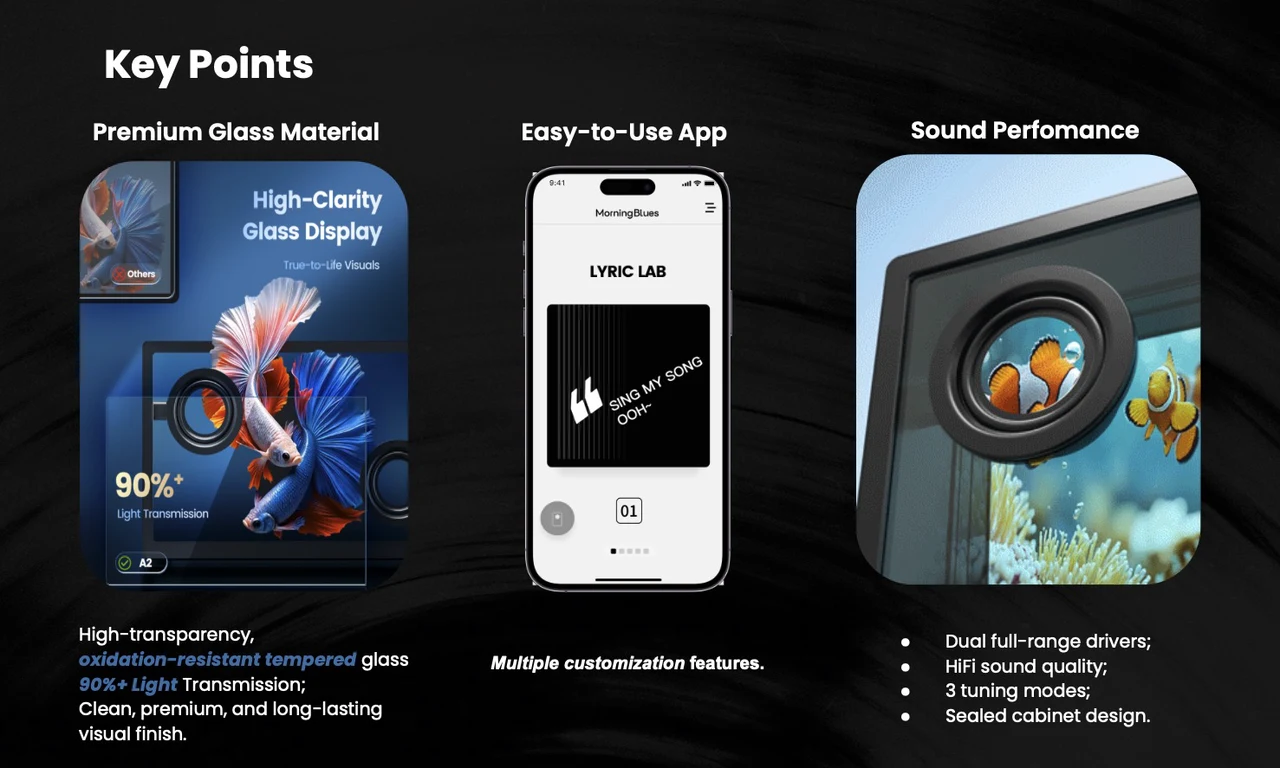
There is also a digital photo and video frame function, so you can upload your own images and clips and let the transparent panel cycle through a personal gallery, or, as MorningBlues cheerfully demonstrates in its own materials, fill the glass with a virtual aquarium. That flexibility is a deliberate design strategy.
By functioning as a premium speaker and a beautiful, configurable home object even when silent, the SonicGlass A1 is pitched at design-conscious buyers and interior enthusiasts as readily as at audiophiles. The product imagery leans into this, showing the speaker equally at home on a minimalist console, a bedside table or a sunlit living-room shelf. Software keeps it current: the platform supports over-the-air updates, so new effects, scenes and features can arrive after purchase rather than the hardware standing still the moment it ships.
Music Hub 1 and a Phone-Free Ecosystem
On Kickstarter the SonicGlass A1 is the headline act, but MorningBlues is using the campaign to sketch out a wider ecosystem, and backers can add accessories to the pledge to save money. The most interesting of these is the Music Hub 1, described as the first all-brand wireless speaker companion designed to free music from your phone.
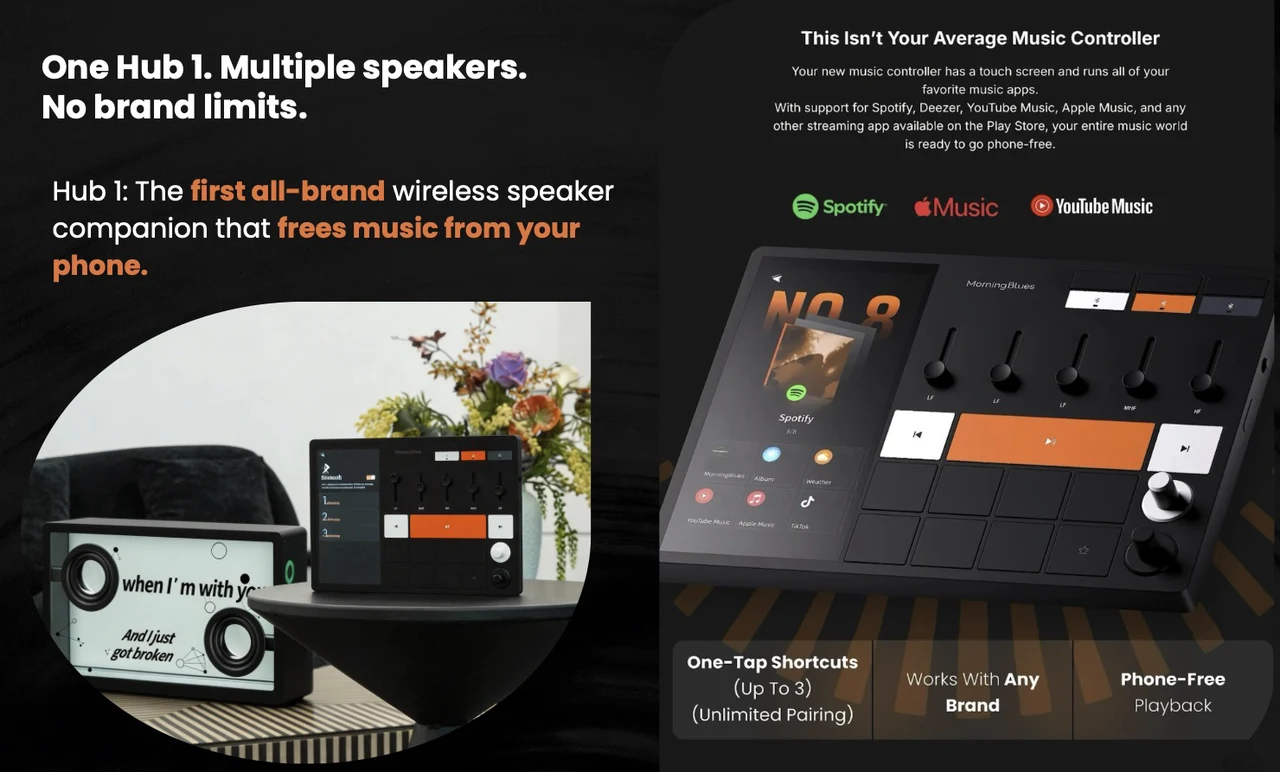
It is a touchscreen music controller that runs streaming apps directly, with support for services such as Spotify, Apple Music and YouTube Music, one-tap shortcuts and pairing across multiple speakers regardless of brand, the goal being phone-free playback you control from a dedicated desktop device rather than your handset.
The second accessory is a karaoke microphone tuned to pair with the SonicGlass A1 for that lyric-visual karaoke experience. Together with the company’s existing displays, headphones and furniture, the accessories signal MorningBlues’ ambition to build a connected family of visual-music products rather than a single hero gadget.
Pricing, Availability and How to Back It
- Launch date: Kickstarter campaign opens 18 June 2026.
- Super early-bird price: from $649, around 35% percent off expected retail price.
- Add-on accessories: Music Hub 1 speaker controller and a karaoke microphone, available to bundle for extra savings.
- Key hardware: 21.5-inch 1920 by 1080 transparent display, dual full-range drivers, 2 x 80W Class-D amplification, sealed cabinet, three sound modes, Bluetooth 5.3 and dual-band Wi-Fi.
- Software: MoodLyric floating lyrics with 14 dynamic effects, SceneSync AI videos, AI face-swap MVs, LyricFind-licensed lyrics, ambient and photo-frame modes, OTA updates.
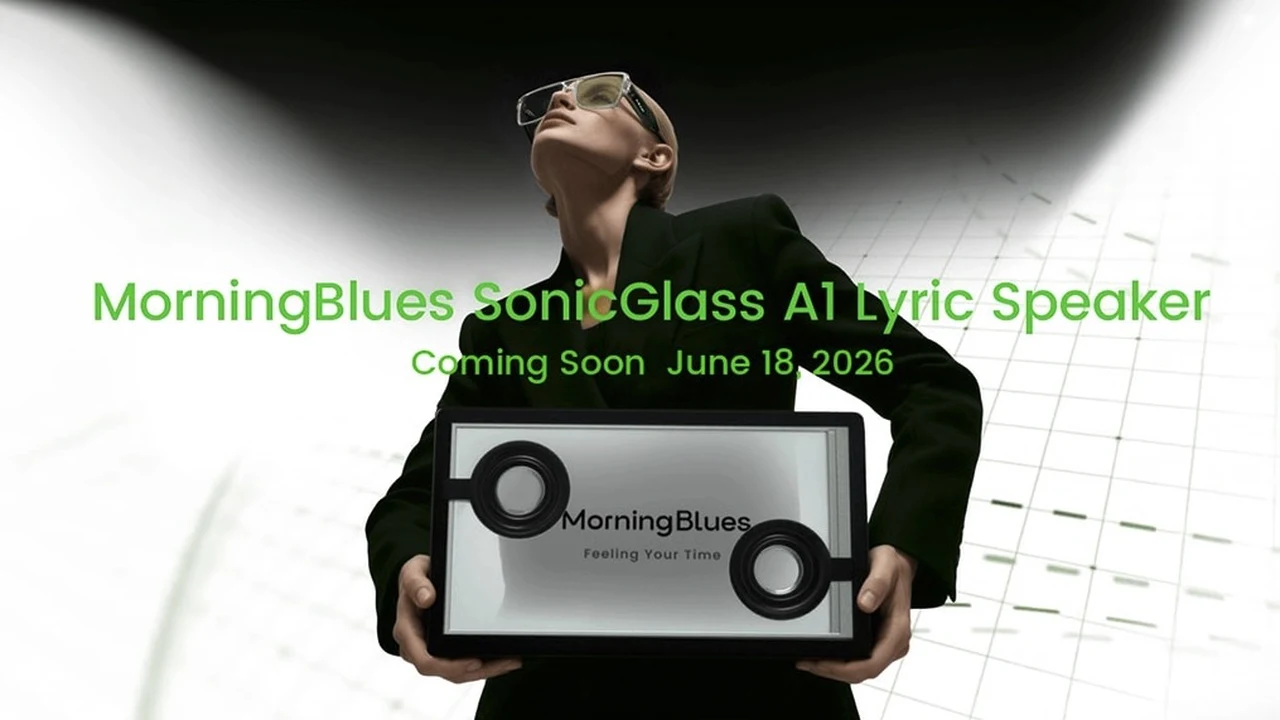
You can follow the MorningBlues Kickstarter campaign and be among the first to back the SonicGlass A1 at its launch-day VIP pricing here: MorningBlues SonicGlass A1 on Kickstarter. More on the brand and its wider range is available at the MorningBlues official store.
Source: Kickstarter
Filed Under: Gadgets News
Disclosure: Some of our articles include affiliate links. If you buy something through one of these links, Geeky Gadgets may earn an affiliate commission. Learn about our Disclosure Policy.


