
Target has become the latest major company to downgrade its emission goals. The retailer, which operates almost 2,000 stores across the United States, said this week it is now targeting net zero by 2050, up to a decade later than previously planned. It also pushed back its goal of a 32.5 percent cut in Scope 3 emissions by five years to 2035.
The Scope 3 goal is central to Target’s efforts because these indirect emissions, which stem from purchases of goods, transportation and use of its products, make up 98.5 percent of the company’s footprint.
Target said little in its annual sustainability report about the reasons for the change, but did note that further supply-chain decarbonization will require a “broader transformation in energy systems, technology and infrastructure.” PepsiCo cited similar reasons for a May 2025 decision to push its net zero target back from 2040 to 2050. Coca-Cola, McDonald’s and Starbucks have also downgraded Scope 3 targets or are facing challenges in hitting them.
Change of pace
The deadline change comes after Target made significant progress on Scope 3 in 2022 and 2023, cutting emissions at a pace that left the company comfortably on track to hit its original 2030 goal. But progress slowed in 2024 and 2025, putting the company on a new trajectory that may not have been aligned with a 2030 deadline. Target did not immediately respond to a request for comment on this or other aspects of its report.
Percentage change in Target’s Scope 3 emissions relative to a 2017 baseline
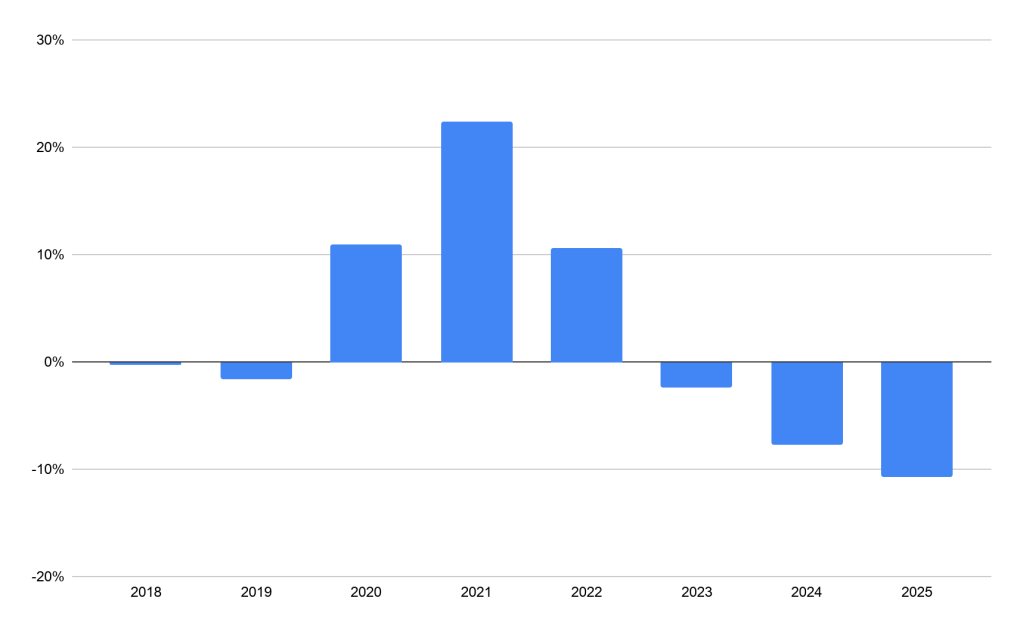
The retailer had better news to share on Scope 2: It achieved 100 percent renewable use in 2025, five years ahead of schedule. The jump in renewables coverage — the figure for 2024 was 76 percent — was made possible by a near-doubling in purchases of renewable energy certificates.
Packaging pledges
Target also reported mixed results with its waste reduction goals:
- Eight-eight of the company’s waste was diverted from landfill in 2025, close to its target of a 90 percent diversion rate by 2030.
- A goal to cut total virgin plastic in owned brand packaging by a fifth between 2020 and 2025 was missed: Virgin plastic use was up 3 percent on baseline. Supply chain constraints and increased sales were among the reasons cited by Target for the rise.
- Last year was also the deadline for a pledge to have 100 percent of owned brand plastic packaging be recyclable, compostable or reusable; the retailer achieved 41 percent.
As with emissions, Target is far from alone in failing to hit its goals in this space: Walmart also missed all of its 2025 packaging pledges.


