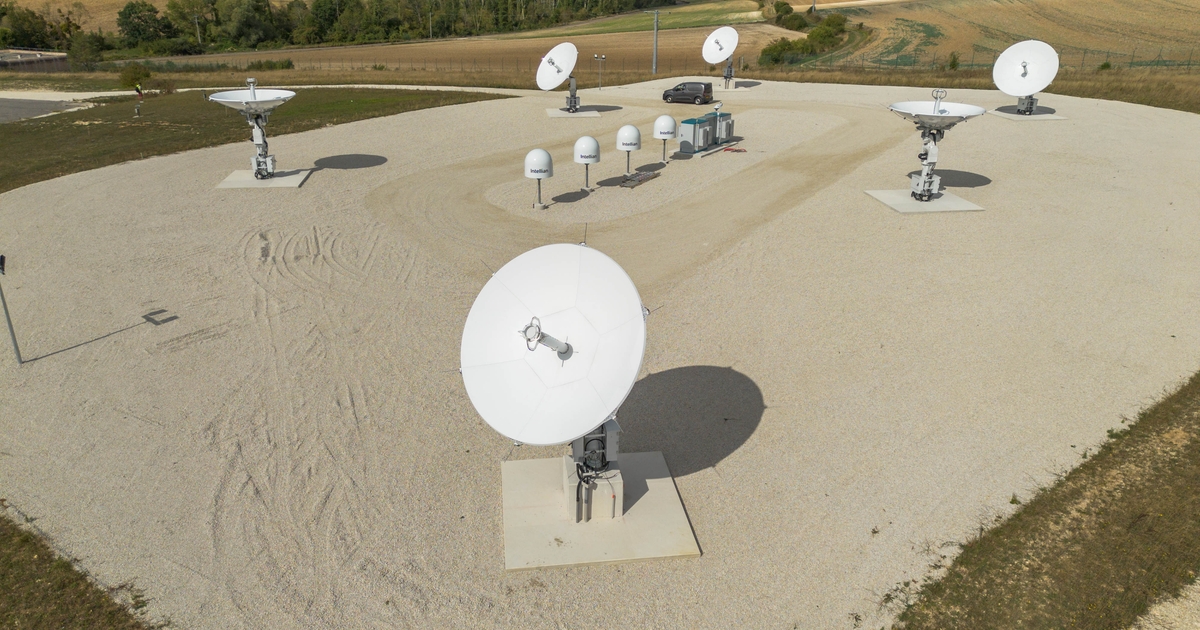
Nearly 50 years ago, Orange built a site for satellite antennas in the middle of rural France about 100 miles from Paris. This week, the telco unveiled a new addition to the facility with the commissioning of the first European gateway for Telesat’s Lightspeed low-Earth orbit (LEO) satellites.
For Jean-Louis Le Roux, EVP for Orange International Networks, the inauguration of Telesat’s gateway at the carrier’s teleport in Bercenay-en-Othe is “a revival of the location with new space technology.”
“It’s a very historical site for Orange … We have 46 antennas ranging from one meter to 32 meters. We call the antennas our ears, even if we are not listening to anything … The landscape is quite beautiful. It’s in the middle of nowhere in the country and you can see all the ‘ears,'” he told Light Reading.
The location is also good from a technical perspective, because it can access “all the orbits” and the “electromagnetic noise is very low,” he explained.
To make way for the Telesat gateway with ten antennas (1 to 4 meters in height), Orange dismantled an old geostationary-Earth orbit (GEO) antenna that was 32 meters tall and no longer used.
“It’s an important evolution … Bercenay-en-Othe is becoming multi-technology. We want to make this location an international space hub in Europe that will be able to manage the legacy technology, but also the new technology,” said Le Roux.
Orange will also provide terrestrial connectivity from Telesat’s gateway to its planned point of presence in Paris to support “mission-critical applications.”
Le Roux’s international network unit at Orange has approximately 2,000 people managing connectivity across submarine cables, terrestrial fiber and satellites for the carrier’s wholesale and enterprise businesses. Within his team, a “satellite factory” of 100 people are dedicated to satellite communications, 25 of which are maintaining all the antennas at Bercenay-en-Othe.
The new gateway will be used by Orange to serve its own wholesale and business customers, but it will also be used by Telesat customers.
Orange acts as a “bridge” between the ground and space. It has satellite partners across LEO, GEO and medium-Earth orbit (MEO), including Eutelsat OneWeb, Globecast, SES, Starlink and Telesat, and it is open to more. In the mobile satellite direct-to-device space, the carrier also works with Skylo and AST SpaceMobile.
“We consider satellite a full complement to our terrestrial and submarine networks. Today, satellite is only 2% of total communication. It’s not a lot but that 2% is very important. This allows to cover remote areas with low coverage. It allows also to cover emergency situations when our terrestrial networks are no longer working,” he said.
For Canadian satellite operator Telesat, the European gateway is a step toward offering services in the region when its Lightspeed LEO constellation is up and running. It is one of 24 landing stations that the operator plans to have worldwide.
The initial constellation is planned for 225 satellites, and global commercial services are expected in early 2028. Telesat’s existing GEO constellation comprises about 11 satellites.
One of the features that Orange likes about the new LEO system is that the satellites will be interconnected by optical links. This is “good for sovereignty,” said Le Roux. “They have an implementation for inter-satellite communication with lasers, so you can select where you want to land.”
A customer’s traffic and data can stay in space until it is delivered securely to a Telesat groundstation or a customer’s private facility.
Luke Pearce, principal analyst at FDM CCS Insight, said Telesat’s laser technology on its own is not what differentiates Telesat, but it’s “how it is being incorporated into an enterprise and government-focused network.”
“This gives customers greater control over where their data is routed and where it ultimately comes back to Earth, potentially avoiding untrusted or foreign terrestrial networks. That is valuable for data sovereignty, security and defense applications,” he said.
Telesat’s Lightspeed stands out from other LEO providers targeting B2B services, such as SpaceX, Amazon Leo and Blue Origin’s TeraWave, with its support for Military Ka-band connectivity and commercial spectrum bands. This, along with a Canadian defense contract, helps to “shape a proposition centered on secure and sovereign connectivity,” said Pearce.
In Europe, it also helps to be Canadian. Telesat can position itself as “a trusted, non-US alternative at a time when European governments and defense customers are seeking greater diversity and control over critical satellite infrastructure,” he said.


