If imitation is the sincerest form of flattery, Teradyne Robotics has had enough compliments for one year.
Teradyne Robotics, the parent company of cobot arm maker Universal Robots, has filed a patent infringement lawsuit against a German subsidiary of Chinese robotics company JAKA. The case alleges that JAKA infringed patents covering both hardware and software used in Universal Robots’ collaborative robots.
The lawsuit is Teradyne Robotics’ second major case involving a Chinese robotics company in Europe this year. In February 2026, the company sued Elite Robots’ German subsidiary over alleged copyright infringement.
In April, the Regional Court of Hamburg issued a preliminary injunction prohibiting Elite Robots Germany from offering the disputed software and products containing it in Germany. The case is still ongoing.
The JAKA case is different. “This is a patent case where the other one was about copyright,” David Brandt, vice president of research and development and chief technology officer at Universal Robots, told The Robot Report. “It’s multiple patents this time, and they cover both significant hardware and software aspects of our products.”
Teradyne spots cobot similarities
According to Brandt, Teradyne Robotics became interested in JAKA‘s products after noticing similarities between the two companies’ force- and power-limited robot arms.
“Our robots and the robots of JAKA look quite alike,” Brandt said. “We then chose to acquire one of the robots and take a deeper look at it. Then it became quite obvious that there’s possible patent infringement in this.”
Teradyne Robotics said the lawsuit involves a range of JAKA collaborative robots marketed in the European Union. The company filed the case with the Unified Patent Court (UPC) Local Division in Copenhagen because alleged acts of infringement occurred in Denmark and other EU member states.
EU ruling has broad implications
A ruling from the UPC could have broad geographic implications. According to Teradyne Robotics, a ruling could take effect across 17 of the 18 EU member states participating in the UPC, as well as in certain countries outside the UPC Agreement, including the U.K. and Spain.
The Robot Report reached out to JAKA for comment, but did not hear back at press time.
“This case is another clear demonstration that Teradyne Robotics will enforce its patents and intellectual property (IP) rights against what we consider to be illegal and unfair copying and infringement, across both hardware and software,” stated Teradyne Robotics Group President Jean-Pierre Hathout.
“We cannot and will not accept companies that unlawfully copy protected technologies, and we are resolute in safeguarding our IP so customers can continue to have innovative automation solutions that meet the highest standards for safety and compliance,” he added.
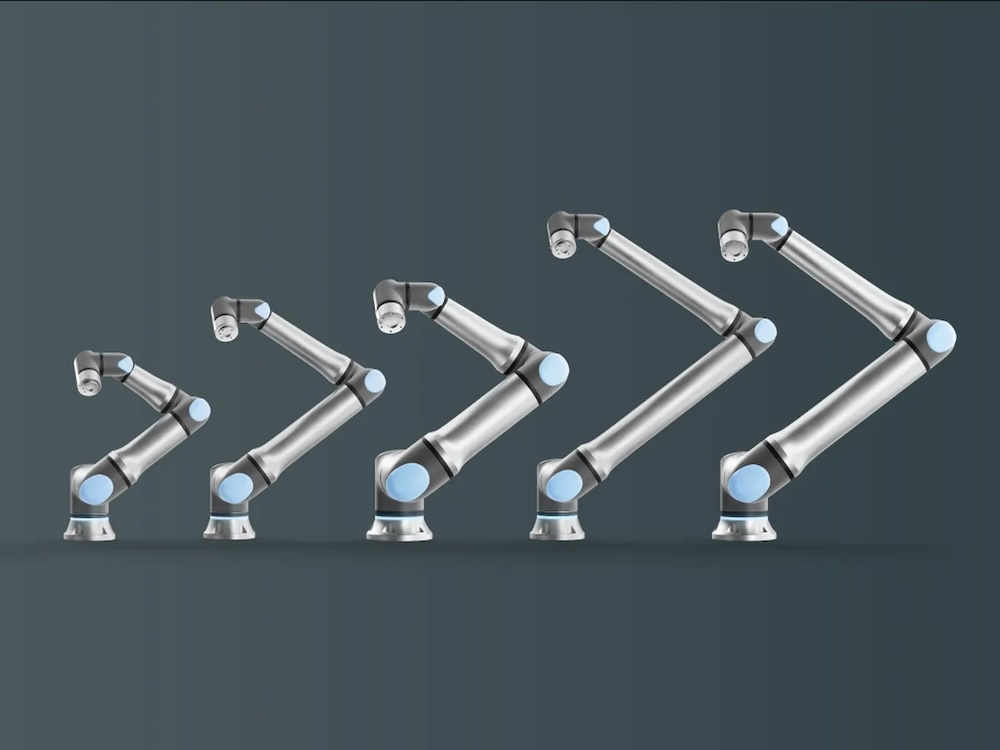
UR Series cobots from Universal Robots.
Comparing cobot portfolios
The dispute puts two collaborative robot portfolios under the microscope. Universal Robots currently divides its robot arms primarily between its UR Series and e-Series. The UR Series includes the UR8 Long, UR15, UR18, UR20 and UR30. Payloads range from 10 kg on the UR8 Long to 35 kg on the UR30, while reach extends to 1,750 mm on the UR8 Long and UR20.
The e-Series is aimed at more compact and general-purpose automation. It currently consists of the UR3e, UR7e, UR12e and UR16e. Payloads range from 3 kg to 16 kg, with reaches from 500 mm to 1,300 mm.
JAKA’s portfolio is similarly extensive. Its current lineup includes the Zu, Pro, S, AL, A and Mini series, along with the MiniCobo. The Zu family includes the Zu3, Zu5, Zu7, Zu12, Zu18, Zu20 and Zu30. The Pro family includes the Pro5, Pro12 and Pro16.
The Zu series is JAKA’s broad general-purpose cobot family. For example, the Zu5 offers a 5-kg payload and 954-mm reach, while the Zu12 carries 12 kg to a 1,327-mm working radius and the Zu18 carries 18 kg to 1,073 mm.
The Pro series is designed for more demanding environments and carries an IP68 rating. It includes the Pro5, Pro12 and Pro16, with payloads of 5, 12 and 16 kg, respectively. The Pro16 offers a 1,713-mm reach and is positioned for applications including palletizing, machine tending, polishing, grinding, and welding.
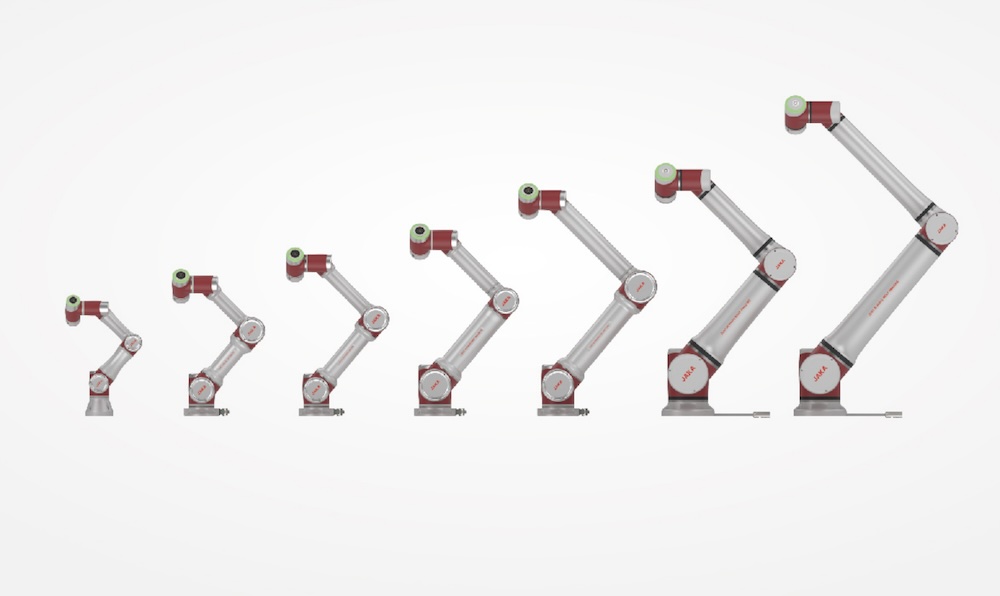
JAKA’s cobot lineup.
Lawsuit is not about China, says Teradyne
Brandt emphasized that Teradyne’s decision was not driven by JAKA’s Chinese ownership. “To us, it’s not about China,” he said. “It’s about other companies copying stuff that we designed, whether they’re Chinese or not.”
Teradyne Robotics has long maintained a large intellectual property portfolio covering its robot technology. Brandt said the company uses patents, copyrights and trade-secret protections, but acknowledged the fundamental difficulty of protecting robots once they are commercially available.
“You have to build the robot and ship it to a customer to have a robot,” he said. “And, of course, some competitor can buy the robot, take it apart, and look at how we design stuff.”
“We welcome competition and we think competition is healthy,” added Brandt. “But we have a competition where we make big investments in creating what we believe is a great product, having good quality, having a very safe product, a lot of investment going into that. It’s quite expensive to develop such a product, and then having another company simply steal your innovations and copying it. That’s where we’re trying to put our foot down.”
Editor’s note: James Davidson, chief AI officer at Teradyne Robotics, will speak at RoboBusiness 2026. The event takes place Oct. 20 and 21 in Santa Clara, Calif., and attract 1,500+ attends from the robotics development community. Register now to attend.
 Register now and save on your pass to RoboBusiness 2026
Universal Robots wants JAKA to stop
Brandt said Teradyne’s primary objective isn’t financial compensation. “Ideally, we would like them to stop copying and infringing our IP,” he said. “This is not predominantly for getting money out of JAKA. This is more to send a very clear signal that they need to stop copying our products.”
Brandt also sees a potential safety issue. Universal Robots helped establish the market for collaborative robots designed to operate in proximity to people, subject to appropriate risk assessment and safety measures. Brandt said the proliferation of copycat products that don’t meet the same standards could create risks beyond the companies involved in this dispute.
“If they are not as safe as they should be, and in the worst-case scenario lead to somebody getting seriously hurt by these products, there’s of course a risk that this could reflect badly on the entire industry,” he said.
That could lead regulators and workplace-safety authorities to view collaborative robots more broadly as a safety problem, Brandt said.
“So we are concerned,” he said. “Mostly, of course, we’re concerned about people getting hurt. But there’s also, of course, a business side to that problem.”
Competition in the cobot market
Teradyne Robotics’ two lawsuits underscore the competitive nature of the collaborative robot market. Universal Robots has sold more than 100,000 cobots and has spent more than a decade building an ecosystem around its robot arms, software, and accessories.
Teradyne Robotics generated $100 million in revenue in Q2 2026. The $100 million in quarterly revenue is an increase from the $91 million that its made in Q1 2026.
The North Reading, Mass.-based company marked its fifth consecutive quarter of growth. It also reported 33% year-over-year revenue growth from Q2 2025, when it made $75 million. Most of the $100 million came from Universal Robots, while the rest was generated by its AMR subsidiary Mobile Industrial Robots (MiR).
At the same time, the market has attracted an expanding number of competitors, including companies from China offering cobots at aggressive price points. Brandt said that trend is not necessarily bad for Universal Robots.
“The global market is growing,” he said. “There are just more companies trying to do the same thing, so in that respect, of course, the competition is heating up.”
The problem, in Teradyne Robotics’ view, is where competition crosses into alleged copying of protected technology.
And Brandt suggested that JAKA may not be the last company that Teradyne Robotics challenges. “We do not see this as a one-time thing,” he said. “We are dedicated to aggressively protecting our IP, and JAKA is not the only robot out there that looks suspiciously like ours.”
The post Teradyne Robotics ramps up fight against cobot copycats appeared first on The Robot Report.


