


Top pick
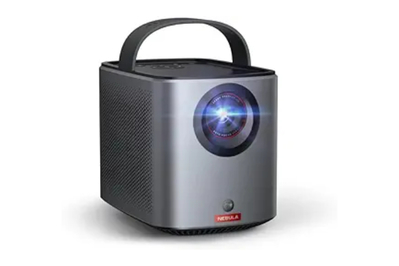
This 1080p LED projector offers good image brightness and contrast, above-average sound, easy setup, and a built-in battery. But mounting it on a tripod can be tricky.
Key specs
| Projection tech: | DLP | Smart-TV platform: | Google TV |
| Light source: | LED | Built-in battery: | Yes; 2 hours 38 minutes at 50% brightness, 1 hour 30 minutes at 100% brightness |
| Connections: | HDMI, USB-A, auxiliary audio out, DC power | Size and weight: | 7.01 by 4.8 by 5.24 inches; 3.75 pounds |
| Throw ratio: | 1.2:1 | Auto image shaping/sizing: | Yes |
| Bluetooth: | v5.1 | Wi-Fi: | 802.11ac |
The Nebula Mars 3 Air is our favorite portable mini projector because it has all of the essential features we like to see in this category, and it delivers good picture and sound quality for a competitive price.
This projector measured well on our test bench. In the Movie picture mode, the Mars 3 Air served up a nice-looking image with good detail, rich color, and better contrast in comparison with what we saw on most competitors.
The overall color balance is fairly neutral — not as accurate as what you can get from a good home-theater projector, but the image doesn’t skew too blue, red, or green. The colors themselves are vibrant but a bit off the mark from the HDTV standard, which is true of most portable mini projectors we test. Some advanced picture adjustments are available in the Custom picture mode, but they don’t do much to improve upon what you get from the preset Movie mode.
The Mars 3 Air isn’t the brightest portable projector we’ve measured overall, but it strikes a better balance between brightness and black level than many competitors, so you can enjoy brighter HDTV shows and sports in a room with some ambient light and then enjoy a well-saturated movie in a dark room. It also does a better job than many portables of preserving the fine details in dark movie scenes.
Whereas some portable projectors give you only a couple of brightness options to choose from, the Mars 3 Air has preset standard and eco modes plus a 100-step slider for you to fine-tune the brightness to your viewing situation. This projector also supports HDR video in the HDR10 format. Even at maximum brightness, it isn’t bright enough to show off what HDR can offer, but at least it handles HDR video correctly; many competitors (including our runner-up) produce HDR video that’s much darker than it should be, crushing fine details in the process.
The Mars 3 Air has a 1080p resolution, which allows for a sharp, well-detailed image at modest screen sizes. At a distance of about 5 feet, we could see the detail improvement that this projector offered over 720p projectors, especially in text clarity. The pixel structure (that is, the grid of tiny little squares or the screen-door effect) was still somewhat visible in patches of white or solid color, but we really noticed it only when we were actively trying to see it.
It has a built-in battery. We tested the battery life by running the internal YouTube TV app at low volume. We got 2.5 hours at 50% brightness and 1.5 hours at 100% brightness. Those are excellent results.
It automatically focuses and shapes the image. The projector’s Intelligent Environment Adaptation technology uses a combination of automatic focus, keystone correction, obstacle avoidance, and screen fitting to quickly shape a level, rectangular image on whatever wall surface you’re using.
We don’t love the use of keystone correction in higher-end projectors because it reduces image detail and adds artifacts, but it makes sense here, where you’re probably using the portable projector in a variety of less-than-formal settings. You can also turn them off, if you’d prefer to handle the task manually.
The Mars 3 Air comes with a Bluetooth-based, backlit remote that has the core buttons you need and supports voice search through Google Assistant.
Thanks to the unit’s Chromecast support, you can wirelessly transmit audio and video from your mobile device. If you want to connect a Blu-ray player, gaming console, or standalone media streaming device, the projector also has one HDMI input, plus a powered USB-A port.
The built-in speakers perform well. The audio system uses dual 8-watt speakers to produce better dynamics and a more balanced sound than what you hear from a lot of competitors — which is important for movie and TV playback, but also makes this projector more useful as a Bluetooth speaker.
In our tests, dialogue had a less beaming, “cupped hands” quality, and we heard actual bass notes in demo tracks like Ani DiFranco’s “Little Plastic Castle” and Tom Waits’ “Long Way Home.”
That said, it can’t produce as much bass as even a modestly priced portable Bluetooth speaker like the UE Wonderboom that I connected it to.
The design feels sturdy. The Mars 3 Air’s boxy shape may not be as stylish as that of many competitors, but it also has no obvious break points (as there are with our runner-up) and feels better suited to throw in a travel bag or set up outside.
Flaws but not dealbreakers
It doesn’t work with all tripods and mounts. The combination of a shallower tripod socket and the ridged design of the Mars 3 Air’s underside limits which tripods and mounts work with this projector. We couldn’t secure it firmly onto our Vanguard Alta Pro2+ tripod, which has a larger, rectangular baseplate, but it worked fine with a little desktop tripod that had only a threaded screw.
If you plan to use a tripod or mount, choose carefully. Look for one with either no baseplate or a smaller, round baseplate.


It lacks USB-C. This projector uses a standard DC power port that requires an external power brick. But at least the cable is long, and the ability to run the projector off the built-in battery at full brightness makes this inconvenience a little less bothersome.
It isn’t made for big-screen movie watching or serious gaming. None of the small, portable projectors in this guide have the brightness, color accuracy, or deep black levels necessary to produce a satisfying big-screen (80 inches or more) movie image. For that, look at our guide to budget home theater projectors.
We measured over 45 milliseconds of input lag in this projector’s game mode, which, combined with the 60 Hz refresh rate, means that it isn’t responsive enough for serious gaming. But it’s fine for, say, connecting a Nintendo Switch for casual gameplay.


