
Top pick
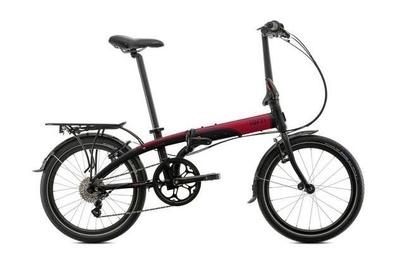
This smooth-riding bike has the most intuitive folding mechanism we tried, and is easily adjustible. However, it’s larger when folded than some other picks, and heavier too.
If you were riding the Tern Link D8 with your eyes closed (I do not recommend this, for the record), you might mistakenly assume it’s a conventional hybrid bike. The difference, of course, is that when you arrive at your destination, you can fold it up and take it inside.
It’s responsive and easy to maneuver. During both our panel test around the Prospect Park loop and my rides on the streets of New York, the Link D8 felt nimble without being twitchy. The handlebars — equipped, like most of our picks, with ergonomic grips — were a great width for most testers, providing enough control to make tight turns. The Schwalbe Big Apple tires grip the pavement well, keeping you planted even if you need to swerve to avoid a pothole. And their 2-inch width — as wide as the tires you’d find on some cross-country mountain bikes, but smooth for efficiency on paved roads — allows you to run the tires at a low air pressure, absorbing bumps and potholes. The bike’s V-brakes (like those on our runner-up and budget picks) offered enough stopping power, even from a high speed on a downhill.
The gearing is sensible for a typical city commute. The 8-speed bike is equipped with a wide enough range of gears to handle the gradients of the roads we tested it on. If, say, you live somewhere with a ton of long, steep streets, you (or a shop) can swap out the cassette for one with easier gearing. (You can’t do this with an internally geared hub, such as the one on our rough-roads pick.)
Adjusting the height of the seat is easy. Adjusting the height (and angle) of the handlebars is weird (but good). The Link D8 uses Tern’s patented Andros pivoting system, which allows you to change the angle and height of its bars by lifting two quick-release levers and maneuvering the bars into place in one fell swoop. Some testers had trouble getting this right initially, but with time, this system let them dial in their handlebar position to their exact needs.
The bike is very easy to fold. And once it’s folded, it stays firmly folded, unlike our runner-up pick. The process of collapsing the Link D8 is the most intuitive of all the bikes I tested. You can either leave the handlebars up, letting you push the bike like a wheelbarrow, or fold them down and strap them to the frame. Either way, the bike will stand securely on its seat post without falling over.
It comes with front and rear fenders. They offer just enough coverage without any unnecessary bulk.
The rear rack is sizable and equipped with a bungee cord. Despite being a small bike, the Link D8 features a decently large rear rack, which should work with some of the smaller bike panniers we recommend. (I used the two-pronged bungee cord to bring a baguette home to my partner.)
You can buy the bike on Tern’s website, but you’ll pick it up (usually) already assembled at a shop. When you purchase a Tern bike, the delivery (or pickup) process for your new bike is handled by your closest Tern dealer. We like this system, since it by default connects you to real people with expertise on how the bike works. If anything goes wrong, you’ll know exactly who to call.
If there’s no Tern dealer near you, a representative from the company told us it can ship your bike to a local bike shop of your choosing, which will assemble the bike. If there’s no bike shop at all near you, Tern’s mechanics will assemble, tune, and test-ride your bike at the company’s Illinois warehouse before packing it in a “ready to ride” condition and shipping directly to you. The rep says this process usually only takes two business days, though there is no guarantee.
If you register the bike within 30 days of purchase, Tern offers a 10-year warranty on its frame, fork, handlepost, and stem. (If you don’t, the warranty drops to five years.) You also get a one-year warranty on all other Tern- or BioLogic-branded parts and components. Beyond that, components are covered by their original manufacturer. (The Shimano derailleur, for instance, has two-year coverage for manufacturing defects.)
Flaws but not dealbreakers
Our runner-up and budget picks fold down smaller. I measured the Link D8 to be 30 by 28 by 15 inches when folded; our runner-up and budget picks would each take up less space in your apartment, garage, or RV. Some testers also found it annoying that the handlebars have to be secured with a strap, when the bike is folded completely. And while the product listing on Tern’s website says the pedals that come with the Link D8 fold down to take up a narrower footprint, the pedals on our bike did not.
The bike is heavy. I weighed the bike at 30.9 pounds — almost as heavy as one of the electric folding bikes I tested. (The stated weight is 26.7 pounds.) I didn’t notice a compromise in ride quality, but the bike was harder to carry.


Some testers felt the brake levers were too far from the handlebars and the position of the shifting lever was awkward. Though everyone said they were still able to actually use the bike just fine, the ergonomics on other bikes might be more to your liking.
The saddle is not very comfortable. The bike ships with a saddle that is quite wide and squishy, which may not be ideal for many riders.
Key specs
Weight (measured): 30.9 pounds
Dimensions when folded (measured): 30 by 28 by 15 inches
Weight the bike can carry (stated): 231.5 pounds
Range of heights bike can accommodate (stated): 4-foot-8 to 6-foot-3


