


Top pick
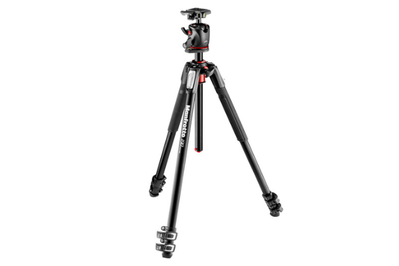
This stable, easy-to-use, and versatile tripod combines sturdy construction and ample working height with a compact storage size. Its center column can sit horizontally, as well.
The Manfrotto MK190XPRO3-BHQ2 is a solidly built, versatile tripod that balances an ample working height of 63 inches with a collapsed-for-storage size of just 23.2 inches.
An ingenious mechanism in the yoke of the tripod allows you to extend the center column upward from its maximum usable height by pressing a button on its bottom and then lets you reposition it horizontally. Combined with the tripod’s widest leg angle of 88 degrees, this horizontal arrangement can bring your camera down to just 3.5 inches off the ground.
Its weight of 5.7 pounds (with the ball head) is on the heavier side, but that can help add stability, especially in windy conditions.
It can hold heavy camera rigs. The MK190XPRO3-BHQ2 is rated to support up to 15.4 pounds. In our testing, it was especially stable, even when we mounted pro-grade cameras and heavy super-telephoto zoom lenses.
Each leg has three extendable segments, and though you’re likely to notice a hint of wobbliness when they’re fully extended for maximum height, that’s true of any tripod in this price range, and it didn’t negatively affect the photos we made.
It’s easy to set up. Tripods come with two primary types of locking mechanisms: twist locks and flip locks. Though we’ve often recommended twist locks in the past, we’ve never had a firm preference.
The flip locks on the MK190XPRO3-BHQ2 aren’t difficult to open or close, and they lock down tightly. They’re not quite as dreamy-smooth to operate as those on Peak Design’s $1,000 tripod, but they’re among the best we’ve seen on any tripod in this price range.
Similarly, the knob for the center column takes only one quick twist to unlock or to lock back down. We were able to raise the MK190XPRO3-BHQ2 to its maximum height in less than a minute.
It can get especially low to the ground. With four leg angles available (25, 46, 66, and 88 degrees), you have a lot of options for how to position your camera before you even get the center column involved.
That also gives you more ability to adapt to uneven surfaces, such as if you need to set up on a hillside or on rocky terrain. And a bubble level on the platform where the ball head attaches helps you ensure that the tripod is level even if the legs are extended to different angles.
The center column works both vertically and horizontally. If you press the button on the bottom of the center column, you can push it past its maximum height. When you do so, the red metal mechanism that holds it in place rises up to let you lay the column down horizontally and slide it into place.
This way, you can position your camera pointing downward or move it to the side to get closer to a subject. We’ve found this flexibility helpful when making photos of flowers in public gardens, where you’re not supposed to set up tripods except on paved pathways.
When you’re using the column in its horizontal position, always remember that you’re placing the bulk of your rig away from the center of gravity, which makes it easier for your expensive gear to tip over.
Thankfully, you can also rotate the column in relation to the legs to better balance things. Adding some weight, either by placing a sandbag against one or more of the legs or by hanging something from the loop on the side of the tripod yoke, can also prevent disaster.
The included ball head is great. The MHXPRO-BHQ2 is better than a lot of other bundled tripod heads. The ball always has some tension, even when the adjustable tension knob is loosened all the way, but if you mount a heavy rig, you’ll appreciate the ability to tighten the tension so that your rig doesn’t flop uncontrollably when you’re finding the right position. In our testing the ball moved smoothly and locked down tightly without too much effort on our part.
It has both vertical and horizontal bubble levels (to supplement the one on the legs), as well as a rotation gauge at the base of the head to help you duplicate panning positions when you’re shooting multiple images to stitch into a panorama later.
The ball head is also sold separately, if you want to pair it with a different set of legs. And the 200PL quick-release plate it comes with doesn’t cost much to replace, or to pick up if you want a spare.


Flaws but not dealbreakers
It’s on the heavy side. Of the tripods we tested for this guide, the MK190XPRO3-BHQ2 was one of the heaviest, at 5.7 pounds. That said, we’ve used heavier models with medium-format cameras. And, as mentioned earlier, more weight brings more stability.
We’ve had tripods that are too light (or not weighed down enough) blow over on a very windy day when they’re supporting a smartphone or a compact camera. If a model that’s nearly 6 pounds is too much for you to carry around, consider one of our travel tripod picks.
It has no center-column hook. A lot of tripods have a hook on the bottom of the center column so that you can hang a bag for extra stabilizing weight. The nifty trick that the MK190XPRO3-BHQ2 uses to convert its center column into a horizontal arm prevents that.
It does offer a loop for adding ballast, but if you want to add a larger amount of weight to the MK190XPRO3-BHQ2, we suggest a hammock that attaches to the legs like this one from Oben. You can grab some rocks and place them in there to maximize stability.


