
If you want to stream audio from your phone or computer to an older, non-Bluetooth–friendly home-audio system, you want a more robust Bluetooth audio receiver that can sit in your equipment rack and connect directly to your gear — be it an amp-and-speaker combo, a pair of powered speakers, or maybe an older soundbar. These Bluetooth receivers are usually larger than portable headphone adapters and are not battery-powered.
Sound quality is probably your number one priority here, and these receivers support higher-quality Bluetooth codecs. Indoor signal range, as well as the ability to receive a signal through multiple walls or in the presence of other radio-frequency devices like Wi-Fi routers and smart-home appliances, is also important.
Top pick: iFi Audio Zen Air Blue 2


Top pick
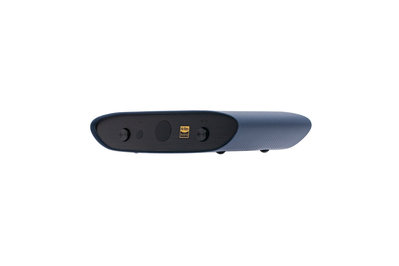
This Bluetooth audio receiver sounds amazing, is simple to set up, and offers excellent range. But it lacks digital audio outputs.
The iFi Audio Zen Air Blue 2 offers Bluetooth 5.4 connectivity and supports all of the majorBluetooth audio codecs, including SBC, AAC, aptX, aptX Adaptive, aptX HD, aptX LL, LDAC, aptX Lossless, and LHDC/HWA. It also offers excellent signal range, and it’s one of the simplest and most straightforward receivers we’ve tested in respect to setup and daily use.
The receiver sounds great. It uses the ESS Sabre ES9023 Premier Stereo digital-to-analog converter, which is a great-sounding DAC. In our audio comparisons using the aptX HD codec, we couldn’t hear a meaningful difference between the DAC in this little $130 box and the DAC in the $2,450 NAD C 3050 BluOS integrated amplifier that we used for testing.
The Bluetooth performance is reliable. Pairing the Zen Air Blue 2 proved to be as easy as with most of the other Bluetooth receivers we tested, and its reconnection with sources was unimpeachable in terms of reliability, consistency, and speed.
The original, now-discontinued Zen Air Blue relied on an internal antenna for Bluetooth reception, and its range was among the best we tested. The Blue 2 performed even better, thanks to its inclusion of two external antennas. With the smaller antenna attached, this receiver held its connection perfectly up to a distance of about 43 feet in a direct line indoors, and the signal passed through four sheetrocked interior walls and two bricked exterior walls before the audio started to stutter, skip, or take too long to reconnect.
With the larger antenna, the Blue 2 maintained a strong connection up to a distance of nearly 120 feet, through six interior sheetrock walls and two exterior brick walls.
It’s more user-friendly than other receivers in its price class. First, it’s always on as long as it’s connected to power, so all you have to do is pair with it and switch to the appropriate input on your sound system, and you’re ready to listen without delay. And if you’re using it in a car or boat, it automatically powers on upon engine startup.
It also gives a nice verbal confirmation when a device is connected, and it lets you know which codec is being employed so you can be sure the device is receiving the best codec possible — for instance, “Device is connected … AAC.”
If you happen to miss that vocal announcement, the unit includes LEDs to indicate the codec being used and the signal strength.
From the very first note, the Zen Air Blue 2 never failed to deliver sound. Many receivers, especially in this price range, mute the audio when no music is playing and often take a second or two to unmute when sensing a signal, but this iFi model never did so. It also handled gapless albums like some of our Grateful Dead concert albums, as well as studio albums like King Gizzard and the Lizard Wizard’s Nonagon Infinity, without any pauses or silences between tracks.
Connection options are limited. The only audio output is an analog RCA stereo pair. There are no digital audio outputs, which may be a concern for you if the only available audio connection on your home stereo or speakers is optical or coaxial digital — or if you would prefer to use the DAC built into your audio gear (or an external DAC, for that matter).
The Zen Blue 3 is a Bluetooth transmitter/receiver combo that supports Bluetooth 5.4 and aptX Lossless and adds digital inputs (including USB-C). But it comes with a big price jump to $300, so it’s likely overkill for most people looking solely for a Bluetooth audio receiver.
A few key accessories are missing. The Zen Air Blue 2 doesn’t come with audio cables of any sort, so you need to purchase a good pair of stereo RCA interconnects.
More frustrating is the fact that the receiver doesn’t come with a USB power adapter. Its DC power cord terminates in a USB Type-A connection, which you can plug into the USB power port on the back of most audio components these days, but if your sound system is older or for whatever reason omits such a connection, you need to buy a good USB wall charger.
The always-on nature of the Zen Air Blue 2 can be a blessing and a curse. It means that you won’t have to remember to turn it on before use, but it also means that your portable devices might sometimes connect to the Bluetooth receiver when you don’t want them to.
If your sound system has a USB power outlet, you might benefit from plugging the Zen Air Blue 2 into that outlet instead of the wall so it powers up and down with the rest of your audio gear. Just be aware that some sound systems send pass-through power to their USB ports even in standby mode. We also found in our testing that some of the USB power ports on powered speakers — such as our SVS Prime Wireless speakers — produced audible noise with the Zen Air Blue 2 connected, whereas plugging the USB cable into a nearby PC’s front-panel USB ports resulted in ultra-quiet operation. At any rate, a good USB wall charger is your safest bet, but an extra expense.
Budget pick: 1Mii B06 Plus


Budget pick
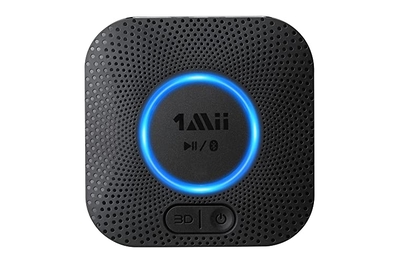
This Bluetooth audio receiver sounds really good for the price and offers some higher-quality codecs. Its range is good, as well. But it feels as hollow and plasticky as you might expect for the price.
If you want to keep your spending to a minimum, the 1Mii B06 Plus is a surprisingly good Bluetooth audio receiver for under $30. It uses Bluetooth 5.3, supports higher-quality codecs such as aptX HD and aptX Low Latency, and had one of the best signal-range results in our tests. It’s also simple to configure and not as susceptible to noise as some other Bluetooth receivers we tested.
The B06 Plus sounds great for the price. In our listening tests, this receiver’s sound quality was somewhat dependent upon the transmitting device. iOS users are likely to lament its lack of support for the AAC codec, but standard SBC sounded as good as what we heard from the Bluetooth built into the NAD C 3050 integrated amplifier. Switching over to an Android tablet, we found that using the aptX HD codec produced some minor improvements in sound quality, mostly with regard to higher frequencies; the improvements were easier to appreciate over headphones.
The B06 Plus doesn’t have digital outputs, offering only stereo RCA and 3.5 mm analog outputs. And its built-in DAC isn’t quite up to par with that of the iFi Audio Zen Air Blue 2. But considering the price gap between the two models, the differences aren’t nearly as pronounced as you might expect.
The Bluetooth connection is pretty reliable. Pairing the B06 Plus was simple and painless, and in my range tests it held its own against some notably pricier competitors. The signal passed through five sheetrock walls just fine and only occasionally suffered minor dropouts, mostly when I was running the microwave. Only the iFi Audio Bluetooth receivers I tested provided substantially more range.
It comes with most of the accessories you need. Unlike many affordable Bluetooth receivers we tested, the B06 Plus comes with a USB wall charger, so you don’t need to power it with a spare USB cable or port.
If your gear does have a powered USB port, note that in our tests the B06 Plus didn’t suffer from the sort of interference we experienced with some pricier alternatives. This receiver sounded clean and noise-free no matter how we powered it, even via a noisy USB port on the front of our desktop PC.
Our one gripe regarding the supplied accessories is that, instead of stereo RCA cables, the package includes a 3.5 mm–to–RCA adapter cable. This is a fine-sounding option, but the 3.5 mm aux output is plastic and feels a bit fragile; we got a more secure connection using a pair of Monoprice RCA cables.
This receiver has an off button. At times, I left the B06 Plus powered on for weeks, which was nice because it meant I didn’t have to remember to turn it on before use. But sometimes my iPhone connected to the receiver and started playing audio when I didn’t want it to, which made me appreciate the inclusion of an easy-to-reach power button to switch the receiver off.
That said, the power button sits beside the 3D button (more on that in a sec), replacing the volume controls that you get on other 1Mii receivers that have this same form factor. But I preferred using the volume controls on my phone or stereo system anyhow.
The 3D-audio feature is a mostly pointless gimmick. If you’re thinking of buying the B06 Plus purely for its advertised “3D Surround” feature, don’t bother. Not that the feature’s presence should deter you, but the surround effect is really dependent on the content being played. It’s subtle at best, and when it is audible, it mostly just sounds like a slight echo or reverb effect.


