
If you have the space and budget to create a dedicated home theater, these projectors will deliver the most cinematic viewing experience. They have a traditional form factor that’s meant to be integrated into a home theater system, with a variety of connections and setup tools. They may have integrated speakers, but they don’t have built-in streaming services.
For both the home theater and living room categories, we focused on 4K projectors with a claimed brightness spec of at least 1,000 lumens, to help ensure that they are bright enough to produce a well-saturated image on a large screen (100 inches or bigger).
Top pick for a home theater: Epson LS11000


Top pick
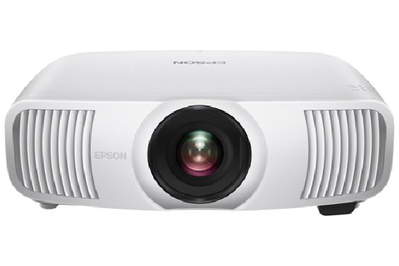
This 4K laser projector delivers a rich, accurate image and has a traditional form factor that’s ideal for a theater room. But it doesn’t support 3D video.
The Epson Home Cinema LS11000 is great for serious movie enthusiasts. This 4K projector delivers a theater-worthy image with great contrast, brightness, detail, and color, and it uses a triple-laser light source that should last through the next decade or longer, with no need for you to pay for replacement bulbs.
The LS11000 serves up a rich, high-contrast image. Contrast ratio (the difference between the brightest and darkest portions of the image) is the most important performance element in a projector, as it determines whether the picture looks rich and inviting or flat and washed-out (especially in a dark room). Lots of projectors are bright, but only the best movie projectors can combine high brightness with deeper, darker black levels — so movie scenes look more saturated and three-dimensional. That’s what the LS11000 delivers.
I measured a maximum brightness of over 2,400 lumens in the Epson’s Dynamic picture mode and over 1,800 lumens in the more accurate Natural picture mode. The native contrast measured about 1,400:1, and the well-designed dynamic iris — which automatically fine-tunes the lens to suit the image being displayed — increased the contrast ratio to over 5,500:1.
Add in the high-quality, all-glass lens, and the result is a clean, detailed image that looks great with all types of content: SDR or HDR, movies or HDTV, games or sports.
The color accuracy is superb. A lot of living room projectors sacrifice color accuracy to look brighter and deliver color that “pops,” but a great home theater projector focuses on accuracy. My measurements showed the LS11000 to be wonderfully accurate in its Natural picture mode, requiring no advanced adjustment.
Colors are bright but natural, and this projector can reproduce about 89% of the P3 color gamut currently used for 4K HDR video. That’s solid, though not as good as what some competing triple-laser projectors can deliver.
Epson is generous with its setup tools. The motorized, 2.1x zoom control gives you more flexibility in where you put the projector in relation to the screen, which is especially helpful in a theater room where you may need to place the projector farther back.
Also, the 96.3% vertical lens shift and 47.1% horizontal lens shift make it easier to position the image precisely on your screen, without having to rely on digital adjustments like keystone correction that can degrade image clarity and add latency for gaming.
Plus, all the lens controls are motorized, so you can adjust them via the remote and set up configurations for different video aspect ratios, such as 16:9 for HDTV or 21:9 for some movies.
The inclusion of full-bandwidth HDMI 2.1 inputs is rare on projectors. The LS11000 has two HDMI 2.1 inputs that can accept a 4K 120 Hz signal from the latest Xbox and PlayStation consoles. Combine that with the projector’s low input lag under 20 milliseconds, and it’s a good choice for hardcore gamers.
Flaws but not dealbreakers
It doesn’t support 3D or Dolby Vision. Although 3D is dead in the world of TVs, it still has a fan base in the projector world. New 3D content is rare, but if you have a large collection of older 3D discs and still want to watch them, this omission could be a dealbreaker.
Some newer living room projectors support the more advanced Dolby Vision HDR format, but none of our home theater picks do. Projectors don’t handle the nuances of HDR as well as TVs: They can’t get as bright, and their light control isn’t as precise. So I don’t consider this omission to be a dealbreaker.
Budget pick for a home theater: BenQ TK710


Budget pick
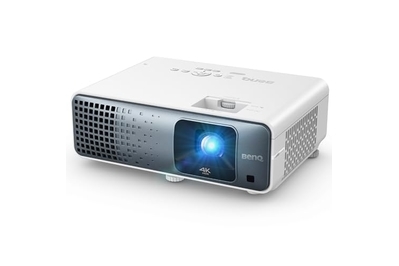
This 4K laser projector has excellent image contrast for the price, and it’s easy to set up and use. But the color accuracy is just okay.
If you want to keep the price under $2,000, the BenQ TK710 delivers a bright, sharp image that has surprisingly good contrast for the money.
This projector’s measured contrast was fantastic. In my tests, the TK710 measured an excellent native contrast ratio of almost 1,750:1 and a dynamic contrast ratio of 5,400:1. It combines a fairly deep black level with a lot of brightness to create an image that looks good in a brighter or darker room.
Although the TK710 technically measured brighter than the Epson LS11000 in its Bright picture mode (over 2,600 lumens), that mode produces highly inaccurate color that makes it almost unwatchable. In the most accurate Cinema and RPG picture modes, I measured around 1,750 lumens.
The 4K image looked sharp and clear in our tests, though you do have to manually adjust the focus control using a dial around the lens. You don’t get the motorized controls found on our top pick.
It’s great for gaming. This projector includes gaming-specific picture modes that tailor the signal brightness to suit the type of game you’re playing. I measured a low input lag of 16.7 ms with a 1080p 60 Hz signal in the RPG picture mode, which translates to about 4.2 ms for a 1080p 240 Hz signal. The two HDMI inputs are only version 2.0, so you can’t feed the projector a 4K 120 Hz signal — but you can feed it a 1440p signal at 120 Hz or a 1080p signal at 240 Hz.
3D video is also supported, though the glasses are sold separately.
The TK710 has a little bit of zoom (1.3x) and vertical lens shifting (10 percent), which gives you more placement flexibility in your room and makes it easier to position the image on your screen. But the picture-sizing tools are manual, not motorized.
Flaws but not dealbreakers
The TK710 falls short of our top pick in color accuracy and HDR performance. While this projector uses a laser light source, it’s not the triple-color laser you get with our top pick. As a result, colors are not as bright and vibrant. They measured a bit darker than they should, and the projector can only reproduce about 83% of the wider P3 color gamut currently used for 4K HDR video.
Also, this projector does not support Dolby Vision, it doesn’t get as bright overall with HDR video as the Epson does, and the HDR signal was consistently darker than it should be.
The 5-watt speaker emphasizes voices but lacks bass. The built-in speakers don’t have much gusto. Voices sound clear, but there’s not much in the mid to lower bass region. But for a home theater, you’ll probably add an external sound system, and the connection panel includes analog, digital, and HDMI ARC audio ports to do so.
Best short-throw projector for a small room: BenQ X500i


Best for…
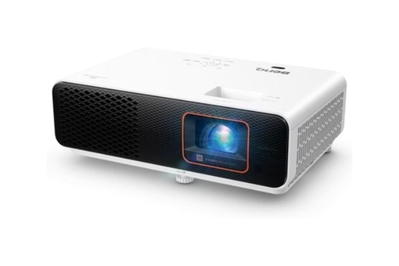
This 4K short-throw projector produces a rich, high-contrast image with more accurate color than most competitors offer. But it has brightness and placement limitations.
Short-throw projectors allow you to produce a large image from a shorter distance, which makes them a good choice if you have a small room but still want a big screen.
The BenQ X500i is our favorite short-throw projector because it does a great job rendering movies and games in a light-controlled room, and you can project a 100-inch size from a distance of 5 feet. This projector has a traditional shape that’s fairly small and light, so you can set it on a table or easily mount it in a ceiling or tripod mount.
It offers impressive contrast and color accuracy, and solid brightness. In my objective tests, this projector had one of the best native contrast ratios I measured in the sub-$1,500 price category (over 1,500:1). Its black levels were impressively deep, and this projector did a good job of revealing fine details in darker scenes. As a result, darker movies, TV shows, and games looked rich and well saturated when the lights were low.
The X500i also delivers bright, accurate color, and it has a neutral color temperature (or color of white) that doesn’t look overly blue or green.
This LED projector can’t get as bright overall as our pricier picks, but in its most accurate picture modes for watching movies and playing games (the Cinema and RPG modes, respectively), I measured over 1,000 lumens, which is ample for a modestly sized screen in a light-controlled theater room or den. It maxed out at about 1,750 lumens in the Bright mode, but that mode’s less-accurate (too green) color temperature isn’t good for movie-watching — though it might be okay for taking in the occasional TV show or sporting event during the day.
Like the TK710, this projector has gaming-specific picture modes and two HDMI 2.0 inputs that will accept a 1440p signal at 120 Hz or a 1080p signal at 240 Hz. The input lag was 17.2 ms with a 1080p 60 Hz signal, which translates to about 8.6 ms for 4K 60 Hz and 4.3 ms for 1080p 240 Hz.
The rare inclusion of a USB-C video port allows you to directly connect a Nintendo Switch, with no need to add Nintendo’s optional HDMI dock.
The X500i also comes with an Android TV dongle (which hides in a recessed chamber on the top panel), and it supports 3D video, though you have to provide your own glasses. The built-in speakers sounded respectably robust and balanced, and this projector has the needed analog and digital audio outputs to send the audio signal to a separate sound system.
Flaws but not dealbreakers
The X500i has a few limitations with HDR video. This projector does not support the Dolby Vision HDR format, and it uses a long-lasting LED light source instead of a laser light source, which carries pluses and minuses. Triple-laser projectors can reproduce a wider color gamut than LED projectors, so the color in HDR videos will have more vivacity and pop. But people who wear glasses may see color-fringing artifacts around edges with a laser projector (I do!), and some people are more bothered by laser speckle. For these people, an LED projector is the better option.
The X500i has limited lens adjustments. A short-throw lens isn’t ideal if you need to position the projector farther back in the room but your screen is on the smaller side. The X500i’s physical lens zoom is just 1.2x, and it has no ability to shift the lens horizontally or vertically.
Other home theater projectors worth considering
If you don’t want a laser projector: Triple-laser projectors have color and brightness benefits, but they have drawbacks, too. People who wear glasses (myself included) may see color-fringing artifacts around edges, and some people are more bothered by laser speckle. BenQ’s W4100i is a very good 4K projector that uses a long-lasting LED light source instead. In our tests, it had great brightness and color accuracy, as well as above-average contrast — though it did not rival the Epson LS11000 in its black level or dynamic contrast. I loved how exceptionally clean, detailed, and natural the BenQ’s image looked in the Cinema and Filmmaker picture modes. However, the W4100i could not get as bright as the Epson with HDR video, and you have to choose between a wider color gamut and higher brightness with HDR content. This projector’s zoom and lens-shifting abilities are also lower than the Epson’s. The W4100i supports 3D playback, comes with an Android TV dongle, and has three HDMI 2.0 inputs that support up to a 1440p resolution at 120 Hz. I measured about 19 ms of input lag with the “fast mode” setting enabled.


