3
Agentic AI in telecom has to start with open-loop recommendations, explainable confidence and human-centered workflows before operators will trust closed-loop autonomy
At DTW Ignite in Copenhagen, much of the telecom AI conversation centered on how operators move from automation to autonomy. But the more practical question is whether operators will trust agentic systems enough to let them act.
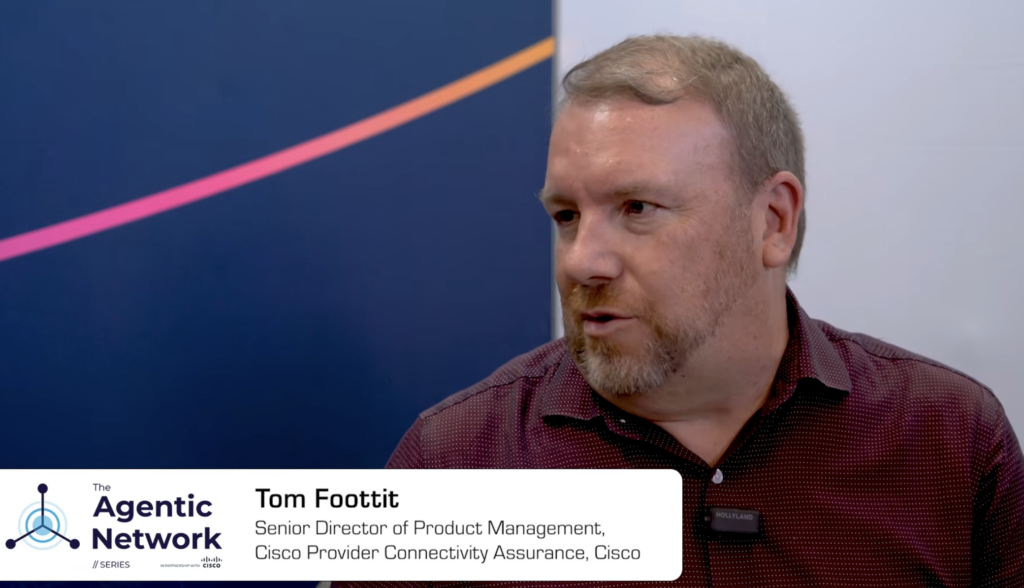
That is where Cisco’s Tom Foottit starts the discussion. He framed agentic operations less as an immediate leap to full autonomy and more as a trust-building exercise. “Most of our customers want to see that open loop,” he said. “They want to see a recommendation from a system but also be able to validate that recommendation before they implement it in their network.”
That is not a retreat from autonomy. It is the path toward it. Cisco has been positioning AgenticOps around trusted AI, guardrails, observability, monitoring and validation of agent actions. In a TM Forum blog published ahead of DTW Ignite, Foottit described Cisco’s focus as helping service providers move toward autonomous, intelligent and predictive network operations, with observability and validation as core elements of building trust in AI systems.
The reason is straightforward. Telecom networks remain high-consequence environments. An AI agent that can find a fault is useful. An AI agent that can recommend a remediation is more useful. An AI agent that can act autonomously across a multi-vendor network has to be governed, explainable and auditable.
Foottit said Cisco is building around that intermediate operating model with an emphasis on proactive issue identification, possible remediation, confidence scoring and human validation. That model maps to where much of the industry actually is. While the show floor may highlight Level 3 and Level 4 use cases, many operators are still operating at lower levels of automation maturity. The practical near-term work is making agents useful without making operations teams feel like they have surrendered control.
Foottit argued the telemetry problem is no longer the hardest part. “Telemetry and the collection of telemetry…has been largely solved,” he said. The bigger problem is relational. “Your agents are only going to be as good as the data source you’ve got,” he said. “The raw data is good, but determining relationships between the data is really critical.”
That pushes the discussion toward knowledge graphs and contextual models that can connect network telemetry, KPIs, service context and business data across domains. In the TM Forum blog, Foottit similarly emphasized observability across network domains, multi-vendor infrastructure, federated data platforms, real-time telemetry and business context as the base for agentic frameworks and autonomous decision-making.
The second challenge is agent fragmentation. Operators will build some agents. Vendors will provide others. Open-source communities will create still more. Without interoperability, the industry risks adding another bespoke layer on top of an already complicated operational stack. Foottit pointed to Cisco’s work around AGNTCY, a Linux Foundation project focused on discovery, identity, messaging and observability for agents across different vendors and frameworks. The Linux Foundation said AGNTCY was initially open sourced by Cisco and is intended to help multi-agent systems work together across platforms.
Foottit discussed the need for agent-to-agent communication, discovery and inventory to become standardized if the industry wants agentic operations to scale. Otherwise, the agent layer becomes one more source of fragmentation.
The business case also has to move beyond efficiency. Many early agentic operations use cases focus on troubleshooting, fault reduction, energy efficiency and mean-time-to-repair. Foottit sees the next step in service assurance. If a service provider can combine a differentiated service with assured network performance, reliability and security, then the network becomes part of the product rather than just the transport layer.
“If you own the network, in theory, you should be able to assure reliability, security and performance,” he said. Agentic operations can help operators proactively understand service performance, identify risk and address issues before they affect customers. That is where AI operations begins to connect with new service revenue.
The cultural piece may be just as important. Foottit’s point is that agents should reduce the burden of digging through “mountains of data” and help people move toward higher-value work. The human remains in the loop, validating recommendations, providing feedback and governing risk.
“It’s an agent that helps you do your job,” he said, “not an agent that’s designed to replace your job.”
The agentic network, in Cisco’s formulation, is not a black box that runs the network on behalf of humans. It is a trust architecture. The pieces are observability, knowledge graphs, confidence scoring, agent interoperability, human validation and, eventually, closed-loop action. Autonomy comes later. Trust has to come first.


