
Water container
Water is usually the first item that FEMA brings to a storm-damaged area, according to Grant Brown, director of recreation and cultural affairs in Gulf Shores, Alabama. But water is also what you’ll miss the most if you don’t have it. Officials announce hurricane warnings at least 36 hours before the onset of the storm, which means you have time to store water for both drinking and other household activities like cleaning and flushing the toilet. In an emergency, experts recommend having at least one gallon of water per person per day for a minimum of three days. “There’s an old adage: The first 72 is on you,” says Brown, referring to the initial 72 hours after a storm.
While our water container recommendation is convenient to have around, you don’t need a specific tool in order to retain liquids. For “gray water,” which you can clean and flush the toilet with but not drink, you can close the drains on your tubs and sinks as you fill them up.
You can also fill up any water bottles you might have lying around with drinking water. Put them in your refrigerator and freezer (after checking that the materials are freeze-proof). This will keep the water itself cool, and if the power goes out, the inside of your fridge or freezer will warm up more slowly, due to the high specific heat capacity of water compared to air. Hurricanes usually happen in warm locales in the summer and fall. Even if the electricity stays running, you won’t regret having a cold drink as you head outside for cleanup duty.


Top pick
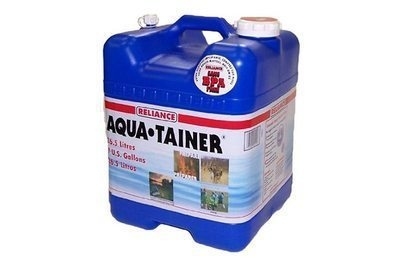
This sturdy and portable 7-gallon plastic jug is ideal for storing a week’s worth of emergency water for one person. It also has smart features like a tethered air vent for an easy pour.
At 7 gallons, the portable Reliance Aqua-Tainer offers a week of water for one person, whether you’re sheltering in place or on an evacuation route. We tested five water containers, and the Aqua-Tainer distinguished itself with its durable build, smart features, and larger size (most are in the 5-gallon range). We like that the spigot is stored inside the cap when not in use and that it has a tethered screw-on air vent valve for faster pouring.
A full Aqua-Tainer weighs nearly 60 pounds, so if you’re not comfortable with lugging that weight around in an evacuation scenario, we also like the smaller Reliance Aqua-Pak 5-gallon container. For a much larger at-home setup, we like the Augason Farms 55-Gallon Water Storage Barrel.
Regardless of which storage option you go with, the CDC recommends replacing your water supply every six months, and you’ll want to clean and sanitize the container between uses. We have advice on how to approach rotating your supply in our guide to prepping your pantry, as well as recommendations for extra purification products you might want to add to your kit.
First aid kit


Top pick
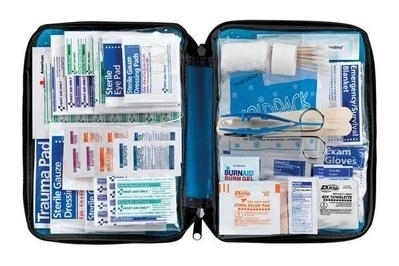
This First Aid Only kit has all the necessary gear for treating minor scrapes, cuts, and burns (including an abundance of adhesive bandages). All of the supplies are organized, and the kit also includes a decent first aid booklet.
We like the First Aid Only 298 Piece All-Purpose First Aid Kit (FAO-442) for its wide selection of gear for treating minor cuts, burns, and scrapes (bandages, gauze, wipes, ointments, and painkillers), as well as some items for handling more-serious injuries (a trauma pad, gauze, and some dressing pads). The case opens like a book, and items are stowed in 10 clear plastic compartments, so you can easily find what you need in moments of high stress. One of the kit’s highlights is its selection of 187 adhesive bandages in all shapes and sizes. After sticking it under a shower, we found that water can leak inside the case through its zipper, so we recommend keeping it inside a gallon zip-lock bag if it’s stored under a sink or you’re adding it to a go bag. Although this adds a layer of inconvenience, other kits we looked at were less organized or didn’t have enough of the essentials.
Weather radio

Top pick
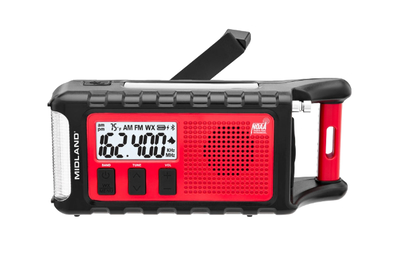
With easy-to-set alerts and a massive battery, the ER310PRO is a durable radio that doubles as a bright flashlight and a portable charging station.
Whether you’re evacuating from a hurricane or sheltering in place, it’s crucial to keep tabs on the status of the storm. You’ll need “some kind of way to listen to a radio station because TV stations may be out,” Reichel told us. We think your best option is a dedicated emergency weather radio, specifically the Midland ER310PRO. The Midland offers better reception, a brighter flashlight, and more-effective charging options than other models we tested, including the ability to charge its 10,000 mAh battery from dead through solar power or hand-cranking. It can also receive NOAA extreme-weather alerts, providing notifications that are both loud and readily visible so you won’t miss any warnings. The ER310PRO’s convenient size makes it comfortable to carry, so it’s easier to grab on the go in the case of an imminent storm, and we found it to be sturdy enough in our testing to toss into a go-bag or trunk without worry. It has some useful extras, too, including Bluetooth compatibility and an SOS blinking setting.
Storage bins

Top pick
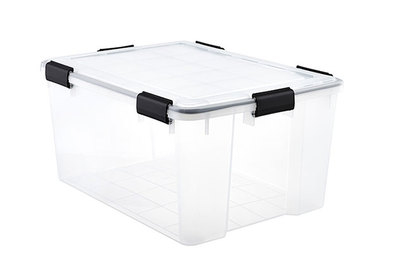
The lid of a Weathertight Tote is gasketed and attaches with six clasps (whereas most lids have only two), making this the best choice for keeping valuables and supplies dry during a storm.
During the high winds and flooding of a hurricane, water-resistant bins can keep emergency supplies, important documents, valuables, and other personal effects clean and dry. After testing 32 different bins—by tossing them down a set of stairs and leaving them out in the rain—we found that the Iris WeatherPro Storage Boxes had the best combination of weather resistance and durability.
The bins are available in 12 sizes and are designed to be stacked. so you can customize them to fit your space. The lid’s foam gasket creates a watertight seal, and six clasps hold the top on tight (most lids have only two clasps). For extra security, run duct tape around the rim of a bin’s lid and wrap the upper half of the bin with stretch plastic. You should seal important items, such as official documents and family photos, in zip-top bags for additional protection.
Lighter


Top pick
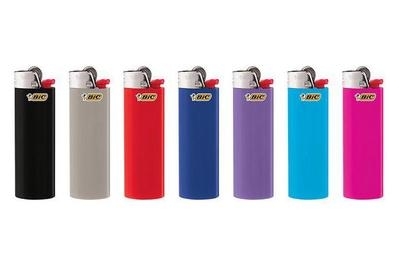
A Bic lighter is a simple way to get a fire going or spark up the range during a power outage. These lighters are long-lasting and can hold a flame in a light breeze or a little rain.
Most experts, including those at the American Red Cross don’t recommend using candles for emergency lighting, but a source of fire can be helpful for cooking in the aftermath of a hurricane. Reichel pointed out that without power, most gas stoves are rendered useless because of their electronic igniters. To get the stove going, you need to provide your own starter flame. A lighter can also get an outdoor cooking fire going, such as in a fire pit or chiminea. Bic lighters are easy to use and inexpensive, and they can hold a flame in light wind or a little rain.
Handsaw and chainsaw
Top pick
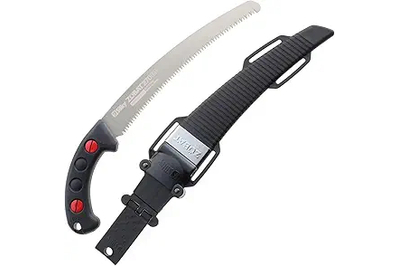
The Silky Zubat is a fast cutter capable of clearing branches and even small trees from a property.
A good handsaw, such as the Silky Zubat, is a valuable tool for pruning dead branches before a hurricane and cleaning up debris. Although this model wasn’t our top pick for carpentry, it is our choice for this particular task because its thicker blade is more durable than those of the speedier carpentry options we looked at. Its curvature helps with cutting, and the 270 mm blade was able to handle maple and ash branches cleared after a storm in Virginia.
For more aggressive work, we also tested several chainsaws, any of which would be appropriate for post-storm cleanup.
Tarp


Top pick
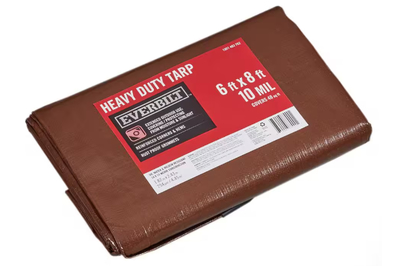
A strong tarp is one of the most versatile tools to have on hand, and an Everbilt Heavy Duty Tarp handles everything from catching the results of yard cleanup to keeping areas dry.
Like saws, tarps (or tarpaulins, if you’re fancy) have uses both before and after a hurricane. You can tie them down onto objects to keep those things dry, use them to patch a damaged home, or keep them nearby to help with yard cleanup—just pile branches and debris on the tarp and then slide it around like a makeshift wheelbarrow. We like Everbilt’s 6-by-8-foot tarp for general use. It’s 10 mils thick, waterproof, and designed with thick grommets. In our experience, we’ve found that 10 mils represents the sweet spot between durability and usability: Thinner tarps fray more easily and develop holes, while thicker tarps are heavier and more difficult to maneuver, carry, and fold. We’ve had a few Everbilt brown tarps set up outside for years, and they show no discoloration or wear at all. They’re usually available on the shelves at Home Depot. If you are looking for something larger or smaller, other sizes are available, too.
Heavy-duty garbage bags


Top pick
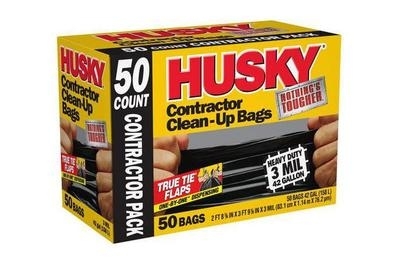
When you’re cleaning up storm-related messes, use these Husky bags. They’re large, durable, and good for keeping supplies—like blankets and clothes—clean and dry.
Heavy-duty garbage bags are always good for hurricane cleanup, but in an emergency they can have other uses as well. For one thing, they can keep your supplies dry, especially items like clothing and blankets. They can also serve as makeshift ponchos. The thick plastic resists puncturing from broken glass and nail-embedded wood. After spending a decade in the building trades and shoving sharp objects into all kinds of trash bags, co-author Doug Mahoney can personally attest to the durability of Husky 42-gallon bags over that of the competition.
Paracord


Top pick
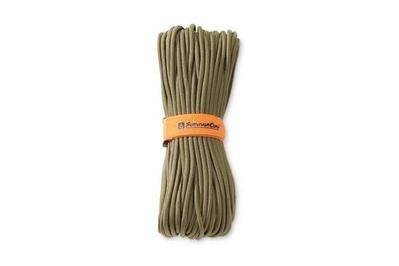
The Titan SurvivorCord is a strong nylon rope that you can unthread to reveal a wire, a fishing line, and a strand of waxed jute, which can help start a fire.
A length of rope is useful for any number of tasks, such as tying supplies together, strapping something to your car, replacing a broken shoelace, or even applying it to first aid uses such as creating splints and tourniquets. Paracord is the ideal rope in an emergency. In particular, 550 paracord, with its 550-pound weight rating, is the most universal thickness. It consists of a nylon sheath with usually seven nylon strands inside, each strand made up of three smaller strands twisted together. You can pull all of these separate pieces apart—so if you have 1 foot of paracord, for example, you can create about 7 feet of the triple-strand cordage or 21 feet of single nylon strands.


We tested two highly regarded brands of paracord, and we prefer the Titan SurvivorCord. At about $35 for a 100-foot length, the SurvivorCord is more expensive than regular high-quality cord, but it has unique features that make it worth the investment. Within the nylon sheath, residing among the seven triple strands of nylon, are a fishing line, a small wire, and a strand of waxed jute (a fire tinder). The 100-foot length is a good amount; it’s better to have more and not need it than to have less and need it.
Individually, the wire, fishing line, and waxed jute offer potential benefits in an emergency situation, but at a more practical level they serve to make the rope stiffer, which really helped while we were tying knots. Regular paracord is loose and flops like a shoelace, but the SurvivorCord holds its shape with a slight rigidity. Those additional internal strands also reduce excess stretchiness, which was a problem we noticed with the regular paracord we evaluated.
The SurvivorCord is available in a huge variety of colors and comes with a nice Velcro strap to hold the bundle together.


We also tested Tough-Grid’s 550 paracord and the brand’s larger 750 paracord (with 11 internal strands instead of seven). Both of those offered great performance, and if you think the cost of the SurvivorCord is too high, these are less expensive alternatives, albeit without the added stiffness or the functionality of the fishing-line, wire, and waxed-jute strands.


