


Top pick
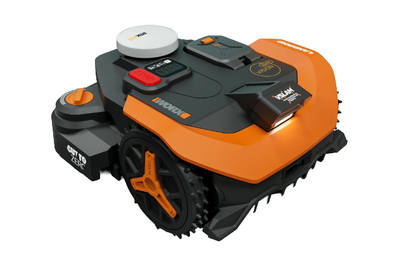
This mower combines antenna-free satellite navigation with onboard cameras for accurate mapping and obstacle avoidance. It also has a built-in trimmer, but you’ll still have to do a little trimming yourself.
The Worx Landroid Vision Cloud WR340 has the squarish, menacing look of an old Tonka truck. Worx claims this model is suited for use on half-acre yards, but the 5 Ah battery is less than what you find in most mowers rated for similar yards. And that’s why I think this one is better suited for use on quarter-acre areas like mine.
The WR340 navigates via cloud RTK, which combines satellite GPS with a built-in 4G cellular connection; that 4G connection is free for the lifetime of the robot. There’s no need to install an RTK antenna, which some mowers require. This is the only mower I tested that has front-wheel drive, which seems to help it navigate rough parts of the yard. And when it turns around, the mower looks like it’s wiggling its butt.
It’s very dependable. After I mapped the area and set up a couple of no-go zones around trees, I didn’t have to think about the mower again. It maintained the schedule I’d set up in the app. It didn’t destroy my dog’s tennis balls or mow down the basil. And when a sudden shower kicked up, the onboard rain sensor sent the mower back to the base. This mower did get stuck once when it was trying to cross a gap to a very uneven sidewalk, but I need to fix that gap anyway.
It has a respectable 8.7-inch cutting width. While it’s not the largest cutting area among those of the mowers we tested, the six-blade cutting disc is wide enough to keep the mower efficient and also small. Plus, it has an additional offset cutting disc just for edge trimming, which reduces (but doesn’t eliminate) extra weed whacking with a string trimer. This model mowed the 5,500-square-foot backyard in just under four hours — including an extra run around the border with the edge disc. And it can also work at night, if you want. This mower is faster than the other mowers we tested, except for our Lymo pick, which is in another class speed-wise.
It’s compatible with the wide-ranging Worx cordless catalog. You can swap batteries with other Worx gear within the Worx PowerShare system, including with this string trimmer that we recommend. While 5Ah seemed small to me at first, the Landroid completed its tasks faster than mowers with bigger batteries. And if you don’t want to wait the 60-minute charge time, you can easily pop out the battery and install a fresh one.
It’s excellent at dodging balls, trees, and dogs. In the front, two cameras make up the mower’s VSLAM system for obstacle avoidance. When the mower sees something in its path, it slows down and moves around it before continuing on its way. And if the WR340 misses a patch of grass, it will go back for it later. If the obstacle is something permanent, like a tree, the mower just goes around it. I tossed tennis balls, dog toys, and even a dog in its direction, and none of them were ever in any danger. The VSLAM system also steps in to aid in navigation if tree cover makes the RTK signal difficult. But if your yard is completely shaded by trees, I’d look for a LiDAR model, such as the Navimow or the Mova.
The app lets you easily tweak cutting features. In the app, you can change the cutting height, add or remove the edge-cut routine, and adjust the mowing pattern, but the edge-trimmer blade has a manual adjustment. If you make any changes to the shape of your yard, such as adding a garden or fence, you can easily modify the map. When I moved a fence, the backyard became a little larger, so I simply drove the Landroid around the new section, and the app automatically added it to the original zone. Our other picks also have this feature but you can’t do this with an older-generation boundary-wire mower.
Flaws but now dealbreakers
Initial setup can be a little frustrating. The included quick-setup guide had one step reversed, so I was forced to call customer support for help. The guide includes a QR code for an online manual, but every time I clicked on it, the page wasn’t found. There are also instructional YouTube videos, but not for this model. However, the Landroid is a brand new model, so hopefully those online assets will get updated soon. In any case, I eventually found all of the features by poking around the app.
Tracking costs extra. While the Landroid includes a built-in geofence feature, a custom PIN code, and an alarm, all to deter theft, but the GPS-tracking module, called Find My Landroid, is an extra (one-time) $100 purchase. For a cheap DIY solution, you could duct-tape an Apple AirTag in a discrete place.
You need to be careful on steep hills and under trees. The Landroid managed the moderate inclines in my yard, but it’s rated for 30%slopes only, while all of the other picks claim to be able to handle 45% slopes. Because this mower relies on satellites for navigation, it might not work well if trees cover a lot of your yard.
Privacy and security snapshot
- The Worx app requires a unique password, and the device can be secured with a user-generated PIN. 2FA is not an option.
- Worx says it collects location information during setup. Images captured by the camera system are not shared without permission. If a human face is recorded by the camera, it is automatically blurred out.
- Data is stored on an AWS server in the United States.
- Worx says it employs end-to-end data encryption both at rest and during transmission. Sensitive information (including human faces, license plates, and house numbers) is permanently masked or anonymized locally. Raw or identifiable sensitive personal imagery is never uploaded to the cloud.
- Worx says that internal access to data is strictly controlled and monitored. The company says it does not sell any data nor does it share data with outside organizations or third parties. The default for sharing data internally is set to “off,” and users must select “yes” to share data internally (with the company).
- You can read the Worx privacy policy here.


