
2
The FCC’s retreat on bulk billing did not end the fight; it fragmented it. States and cities are now squeezing bulk Wi-Fi economics through opt-outs, access mandates, markup caps and billing rules., writes Maravedis Research.
Most of the industry is still treating January 2025 as a victory. The FCC dropped its bulk billing proceeding, the lobbying worked, and everyone went back to their day jobs. What actually happened is that the ceiling on state action came off. Nine state and local jurisdictions have since written their own rules, and the newest of them, an ordinance passed in Alameda this June, rests on a principle bulk managed Wi-Fi cannot satisfy at any price: you cannot charge a resident for what you cannot meter at their unit. I have mapped every one of them, with an assessment of what each does to your margin.
The short version is that nobody banned bulk. They regulated the margin instead, and the compliance answer in three separate cases turns out to be the same one.
- The FCC retreat was not a win. Killing the bulk billing proceeding in January 2025 removed the ceiling on state action, and nine state and local jurisdictions have since written their own rules. One national fight became a portfolio operator running five different programs in five states.
- Nobody banned bulk. They regulated the margin. Every legislature that has acted left the arrangement legal and went after the economics instead, through opt-out rights in California, forced access and markup caps in Colorado, and a $2 monthly ceiling in Seattle that is a prohibition dressed as a cap. Alameda’s new RUBS ban goes further with a principle that bulk cannot satisfy: you cannot charge for what you cannot meter at the unit.
- Every road leads to per-unit billing, and the industry has no evidence to argue otherwise. Three separate regulatory mechanisms now point at the same operational requirement, and not one of these statutes was passed with an independent economic assessment of what bulk managed Wi-Fi actually delivers to residents.
That story is wrong in a way that matters. The federal threat did not disappear. It fragmented. And a fragmented threat is harder to fight, harder to plan around, and considerably more expensive to comply with than a single national rule would have been.
What follows is a jurisdiction-by-jurisdiction map of where things actually stand, built from primary statutes and trade reporting and updated through 2026. Each entry carries something the raw legislative text does not: an assessment of how much the rule actually threatens the bulk model, as opposed to how loudly it was announced.
Three federal developments frame everything above.
The bulk billing rulemaking began on March 5, 2024, with an FCC announcement about broadband choice in multi-tenant buildings. What started as a potential ban evolved into a likely opt-out mandate. On January 24, 2025, incoming Chairman Brendan Carr formally ended the proceeding, calling it regulatory overreach that would have raised costs for seniors, students, and low-income residents. The industry read this as a win. In practice, it removed the ceiling that a federal rule would have placed on state action, and legislators in Sacramento and Denver did not need Washington’s permission.
The digital discrimination rule took effect on September 22, 2024, and it is the one most owners are underestimating. It extends exposure beyond whether residents can subscribe to whether they receive comparable speed, capacity, latency, and other quality of service metrics. Owners, operators, and contractors can all be the subject of complaints. This turns performance parity across a portfolio into a compliance question rather than a marketing claim, and it applies nationally regardless of what any state does.
The CBRS interference modeling change, announced June 12, 2024, is the one piece of good news. Revised modeling shrinks protected areas and opens coastal zones and areas near military facilities covering roughly 71 million people. For MDU operators, this enables property-wide LTE for IoT and building system control, phased in subject to testing.
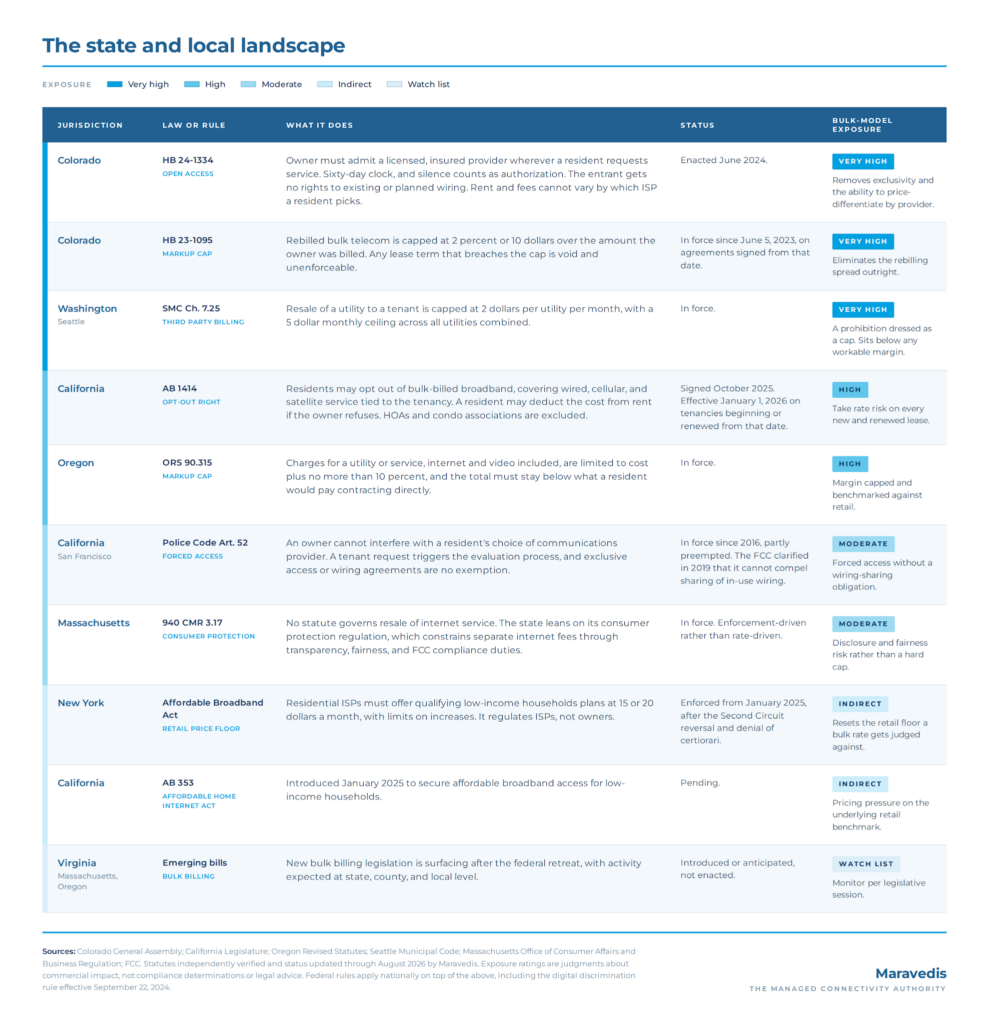
Look across the table, and a structure emerges that is easy to miss when these laws are covered one at a time in the trade press.
No state has banned bulk. Not one. Every legislature that has acted, including the most aggressive, has left the bulk arrangement legal. What they have regulated is the margin and residents’ ability to opt out.
That is the actual pattern: a squeeze from three directions at once. Opt-out rights in California. Forced third-party access in Colorado. Markup caps in Colorado, Oregon, Massachusetts, and Seattle. An owner can still run a bulk program in any of these jurisdictions. What the owner cannot do is run it the way the 2021 pro formas assumed.
Colorado is the sharpest case. HB 24-1334 and HB 23-1095 together strip both the exclusivity premium and the rebilling spread. The open access mandate is unusually aggressive by design: a 60-day clock on the owner, with silence deemed to be authorization, and an explicit prohibition on varying rent or fees based on which ISP a resident chooses. That last provision is doing more work than most people realize, because it forecloses the obvious workaround of pricing the unit differently for opted-out residents. What remains for the Colorado owner is the amenity value of connectivity and nothing else.
California is the largest case by unit count, and the mechanism matters as much as the substance. Because AB 1414 attaches to tenancies beginning or renewed on or after January 1, 2026, exposure does not arrive on day one. It builds across 2026 and 2027 as the lease book turns over. A California operator with a twelve-month lease cycle will see roughly half its exposure by the end of this year and effectively all of it by the end of next. Anyone modeling this as a step function is going to be wrong twice: too pessimistic in 2026, too optimistic in 2027.
Alameda (CA) is the fifth mechanism, and the one to watch. On June 16, 2026, the Alameda City Council adopted Ordinance 3407 by a 3-to-1 vote, banning ratio utility billing systems outright. RUBS is the practice of taking a master-metered utility bill and allocating it across units by proxy formula, typically square footage, bedroom count, or occupancy. The ordinance bars the practice for new tenancies within 30 days of taking effect, and for existing tenancies, it prohibits utility fees on properties without a separate submeter, with landlords able to petition for a one-time rent adjustment supported by a year of documented utility charges. Installing submeters was made eligible for acapital improvement pass-through as the compensating concession.
The principle underneath it is different from anything else in the table: you cannot charge a resident for what you cannot measure at their unit. Not an opt-out right, not a markup cap, not forced access. A rule about billing methodology. And that is precisely why it matters to bulk internet, because bulk managed Wi-Fi is structurally master-metered. One circuit serves the building, and there is no per-unit meter, by design. If a jurisdiction adopts the principle that unmetered means unbillable, the bulk model does not get squeezed. It gets disqualified on a technicality it can never satisfy, because the compensating remedy the ordinance offers landlords, installing submeters, has no equivalent for a shared internet circuit.
Whether Ordinance 3407 actually reaches broadband is unresolved, and I want to be careful here rather than alarmist. The council debate was about electricity, water, and sewer, and the complaints that prompted it involved third-party RUBS providers billing for those. The open question is how the ordinance defines a utility. Alameda’s underlying rent ordinance already defines housing services expansively, naming utilities paid by the landlord, telephone, computer technologies, and entertainment technologies, including cable and satellite television. Connectivity is plainly inside the regulated bundle for other purposes. Whether the RUBS prohibition inherits that breadth is a question of statutory construction that operators with Alameda assets should put to counsel now, not after the first complaint.
Two things make this worth tracking well beyond one island city of roughly 80,000 people. First, the measurability principle travels easily. It sounds like fairness, it is simple to legislate, and it requires no view on whether bulk is good or bad. Second, note where it lands: the compliance answer is per-unit billing, again. That is now the third distinct regulatory mechanism in this analysis pointing at the same operational requirement.
Seattle is the quiet outlier. A $2-per-utility monthly cap, with a $ 5 ceiling across all utilities, is not a margin constraint. It is a prohibition dressed as a cap. Any bulk program inside Seattle city limits is running on amenity logic alone.
New York is not an MDU law at all, and that is precisely why it belongs in the table. The Affordable Broadband Act regulates ISPs, not owners. But by mandating $ 15 and $ 20 plans for qualifying households, it resets the retail benchmark against which a bulk rate gets judged, both commercially and in any future proceeding. When the comparison point drops, the value proposition of the bulk discount compresses without anyone touching the bulk statute.
For property owners, the strategic implication is the same one the FCC proceeding raised before Carr terminated it, and it did not go away when the proceeding did. Programs need to be architected for subscriber-level billing capability even where bulk remains the operating model. Ask your bulk provider directly whether it can invoice residents individually, and what the contract and economic terms of that switch look like. For assets in design or under construction, verify that the planned infrastructure supports subscriber-based delivery and that other building systems stay operational if the model changes. This matters most where the owner is carrying the capital cost of the managed Wi-Fi system.
For MSPs and ISPs, the differentiator is shifting away from bulk economics. When the margin layer is regulated in a growing number of jurisdictions, what remains defensible is service quality, operational reliability, and the ability to run mixed-model properties where some residents are on the bulk plan, and some are not. Providers who can do subscriber-level billing cleanly, without bolting it on, will win contracts in California and Colorado that providers who cannot will lose.
For equipment vendors, the digital discrimination rule is the sleeper. Performance parity across a portfolio is now a compliance matter. Vendors who can demonstrate consistently delivered quality across unit types, building vintages, and neighborhoods have a compliance story to tell, not just a performance one.
And for everyone: this is jurisdictional, not national. A Colorado rule governs Colorado properties. National impact arrives only through federal action or through a critical mass across states. We are not at critical mass. We are at the point where a portfolio operator in five states runs five different programs.
Here is what troubles me most about the table above.
Every one of those statutes was drafted, debated, and passed without an independent economic assessment of what bulk managed Wi-Fi actually delivers to residents. Legislators in California and Colorado acted on an assumption: that removing the bulk arrangement lowers resident cost. That assumption may be right. It may be badly wrong. Nobody has tested it with research capable of surviving cross-examination.
So the industry keeps arriving at hearings with anecdotes and per-property case studies while the other side arrives with a clean consumer-protection framing. That is not a fair fight, and it is not a fight that better lobbying alone will win. AB 1414 is now in effect. Whether residents actually opt out en masse, or even know they can, remains unknown, and that uncertainty is exactly the problem. You cannot argue from data you never collected.
This is why Maravedis Research has been advocating the Bulk Managed Wi-Fi Economic Impact Study: a 12-week independent economic analysis that quantifies the full economic and social value of bulk-billed managed Wi-Fi in U.S. multifamily housing. Not just the resident economic surplus but the entire impact on the economy. From quantifying energy savings, water conservation, and e-waste reduction enabled by IoT-connected buildings to calculating avoided costs from redundant wiring, duplicate truck rolls, and building damage when multiple ISPs install parallel systems. A much-needed study no one else has even contemplated. It is built to withstand opposing scrutiny and to be usable in regulatory proceedings and legislative testimony, which no in-house analysis can be, however good the analyst.
The study is funded through an industry crowdfunding model, deliberately, so that no single sponsor owns the findings. Elauwit is one leading MSP, and WiBUZ, a Saas platform provider, has already contributed financially to the research, but we need more support to take it to the finish line. A study of this scope exceeds any single company advocacy budget. A coalition of MSPs, ISPs, property owners, equipment vendors, and associations can carry it, and then deploy the results for years, with the third-party credibility that in-house economics can never deliver.
This analysis reflects publicly available regulatory developments as of August 11, 2026. It is not legal advice. Property owners, MSPs, and equipment vendors should consult qualified legal counsel before making compliance or business decisions based on it.


