
3
Cambium’s collapse leaves WISPs facing a sprawling installed-base problem, with Airspan’s partial acquisition offering some relief but leaving ePMP and other product lines in limbo. The challenge now is securing support, spares and credible migration plans.
I recently wrote about what the Cambium Networks collapse means for multifamily connectivity, with exposure running through managed Wi-Fi providers and property owners. This piece turns to the segment that built Cambium in the first place: WISPs. It draws on installed-base data from the Preseem 2026 ISP Network Report and a follow-up conversation I had on September 21 with WISPA CEO David Zumwalt, and covers Airspan’s acquisition of part of Cambium’s fixed wireless portfolio on September 22.
For 15 years, a WISP tower without a Cambium radio on it was the exception. The Canopy lineage that Motorola handed off in 2011 became the PMP 450 and ePMP families that a large share of the fixed wireless industry standardized on. That era ended on September 11.
Can Airspan turn things around?
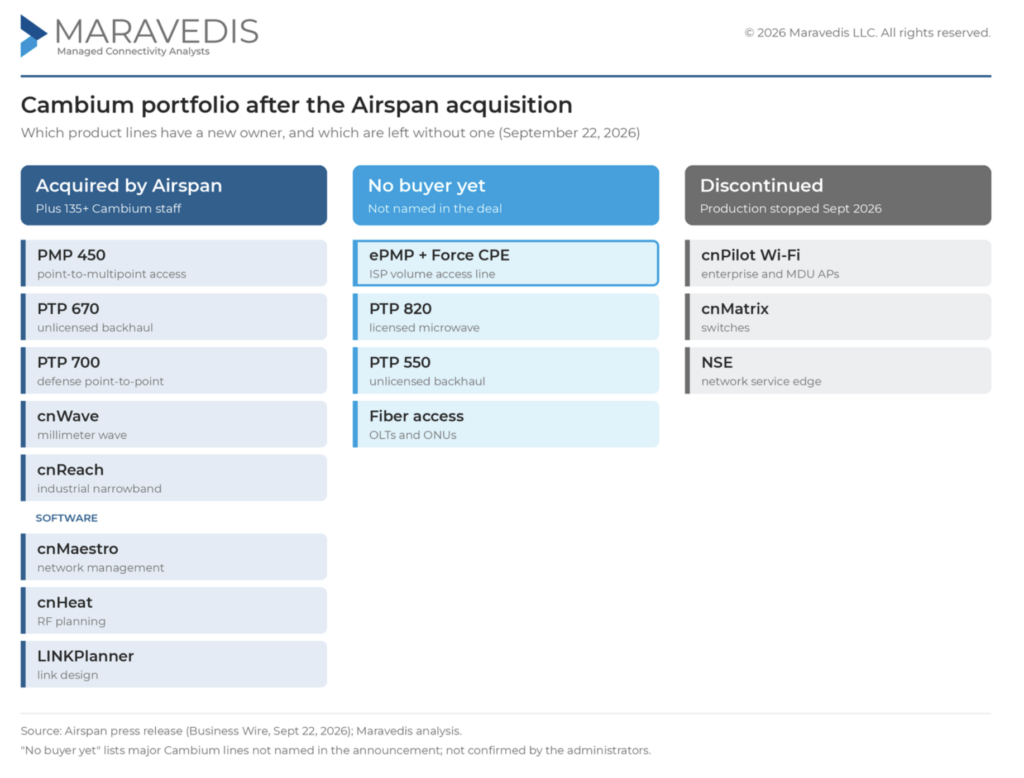
On September 11, Cambium cut more than half its global workforce, and three days later its U.K. operating entity entered administration. On September 22, Airspan Networks Holdings announced it had acquired several fixed wireless product lines from Cambium Networks Ltd., including the PMP 450 point-to-multipoint platform, PTP 670 unlicensed backhaul, PTP 700 for defense, cnWave millimeter wave, and cnReach narrowband, along with LINKPlanner, cnHeat, and cnMaestro. More than 135 Cambium employees in sales, support and R&D moved across. Financial terms were not disclosed.
Part of this is good news. The split outcome I warn about below, where a radio line and its controller end up with different owners, has been avoided for PMP 450: the hardware, the planning tools, the management plane and people who know them stay together. Operators running dense PMP 450m sectors, the most heavily loaded in the Preseem data, now have a counterparty that says it will keep supporting them and invest in the supply chain.
The rest is less comforting. ePMP is not part of the deal. Airspan told the trade press it is not targeting ISPs with this acquisition, which is why it left out the ISP-focused ePMP line, although it says it will keep supporting ISP customers. ePMP is the volume product in a large share of WISP networks, and as of today it has no buyer.
The distinction matters. PMP 450 is Cambium’s premium line, a direct descendant of Motorola’s Canopy, running a proprietary air interface on custom silicon. It is GPS-synchronized, highly tolerant of interference, available in 900 MHz, 3 GHz (CBRS), and 5 GHz, and sold into utilities and critical communications as well as WISPs. ePMP is the value line Cambium launched in 2013: built on commodity Wi-Fi chipsets with Cambium’s own scheduling on top, operating mainly in unlicensed 5 GHz and, in newer models, 6 GHz, with subscriber radios cheap enough to make it the default choice for cost-sensitive WISPs in the U.S. and in emerging markets. The two do not interoperate: an ePMP subscriber radio cannot connect to a PMP 450 access point. Both, however, are managed by cnMaestro.
In other words, Airspan bought the carrier-grade line that fits its defense, critical communications and service-provider positioning, and left behind the high-volume, low-margin line that many smaller WISPs actually run.
That leaves a sizable part of the portfolio without a buyer, at least based on what Airspan has named. On the fixed wireless side, that means the entire ePMP family, including its Force subscriber radios, along with the PTP 820 licensed microwave backhaul line and the PTP 550 unlicensed backhaul radios. Beyond fixed wireless, it includes the fiber access products and the enterprise portfolio: cnPilot Wi-Fi access points, cnMatrix switches, and the NSE devices, which Cambium had already discontinued. For multifamily MSPs running Cambium Wi-Fi, the picture is unchanged, and for WISPs whose backhaul rides on PTP 820 or PTP 550, the question of who supports those links is as open as it is for ePMP.
So can Airspan turn this into a durable business? Given its history, I am skeptical. Operators just burned by one vendor’s instability should look hard at the next one’s track record, and Airspan’s is not reassuring. It went public through a SPAC merger in 2021. By the third quarter of 2023, its quarterly revenue had fallen to about $14 million, from $39 million two years earlier, and its workforce had been cut from roughly 800 to about 370. In 2023, it sold Mimosa, the fixed wireless line it had bought in 2018 to target exactly this market, to Jio’s Radisys for $60 million amid balance sheet pressure. In March 2024, it filed a prepackaged Chapter 11 that eliminated about $205 million of funded debt, and it emerged in October 2024 as a private company majority-owned by its lender, Fortress Investment Group.
The pattern matters more than any single event. Airspan has already entered this market once and walked away from it when cash ran short. It is now buying its way back in, less than two years out of bankruptcy, with a line it positions for defense, critical communications, and service providers rather than ISPs. Its growth since emerging has come largely through acquisitions: Corning’s wireless business, Jabil’s Open RAN radio portfolio, and now part of Cambium. A buy-and-integrate strategy under a lender-controlled owner can work, but it concentrates integration risk, and every acquired product line competes for the same engineering and support budget.
There is also an uncomfortable fact: PMP 450 is the franchise Cambium itself could not make pay. Airspan is taking it on without ePMP, with a team drawn from a company that failed, and against the same competitors: Tarana at the high end, Ubiquiti on price, and LEO at the edges of the network. Nothing about the product’s economics changed on September 22. Only the owner did.
To be fair, the 2024 restructuring was a recapitalization, not a liquidation, and Airspan’s 2026 claims show real momentum: $152 million in revenue for the 12 months to June 2026, with what it calls strong profitability. But those figures are self-reported by a private company, much of the growth appears to be acquired rather than organic, and a financial owner such as Fortress will eventually look for an exit. That raises a fair question about how long a WISP radio line stays near the top of anyone’s priority list.
What would change my mind? Four things, all of which Airspan can provide if it is serious: a published PMP 450 roadmap, including a successor to the 450m; a written, multi-year commitment on cnMaestro, cnHeat and firmware support, covering devices Airspan did not buy; a dedicated WISP channel and support team rather than one bolted onto a 5G and defense sales force; and disclosure of what it paid and how much it intends to invest. Until then, PMP 450 operators should treat this deal as a reprieve, not a resolution.
Beyond that, the open questions are licensing and pricing under the new owner, and whether ePMP, PTP 820 and PTP 550 find a buyer at all.
Squeezed from above and below: Tarana and LEO
Cambium did not fail because WISPs stopped buying fixed wireless. It failed because the fixed wireless market split in two, and Cambium held neither.
At the top end, Tarana Wireless rewrote the performance ceiling. Its ngFWA platform was built from the ground up rather than iterated from a legacy air interface, and its G2 platform pairs a large capacity increase with the ability to blend licensed and unlicensed spectrum in one radio. Tarana now claims more than 300 customers in 24 countries, and the logo wall reads like a WISPA member directory: Nextlink, Wisper, Resound, Rise Broadband, Vistabeam, Bluespan, plus cable operators such as Mediacom, Midco, Cox and Charter that Cambium never fully cracked. The first BEAD-funded ngFWA deployments are already live. Every one of those wins was a sector that, five years ago, would have gone to a PMP 450m or an ePMP 3000. The multi-gigabit, non-line-of-sight, CBRS-plus-unlicensed upgrade cycle that WISPs needed to compete with fiber went to Tarana, and Cambium’s answer arrived late and in fragments.
At the bottom end, LEO satellite took the marginal subscriber. Starlink did not replace WISP networks, but it removed the reason to extend them. The three or four unserved homes at the edge of a sector that used to justify one more ePMP access point are now served from orbit, either by the household directly or by the WISP itself using Starlink as a placeholder until terrestrial capital catches up. In my August interview with WISPA CEO David Zumwalt, he described exactly that pattern: members deploying Starlink for redundancy after disasters, or to stave off demand they were not yet ready to build for. He also noted that Starlink’s teaser pricing pulled some customers away and that many came back once the real price returned. That churn is manageable for a WISP. It is fatal for the vendor that sold the low-end radios those customers used to sit behind, because the incremental “just one more sector” purchase order quietly stopped arriving.
Put the two together, and the picture is clear. Tarana took the growth spend. LEO took the fill-in spend. What was left for Cambium was the maintenance and replacement market on an aging installed base, which is a fine business for a private company with low costs and a terrible one for a Nasdaq-listed company that had bet its future on an enterprise Wi-Fi pivot that never scaled. When production and supply chain problems then delayed deliveries into 2026, the loyal customers who had stayed had every reason to try the competition, and many did.
How exposed are WISPs? What the Preseem data shows
When I asked Zumwalt how many WISPA members are exposed, he pointed me to the best public proxy available: the annual Preseem ISP Network Report, which draws on billions of metrics collected daily from hundreds of ISPs. Its 2026 edition breaks down fixed wireless vendor share two ways, by connected subscriber radios (CPE) and by access points.

Three things stand out.
Four in 10 fixed wireless subscribers sit behind a Cambium radio. At 39.5% of connected CPE and 28.5% of access points, Cambium is the clear number two behind Ubiquiti, and the two together account for roughly 87% of subscribers in the dataset. Tarana, for all its momentum, is at 8.3%. No version of this market makes Cambium’s installed base a rounding error.
The exposure was still growing. Cambium was the biggest share gainer in the report, up 4.1 points in CPE and 2.0 points in APs year over year. Preseem described it as a resurgence of growth. Put differently, operators were adding Cambium subscribers right up to the year the company failed, which means a meaningful slice of the base is recent capital that has not yet been paid back.
Cambium sits in the dense sectors. Cambium’s subscriber share is 11 points higher than its AP share, the mirror image of Ubiquiti. Its access points carry more customers each. Preseem finds that over 75% of fixed wireless APs have 10 or fewer subscribers attached, yet the PMP 450m averages 18 connected subscribers, with a 95th percentile of 55 and a maximum of 131, the heaviest loading in the dataset alongside Tarana’s densest model. The ePMP 3000 averages 12. These are the revenue sectors. Every one of them is a proprietary AP with dozens of proprietary CPEs behind it, so both the cost of a failed AP without a spare and the cost of a migration scale with exactly the sectors that matter most.
Zumwalt’s rule of thumb is that vendor share of the installed base translates reasonably well into the share of members exposed. I would add one nuance: because most operators run more than one vendor, the share of WISPs with at least some Cambium on their towers is almost certainly higher than 40%, while exposure depth varies enormously. At the deep end, Zumwalt recalled that before joining WISPA he was chief operating officer of a 9,000-subscriber WISP where, prior to 2022, something like 95% of residential and commercial customers were on Cambium infrastructure. Many operators have that profile, and they need a plan B now.
The view from WISPA, and what the deal may change
I spoke with Zumwalt on September 21, the day before Airspan’s announcement, so his comments reflect the picture as it stood then. At that point, members were concerned, and not only about hardware. The questions reaching WISPA were as much about cnMaestro and cnHeat, which depend on cloud infrastructure Cambium operates, as about radios. In his view, much of the early reaction was driven by how quickly it happened: a major reduction in force and a tip into administration with no warning to employees or, apparently, business partners. With no information coming from the company, speculation filled the vacuum, and those already inclined to be critical of Cambium piled on. His first reaction, and that of many members, was empathy for the many good people in the industry who lost their jobs overnight.
Operationally, nobody was telling WISPA the sky was falling. There was product and inventory in the channel, and he was not hearing alarms about supply chains. The questions were more measured: what happens next, how long this will be supported, whether to overbuy spares while it gets sorted out, and what plan B looks like for operators highly dependent on Cambium.
On the asset sale, he stressed that nothing he had seen was independently verified, but the hypothetical he sketched was plausible: different buyers for the RF products, the fiber products, and the software. That mattered for WISPs, because a radio line and the controller that manages it could end up under different owners. He also noted that adjacency does not guarantee a deal. A vendor with a strongly differentiated technology may decide that absorbing a legacy product family would only blur its message to customers. A day later, the first transaction bore both points out: Airspan took the PMP 450 and PTP lines with their software, but left ePMP without an owner.
How members will react to the Airspan news is genuinely hard to call, and I would not presume to speak for them. I expect reactions to split across the installed base. PMP 450 operators now have an answer of sorts: a named owner, a support team and a management platform that stays with the radios. Some will take that as a reason to slow their migration plans. Others, given Airspan’s history, will see it as confirmation that they need a second platform anyway. ePMP operators, and many smaller WISPs rely on ePMP, got no answer at all, and the questions they were asking the week before are unchanged. Operators running both lines face the most awkward outcome: part of the network under a new owner, and part under nobody’s.
The cnMaestro question shifts rather than goes away. The platform now has an owner, but that owner has not said for how long it will run it, or whether it will keep managing devices it did not buy. I will be asking Zumwalt how members are actually reacting when we host our Life after Cambium webinar.
Why this hurts WISPs more than any other segment
Cambium sold enterprise Wi-Fi, switching and fiber access too, but fixed wireless was its identity, and WISPs were its most loyal constituency. WISPA members voted the company Manufacturer of the Year four straight times, from 2017 through 2020. That loyalty is now a liability, for three reasons.
First, the protocols are closed. ePMP and PMP 450 run proprietary air interfaces. A subscriber module from one vendor does not talk to an access point from another. PMP operators are stuck because the Canopy lineage ran open spectrum on a completely proprietary protocol. Replacing an AP means replacing every CPE under it, which means truck rolls to every rooftop.
Second, the management plane is a single point of failure. cnMaestro is the cloud and on-premises controller that most Cambium networks depend on for provisioning, monitoring, and firmware, and cnHeat does the RF planning for many of them. Cambium has committed to running cnMaestro Cloud only “at least through” October 1. Airspan, which now owns cnMaestro, has pledged to maintain it but has not said how long, on what terms, or whether it will keep managing devices Airspan did not buy. Moving on-premises helps, but reports indicate the on-premises version still relies on a Cambium cloud service to add and delete devices, so it is not a clean break. If the entity that operates these services is wound up, or if license renewals stop being processed, the radios keep passing traffic, but the operator loses visibility and control. One industry voice has argued that whoever holds the assets should open cnMaestro or bless an OpenWiFi load, because a dead controller means forklifted networks that work fine. Whether the administrators listen is an open question.
This is the point Zumwalt was most willing to put his name to. The industry has become very comfortable doing everything in the cloud, and in many ways that is brilliant, until a failure shows how little resilience there is in infrastructure you do not control. If your management tools depend on a vendor’s cloud, and that vendor is no longer around in the same form, a lot is riding on something outside your hands. The uncomfortable corollary is that the platforms WISPs are most likely to migrate to are every bit as cloud-dependent as Cambium. The question to ask any vendor is no longer just “what does the controller do” but “what happens to my network the day your cloud goes dark.”
Third, spares and RMAs are now a question mark. With half the workforce gone, the support organization that handled returns, firmware bugs, and regulatory certifications is a fraction of what it was. To be fair to the current picture, there is inventory in the channel today, and WISPA is not hearing supply chain alarms from members, and Cambium says it expects fixed wireless production to resume. But the prudent assumption is that distributor stock of the popular access points will tighten as operators build spares, and that secondary-market pricing will move accordingly.
The strategic lesson, not just the operational one
Zumwalt made a point in our conversation that now reads as prophetic: the operators who thrive keep anticipating where their supply is going and never bet the next 15 years on a single input being cheap and available. He was talking about spectrum. The same logic applies to vendors.
The WISP industry has already become hybrid. Roughly half of WISPA’s members now run significant fiber alongside fixed wireless, and the “hometown ISP” Zumwalt describes chooses technology by market rather than by ideology. The Cambium collapse pushes that pragmatism one step further. Vendor concentration is now a board-level risk, in the same category as spectrum policy and BEAD compliance.
A second lesson is reading the signals early. I flagged Cambium as a financial risk in our multifamily industry report in February 2024, and the warning signs weren’t only on the balance sheet. While Tarana spent years building a next-generation platform from bare metal, Cambium’s fixed wireless line visibly slowed in innovation. A vendor whose R&D and firmware cadence falls behind what your network will need in three years is a risk to manage, even if its radios work perfectly today. It was not long ago that 10 Mbps passed for broadband. The benchmark is now 100/20, and an operator that expects demand to keep growing cannot wait for that moment to arrive before asking whether its technology partners will be there. Roadmap risk belongs on the same dashboard as financial risk.
What WISPs should do in the next 90 days?
- Inventory your exposure. Count every Cambium AP, CPE and backhaul link, note the firmware version and how many subscribers hang off each sector, and export every cnMaestro configuration and template today. Do the same for cnHeat projects. Cambium has committed to cnMaestro Cloud only through October 1, so treat that date as your deadline.
- Lock down management access. Confirm that you can reach every radio directly by IP, that SNMP is enabled, and that you have local admin credentials that do not route through the controller. If you stand up cnMaestro on-premises, test what still works with its cloud dependencies cut off.
- Buy the spares you can afford now. Prioritize access points over subscriber modules. An AP failure takes a sector down; a CPE failure takes one customer down. Start with your densest sectors: the Preseem data shows a PMP 450m routinely carrying 18 to 55 subscribers, and that is not a sector you want dark while you hunt for a replacement.
- Plan migration by sector, not by network. Nobody forklifts an entire footprint. Start with sectors where capacity is already constrained or where you planned an upgrade anyway, and put the replacement platform there first. The migration can be paired with a genuine service upgrade, since the current generation of fixed wireless delivers materially more capacity than the gear being replaced. Preseem finds that 26% of deployed APs deliver less than 10 Mbps of real-world throughput at peak, and that subscribers on plans below about 75 Mbps would use more if they could get it. Those sectors were due for replacement with or without a vendor failure.
- Diversify deliberately. After a vendor failure, the instinct is to find one new vendor and standardize again. Resist it. Tarana is the obvious destination for CBRS and high-capacity sectors, but the CBRS bench is thin, and swapping one single-vendor dependency for another is how this story repeats in 2031. Keep a second platform in the mix for unlicensed and lower-density sectors, and treat LEO as a legitimate tool for the edge cases rather than a competitor to be denied.
- Hold the new owner to account, and watch for the next one. Airspan now owns PMP 450, the PTP lines, and cnMaestro. Before committing new capital to PMP 450, ask for written commitments on firmware, RMAs, spares pricing and cnMaestro support, with dates attached. If you run ePMP, assume there is no buyer until one is named, and move ePMP sectors to the front of your spares and migration plan. Until then, treat every rumor as a rumor and plan for the downside.
- Put every vendor through the same test. Ask your current and prospective suppliers three questions: what happens to my network if your cloud is unavailable, what your roadmap delivers in the next 24 months, and how you’re funded to get there. The answers will tell you more than a spec sheet.
The bigger picture
The fixed wireless equipment market has consolidated to a handful of serious players, and WISPs are about to discover how much pricing power that gives the survivors. Expect aggressive trade-in programs, expect distributors to pivot their shelf space within weeks, and expect the vendors chasing Cambium’s installed base to lead with migration tools and financing rather than spec sheets.
For operators, the real cost isn’t the radios. It is the engineering hours and the customer disruption of an unplanned migration, arriving at the same moment BEAD build obligations, spectrum uncertainty, and LEO price competition are all demanding attention. Cambium’s radios will keep running for years. The question is whether the companies relying on them use that time to build a more resilient supply strategy, or wait for the next collapse to force the issue.
One last point, and it is the marker Zumwalt wanted to put down. Cambium’s troubles don’t indicate that something is wrong with the fixed wireless industry, its supply chain, or broadband infrastructure more broadly. Any maturing market consolidates, and products and companies come and go. Is this disruptive? Absolutely. Is it painful for the people who lost their jobs and for the operators now rewriting their plans? Yes. But the Preseem data makes the same case in numbers: fixed wireless subscriber throughput grew 8% last year, average usage rose to more than 14 GB per day, and latency held steady or improved under that load. Operators are keeping up with demand. One vendor did not.
We will also be hosting a Life after Cambium webinar featuring WISPA CEO David Zumwalt very shortly. Details to follow.


