1
The push for orbital data centres promises abundant solar power, but faces severe constraints in heat rejection, launch costs, congestion, downlink bandwidth and depreciation – suggesting niche applications rather than hyperscale displacement of Earth-based infrastructure overall. Vish Nandlall tells the story.
A thermos keeps coffee hot by wrapping it in a vacuum, because a vacuum is the best insulator we know how to build. Now picture a thousand GPUs sealed inside that thermos. That is a data center in space. The very emptiness that makes orbit attractive, no air to scatter sunlight, no losses, pristine power, is the same emptiness that traps heat with nowhere to send it. There is no air to blow across a chip and no river to dump heat into. The only exit left for a megawatt of waste heat is to glow it away as infrared, the slowest trick physics offers.
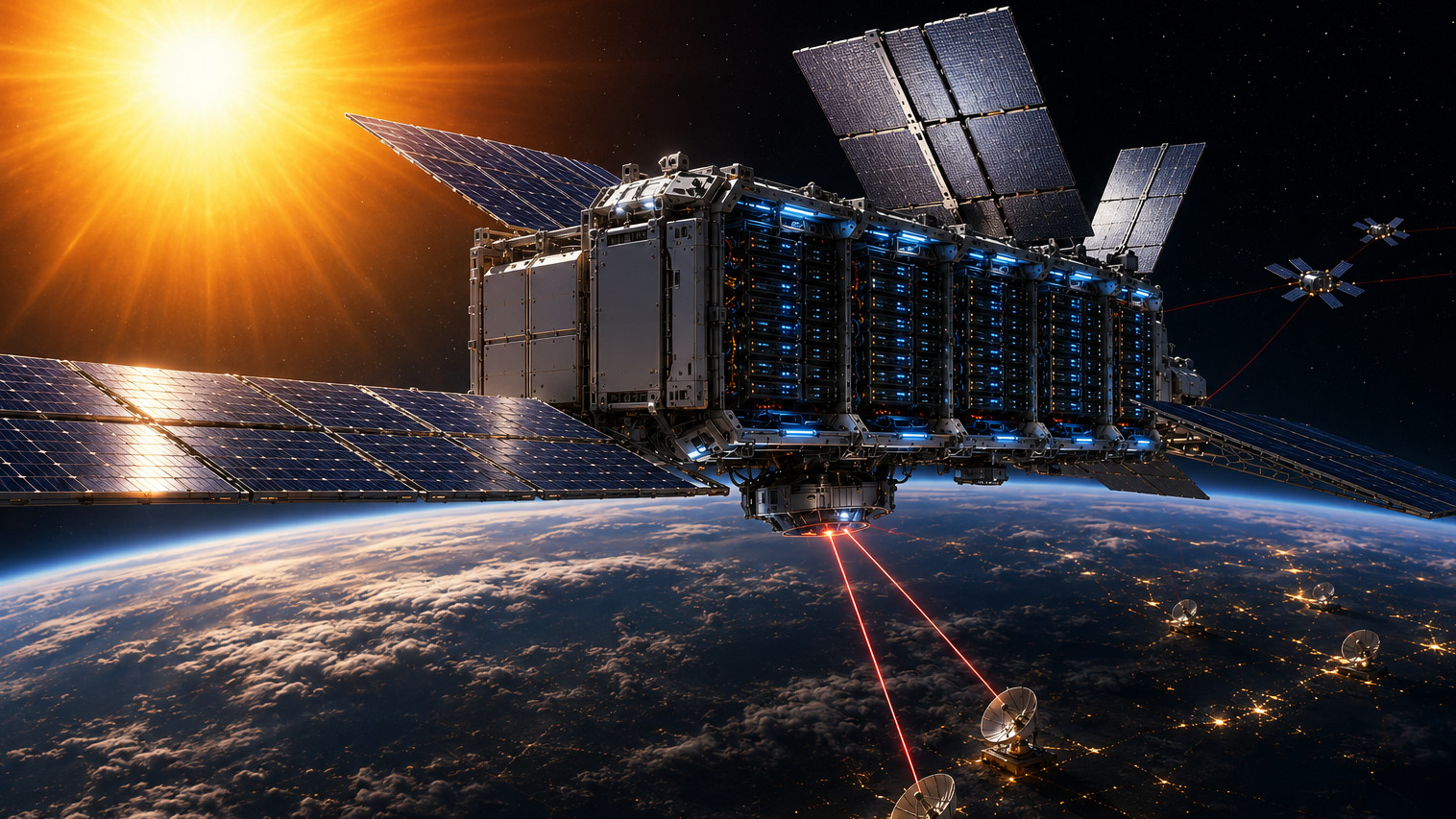
A vacuum is a wonderful thing to put around coffee and a terrible thing to put around a megawatt, and yet the smartest, best-funded companies in the world are racing to do precisely that. SpaceX recently unveiled AI1, its first orbital data center satellite, a 70 meter craft designed to sustain 120 kilowatts of compute, alongside a new Texas factory intended to produce a gigawatt of orbital compute per year by late 2027. Starcloud raised $170 million at a $1.1 billion valuation and has an FCC filing for an 88,000 satellite constellation.
Google’s Project Suncatcher is a moonshot that will put two prototype satellites carrying TPUs into orbit by early 2027. SpaceX made orbital AI compute a pillar of its IPO story while hedging in the same document that the technology may not achieve commercial viability. When the hedges and the capital both show up at this scale, the right response is not mockery or cheerleading. It is arithmetic.
Before the arithmetic, a distinction that most coverage blurs. There are two different bets here. The first is closed-loop orbital compute, where the data is born in space: Earth observation, defense sensing, autonomy, in-space manufacturing, and inference on sensor feeds that never need to touch the ground. That bet is already paying off, because processing imagery in orbit and downlinking insights instead of raw pixels saves bandwidth rather than spending it.
The second bet is the orbital hyperscale cloud, serving customers on Earth from racks in the sky. That is the leap, and it is the one the valuations are priced on. The question is not whether chips can run in space. Google, Nvidia, Starcloud, and SpaceX are already proving they can. The question is whether the landed cost of useful computation beats Earth after thermal rejection, launch mass, spectrum, replacement, and depreciation are all counted.
That question reduces to five numbers: sunlight, the band, heat, freight, and the downlink. The bull case rests entirely on the first. The other four are where the money goes.
Number one: sunlight, the reason anyone is doing this
A solar panel on a roof in Texas sees about a kilowatt per square meter at noon, then clouds, then night. Average it over a year and the panel delivers roughly 20 percent of its rated power. Put the same panel in the right orbit and it sees 1,360 watts per square meter, nearly continuously, with no atmosphere in the way. Google’s own framing is that an orbital panel can be up to eight times more productive than a terrestrial one.
Terrestrial AI buildouts are now gated by interconnection queues, substation lead times, and community opposition, not by chips. If your scarcest input is energy and space offers eight times the energy per panel with no permitting hearing, you can see why a strategist reaches for the launch pad. The bull case is not crazy. It is just incomplete, and the first thing it leaves out is hiding in the phrase the right orbit.
Number two: the band, because continuous sunlight is beachfront property
Most low Earth orbits spend a third to half of every revolution in the planet’s shadow, which means batteries, oversized arrays, and thermal cycling. The eight-times productivity figure depends on near continuous illumination, and the cleanest way to get it is the dawn-dusk sun-synchronous orbit, a narrow shell where a satellite rides the line between day and night and its panels rarely see darkness.
Other architectures exist, including the 600 to 800 kilometer orbits SpaceX has described for AI1, but they trade away some of the energy advantage that justified the trip. The most economically attractive version of this business concentrates in one strip of sky, and the major filings all lean toward it. It is the beachfront property of the energy argument, and like beachfront property, there is not much of it.
Here is what happens as you pack it. Each additional satellite needs more propellant for station-keeping and more frequent maneuvers to dodge its neighbors. The number of satellite pairs that must be deconflicted grows combinatorially with population, and while operational risk does not rise that fast in practice (altitude separation, phasing, autonomous avoidance, and traffic rules all absorb some of it), the direction is unambiguous and the management burden compounds.
There is also a thermal penalty if satellites are packed closely enough that their radiators see one another. The issue is not that nearby radiators create new heat. It is that they steal the view factor from cold space. A radiator works by facing a sink at roughly minus 270 degrees, and a radiator that instead faces another warm radiator has less effective sink to radiate into. The system must compensate with more area, wider spacing, hotter coolant, lower duty cycle, or active thermal machinery.
The marginal satellite in a crowded band is more expensive to operate and potentially worse at rejecting heat unless spacing and orientation preserve its view of cold space. That is a rising marginal cost curve, which is precisely the terrestrial disease that orbit was supposed to cure. And it carries a tail risk with no terrestrial equivalent. A breakup in a congested shell seeds a debris field that threatens every asset sharing the band. On Earth, one data center fire is one insurance claim. In a packed orbit, one collision can be a sector event.
So how big is the beachfront, in numbers? Worth doing the arithmetic, as an order-of-magnitude estimate rather than a hard limit. Treat the dawn-dusk band as a rough volume, 600 to 850 kilometers of altitude with satellites strung along orbital planes near the terminator. This is a first-order bracket, not the real architecture, which involves phased planes, RAAN and local-time spacing, disposal rules, and operator-by-operator coordination.
The FCC has pointedly declined to set a general separation number for large constellations, preferring case-by-case review, so the spacings below are engineering stress cases, not regulation.
One orbital plane at 700 kilometers is about 44,000 kilometers around. How many satellites fit depends entirely on how far apart you keep them. At 150 kilometers apart, the loose spacing cited for dense fleets to manage heat, you get about 290 per plane. At 50 kilometers, about 880. At an aggressive 10 kilometers, about 4,400. Stack a handful to a few dozen planes across 250 kilometers of usable altitude and the totals land in three bands: conservative packing gives roughly 1,000 to 2,000 satellites, moderate gives 8,000 to 10,000, and aggressive gives 80,000 to 90,000.
At 120 kilowatts of compute payload each, that is about 150 to 250 megawatts at the low end, around a gigawatt in the middle, and roughly ten gigawatts at the top. One detail worth flagging: that 120 kilowatts is compute payload, not all-in data center capacity. Terrestrial gigawatt figures include cooling, networking, redundancy, and power delivery losses, so the comparison is rough, not exact.
Starcloud’s FCC filing seeks up to 88,000 satellites in sun-synchronous orbit between 600 and 850 kilometers, which lands right at the top of the aggressive band. I cannot claim they derived that figure from a packing model, and I will not. But when an independent operator’s filing converges on the geometric edge of the same strip of sky, it suggests the ceiling is real and people are already pricing against it.
So the energy-optimal band realistically holds single-digit gigawatts of compute payload, perhaps ten if packed to the edge of safety. Earth is building hundreds of gigawatts, with single campuses now reaching one to five. The entire dawn-dusk shell, fully built, is worth a handful of terrestrial campuses. The orbit that makes the economics look best is not big enough to host a million-satellite hyperscale industry.
To reach that scale, orbital compute has to leave the dawn-dusk sweet spot, and the moment it does, it starts giving back the solar advantage that made the idea attractive in the first place. The grand vision and the pitch that justifies it pull in opposite directions.
Number three: heat, the constraint that sets the terms
Every watt that goes into a GPU comes out as heat. On Earth we remove it with moving air or moving water, which is why data centers are essentially plumbing with computers attached. In a vacuum the only exit is radiation, and radiation is governed by a 19th century equation: at a given temperature and surface emissivity, a square meter can only shed so much. A radiator near room temperature manages roughly 300 to 450 watts per square meter once it is also absorbing sunlight and the warm glow of the Earth below.
Engineers do have levers. Run the coolant hotter, radiate from both faces, orient the panel knife-edge to the sun, improve emissivity, cut mass per square meter. SpaceX’s AI1 design uses exactly those tricks, quoting 110 square meters of deployable radiator against 150 kilowatts of peak compute. Depending on whether that figure counts one emitting face or two, AI1 implies roughly 550 to 1,400 watts per square meter of heat rejection. The low end is aggressive but plausible for double-sided panels. The high end requires hot operation and excellent geometry. Take the range at face value and the napkin math still tells the story.
One megawatt of compute needs somewhere between 700 and 1,800 square meters of radiator. A gigawatt class facility, the unit hyperscalers now plan in, needs roughly 0.7 to two square kilometers of deployed radiator surface even at SpaceX’s own numbers, and more at conservative ones. Starcloud’s white paper describes a five gigawatt facility whose solar array alone measures roughly four kilometers by four kilometers, sixteen square kilometers of structure. For scale, the International Space Station’s radiator system rejects about 70 kilowatts. The plans on the table are thousands of times beyond anything humanity has deployed.
The deeper point is the asymmetry with launch. Launch costs fall on a learning curve because rockets are a manufacturing problem. The radiation cap at a given temperature is physics. The levers above buy real factors of improvement, but they are bounded and mostly already spent in designs like AI1, and running hotter to radiate more fights the silicon, which wants to run cool.
Number four: freight, the price of the ticket
Today a kilogram to low Earth orbit on a Falcon 9 runs roughly $2,700 to $3,000. And we no longer have to guess what an orbital data center weighs, because SpaceX published its own figure: AI1 delivers about 70 kilowatts of compute per ton, roughly 14 kilograms per kilowatt once the solar wings, radiators, and structure are counted. At that mass intensity, a gigawatt of orbital compute is about 14,000 tonnes of freight.
At today’s prices that is nearly $40 billion in shipping alone, before a single GPU is paid for. Google’s feasibility work puts the parity threshold near $200 per kilogram, plausibly reachable around 2035 if Starship flies at high cadence. At that price the same gigawatt ships for under $3 billion, and the conversation changes.
One caveat, and it cuts in the skeptic’s favor. A 70 meter spacecraft carrying solar wings, radiators, coolant loops, power electronics, comms, shielding, and the compute itself at well under two tons is a very aggressive mass claim. If 70 kilowatts per ton proves optimistic, every freight number above grows.
Notice what this means. The orbital data center is not really a data center business. It is a leveraged derivative on the price of a rocket. Every spreadsheet in this sector has a launch cost as the cell that everything else points to.
The modularity rebuttal, and why it answers the wrong question
The pushback to all of this is that nobody is actually proposing a single gigawatt satellite. AI1 is a 120 kilowatt node, roughly one high-end AI rack. The vision is a swarm of small nodes, and a swarm sounds reassuring: you launch them one at a time, a failure kills one node instead of the whole facility, and you can space them apart so their radiators don’t crowd each other’s view of cold space.
All true. But it answers a question nobody was really asking. The worry was never “one big satellite is scary.” The worries were freight cost, total radiator area, and a congested orbit. So the test is whether breaking the system into pieces actually moves those three numbers, and to see that you have to separate two kinds of quantity.
Some things scale with the total size of the system. The number of spacecraft, the number of links to coordinate, the damage from a single failure. Subdividing changes all of these.
Other things are fixed per watt, and stay fixed no matter how you slice the system. Think of a recipe: if a cake takes two eggs, then the same amount of cake takes the same number of eggs whether you bake it as one large cake or a hundred small ones. Cutting it into smaller pieces never changes the egg count. Mass per kilowatt and radiator area per kilowatt are the eggs. Each watt of compute drags its own fixed share of structure, solar, and radiator along with it, and adding those shares up gives the same total however you divide the hardware.
That is why modularity does not rescue the economics. A gigawatt is still about 14,000 tonnes of freight and the same square kilometers of radiator whether it flies as one impossible monolith or 8,000 separate craft, because those are per-watt costs and subdivision cannot touch them. What subdivision does change, it mostly makes worse: SpaceX’s own roadmap implies launching more than 6,000 AI1-class satellites a year to add a gigawatt a year, and every one of those thousands of craft adds to the conjunction load in the band and to the swarm of downlinks the network has to orchestrate.
So modularity buys exactly one real thing, graceful failure, and pays for it with coordination. It changes how the system breaks. It does not change what it costs or how much sky it needs.
Number five: the downlink, where the bits have to land
A data center is not measured by the compute it contains. It is measured by the bits it delivers to a customer, and this is where the orbital story gets quietly expensive. Laser crosslinks between satellites are genuinely fast, with demonstrated terabit-class optical hops. But customers do not live in orbit. Eventually the data must cross the radio link to a ground station, and that link is the rationed resource in the whole architecture.
Spectrum for those feeder links is coordinated under ITU power flux rules written to protect geostationary incumbents, which caps how hard a constellation can transmit toward the ground. Capacity per satellite per beam is finite. Ground stations are real estate, fiber backhaul, and antennas in specific geographies. Ka-band, which most high-throughput systems depend on, fades meaningfully in rain. And a data center is far more egress-hungry than the communications relays these rules were designed around.
A small example makes the texture clear. Moving one petabyte over a sustained 10 gigabit per second link takes about nine days. Frontier training runs deal in tens of petabytes. The gating metric for an orbital data center is not flops in orbit and not even latency. It is dollars per gigabyte landed in the customer’s geography at the required availability. Compute that cannot afford its own egress is not a data center. It is stranded capacity with a view.
The number nobody puts on the slide
There is a sixth factor, and it is the one I spend my working life on. A GPU is not a durable good. It fails at a rate of a few percent per year, and on a factory floor a technician swaps a failed accelerator in minutes. In orbit, a failed GPU is dead mass you keep paying to fly around the planet. Worse, accelerators are economically obsolete in three to four years, while the satellite carrying them is built for a five to seven year life.
You are launching hardware that will be two generations behind before its orbit decays. SpaceX has made AI1’s compute payload interchangeable across chip vendors, which is a tacit admission of the problem, but interchangeable means swappable at the factory in Texas, not at 600 kilometers of altitude.
On Earth, the economics of AI infrastructure are increasingly underwritten by the residual value tail. Yesterday’s training fleet becomes today’s inference fleet, then someone else’s fine-tuning cluster, then a resale line item. In orbit the residual value is zero. There is no secondary market in low Earth orbit. A true total cost model should carry full depreciation with no salvage, no repair, and no refresh. The terrestrial data center is an asset. The orbital one, at least for now, is a consumable.
Five outcomes for the next 10 years
Let’s look at the option space of outcomes. Ranked from likely to fantasy.
Near certain: closed-loop orbital compute wins quietly. Processing data born in space, in space, and downlinking insights instead of raw sensor feeds. The bandwidth math is overwhelming, the downlink problem inverts into a downlink saving, and the defense and Earth observation markets are already paying. This grows steadily and nobody calls it a data center.
Likely: demonstration clusters become a real niche. Tens of megawatts of orbital AI compute operating commercially by the early 2030s, anchored by defense, intelligence, and sovereignty workloads where customers fund a large premium to put data beyond any single jurisdiction, plus early commercial leases of the kind SpaceX is already signing. A niche, not a market.
Toss-up: parity for batch training by 2035. If Starship reaches $200 per kilogram at high cadence, delay-tolerant training could pencil against the most power-constrained terrestrial regions. Note the fork hiding here. Training tolerates latency but carries thermal density that is brutal to radiate. Low-power inference is thermally comfortable but latency-sensitive, the one thing orbit serves worst. The workload that fits the physics and the workload that fits the market are not the same workload, and this rung requires that tension to resolve.
Unlikely: orbital compute displacing terrestrial hyperscale builds. This requires the radiator economics, the congestion costs of the preferred band, the downlink bottleneck, and zero-salvage depreciation to all resolve favorably and simultaneously within a decade. Each is hard. Together they are a stretch no current demonstration supports, and the band economics get worse with every success that precedes them.
Fantasy: a million compute satellites as the default substrate of AI. The filings exist. The arithmetic does not. The energy-optimal band holds single-digit gigawatts before congestion bites, so a million satellites either does not fit the orbit that makes the economics work, or it abandons that orbit and surrenders the solar advantage that was the whole point. Either way the vision and its justification pull apart, and that is before accounting for a launch cadence hundreds of times beyond what humanity currently lifts each year.
The pattern is an old one in our industry. The technology is real, one number in the physics is genuinely favorable, and the timeline in the press release is borrowed from the funding cycle rather than from the engineering. Compute can move to orbit. Competent engineers would not debate that fact. The problem is the market confusing free sunlight with free infrastructure.


