With Apple unveiling macOS 27, or macOS Golden Gate, today at its annual WWDC event, the Intel Mac’s end has finally arrived. It was a good run.
This inevitability has been a long time coming. Last year, Apple said at WWDC 2025 that macOS 26 Tahoe would be the last major macOS release available for Intel Macs. This promise rang true today as Apple unveiled macOS 27, confirming it will only run on Apple Silicon-powered Macs.
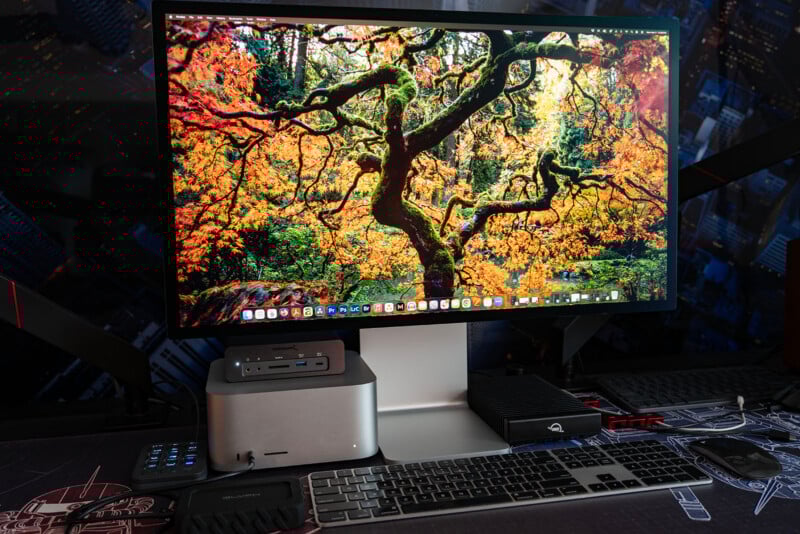
Arguably, the Intel Mac’s death knell sounded earlier this year when Apple unveiled its new Studio Display XDR and updated Studio Display, both of which arrived with some compatibility caveats, most notably that they are not officially compatible with Intel-powered Macs. Even more than ending major OS releases, this showed that Apple completely turned the page, leaving Intel Macs behind.
Now, it’s important to keep in mind that Apple’s last new Intel-based Mac, the Mac Pro (2019), was released nearly seven years ago. That’s a long time in technology. Apple isn’t doing a weird rug pull here. No company supports any platform forever.
However, Apple sold the Intel-powered Mac Pro until 2023, when the M2 Ultra-powered Mac Pro arrived. It’s certainly a shame for those who bought a Mac Pro (2019) just three years ago to be left in the dust so quickly. Admittedly, that’s a very niche user, and one that probably isn’t waiting even three years to upgrade their machine.
But this is not a time to mourn; it’s a chance to look back at Apple and Intel’s Mac relationship. Much like the end of Intel’s time with the Mac was announced at Apple’s WWDC event, so too was its beginning.
Way back at WWDC 2005, Steve Jobs took the stage to announce that Apple would switch from PowerPC to Intel processors. The transition completed the following year, and Mac mini, iMac, MacBook, and MacBook Pro models promptly hit store shelves with Intel Core processors. Intel Core Extreme, i-series, m-series, and Xeon processors were introduced in subsequent years, through 2019’s Mac Pro. The first-generation Apple TV even had an Intel chip when it was unveiled in 2007.
While the Intel Mac era was marked by notable missteps for Apple, including the much-maligned Touch Bar MacBook Pro models and the trash-can-shaped Mac Pro, it was also a time of significant evolution for the Mac and Apple overall. Apple launched the MacBook Air early in its Intel era, for example, one of its most important Mac lines.
Apple also launched the iPhone and iPad during the Intel era. While neither of these product lines ever incorporated Intel chips, aside from Intel modems, they undoubtedly influenced Apple’s broader approach to computing and products in general.
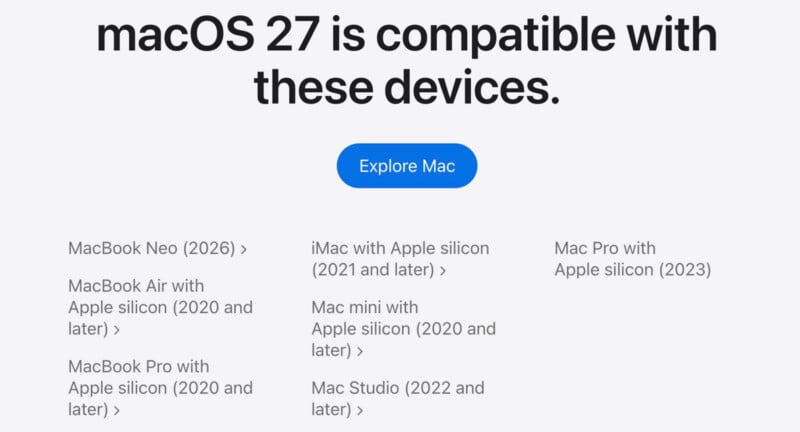
Intel Macs had a good run, but those photographers and video editors still working on one need to know what to expect moving forward. Major macOS updates are no longer coming, of course, but it’s also important to consider what might happen with applications. Developers can start requiring macOS 27 at any time, and apps will inevitably abandon older macOS versions in short order.
Ultimately, Apple was always going to have to leave Intel behind. Apple Silicon introduced new features, significantly improved performance, and an entirely different chip architecture. It is not possible to take full advantage of these capabilities on a deep software level while preserving compatibility with significantly worse and fundamentally different hardware.
Apple Silicon has ushered in an exciting new era for the Mac, arguably its best. But it is vital to remember that the switch to Intel kept Apple alive and growing for 15 years — one of the most important 15-year periods in Apple’s history.
Goodbye, Intel Mac.
Image credits: Apple. Header image created using an asset licensed via Depositphotos.com.


