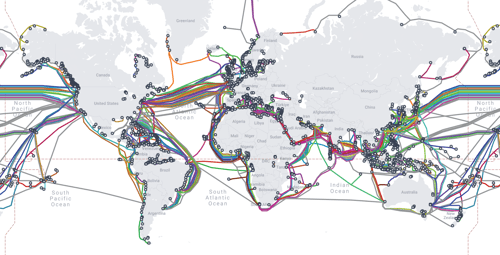
For those who work at the intersection of digital infrastructure and government, regulators, policy, private equity, and finance, you’ll want to make sure to meet us at PTC’DC this year.
As global telecom experts, our team at TeleGeography knows a thing or two about these intersections. We’re regularly cited in the press and have written about how geopolitics shapes telecom infrastructure.
We’ve compiled a selection of our experts’ insights on relevant topics you should brush up on before PTC’DC to make the most of conference conversations.
Quick info on PTC’DC
First, a few basics on this event. PTC’DC will take place on September 17, 2026, in Reston, Virginia, just outside of Washington, DC. The gathering will feature networking opportunities and distinct sessions on:
AI 2030: The Global Race for Power and Capital
Scaling Power, Land, and Infrastructure for the AI Economy
Fiber
Restoring Trust in Digital Infrastructure Through Community Alignment
How Do We Globalize AI and How Do We Make it Safe?
Essential resources for PTC’DC
Our telecom experts make it easy to get up-to-speed for events like PTC’DC through a variety of data-packed resources and analyses. We compiled some of the most relevant pieces here, including analysis on AI’s impact on telecom infrastructure. You can browse further through our Resources hub.
Let’s start with a little something from our last outing with the PTC team. Watch our Telecom Workshop from PTC 2026, led by TeleGeography Senior Research Manager Brianna Boudreau, Senior Research Manager Jon Hjembo, and Chief Research Officer Tim Stronge. Download the slides from this presentation here.
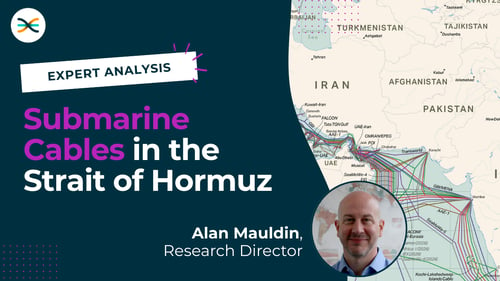
The Strait of Hormuz is a crucial artery, not only for the transit of oil and cargo but also for the data flowing through submarine cables on the seafloor.Given recent hostilities, which have included damage to data centers in the UAE and Bahrain, it is worth considering whether the potential risk to telecommunications infrastructure extends to the submarine cables in the region. Here’s what you need to know about cables in the Strait of Hormuz and in the region.
Iranian drone and missile strikes on three Amazon Web Services (AWS) data centers in the United Arab Emirates (UAE) and Bahrain caused a severe, cascading impact on AWS and its customers.Because the attacks caused physical damage to multiple infrastructure sites simultaneously, standard cloud redundancy models failed, leading to widespread regional and global disruptions. This post discusses the impact of the war in Iran on data centers and cloud architecture.
When TeleGeography Chief Research OfficerTim Strongetestified before congress about subsea cable infrastructure, cable routing issues came up. The U.S. House of Representatives just passed the Undersea Cable Protection Act, which eliminates a duplicative permitting requirement for undersea cables installed and routed through National Marine Sanctuaries, allowing these projects to proceed once all other federal and state permits are secured. Read Tim’s congressional testimony and watch the hearing.
Solid intelligence on AI infrastructure starts with TeleGeography’s seasoned team of global telecom experts. We collect and analyze industry-leading data you can’t find anywhere else—not even your LLM of choice. This is original, complete, and accurate research exclusive to TeleGeography users.
We’ve compiled resources here to help you understand current markets and forecasts for how AI is impacting transport networks, data centers and cloud, and enterprise networks.
In this episode of theTeleGeography Explains the Internetpodcast, senior analyst Lane Burdette takes listeners on a deep dive into the complex world of submarine cable economics. Lane breaks down:
What goes into building them
How much they cost
Who builds them
How operators make money in an industry where supply and demand are in constant flux.
Learn how regulations and governance impact connectivity and why we’re seeing certain cities at the top of our Market Connectivity Score rankings again and again.
Undersea cables are crucial to the global economy and national security. Governments and regional industry groups are considering how to enhance submarine cable security and resilience. A report by TeleGeography and Infra-Analyticsoutlines the necessary steps to sustain current service levels and minimize repair delays for undersea cables that carry global internet traffic, including a comprehensive examination of the regulatory and geopolitical environments that impact cable maintenance and repair.
Last Step? Register for PTC’DC!
Register here to secure your spot for PTC’DC 2026. Our team hopes to see you there.

-1.png?width=392&height=186&name=Mock_Market_Connectivity_Score%20(1)-1.png)