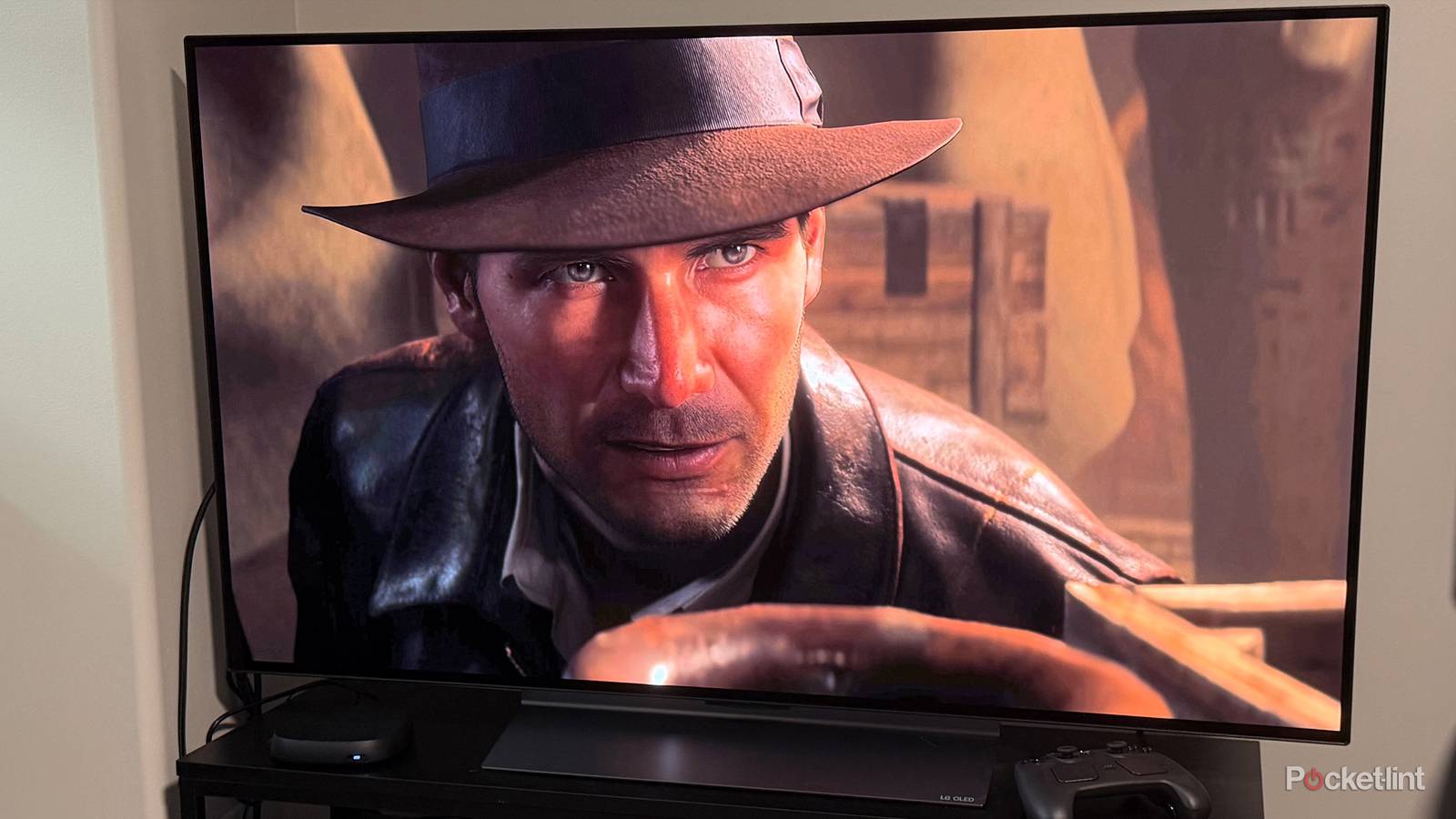
As much as I talk about the importance of choosing the right tech for home theater and PC gaming systems, I really do sympathize with the people who want a plug-and-play experience. If I put you in a new car, or on a new PEV, you’d rightly be frustrated if your previous driving/riding experience wasn’t enough to make it go. A TV is an even more casual contraption. The last thing you, I, or anyone want after a hard day at work is to spend another few minutes (or hours) troubleshooting to get a movie playing properly.
Switching cable technologies might seem an unnecessary complication in that sense. In the long term, though, I think the TV and computing industries are going to have to settle on a shared format, whether it’s DisplayPort, HDMI, or something else. In fact, even if the industry does settle on something like DisplayPort, it probably won’t look like it does on the back of your PC’s graphics card. You’ll understand what I mean later on.
What makes DisplayPort better than HDMI?
Raw performance and flexibility

It’s definitely not connector design, to get that out of the way. The standard DisplayPort (DP) connector is so similar to HDMI that at a glance, it’s easy to mistake the two. There aren’t any parallels with USB-C, which is not only more compact than USB-A, but reversible.
What really makes DisplayPort preferable, when it’s available, is its raw bandwidth. DP 2.0 or later simply crushes HDMI 2.1, with up to 80Gbps (gigabits per second) of throughput versus 48Gbps. Even DP 1.4 offers over 32Gbps, making HDMI 2.0’s 18Gbps look pathetic. HDMI 2.2 does support 96Gbps — but at the moment, a cable is all you can buy with that technology. The first 2.2 devices aren’t hitting the market until 2027.
You might not be used to thinking of AV cables in terms of bandwidth, but it can make a huge difference. Case in point: a mismatch between frame and refresh rates inevitably results in visual artifacts like screen tearing. DP 2.x connections are capable of uncompressed 4K video at 240Hz, meaning there’s effectively no limit on smooth motion while maintaining fidelity. Refresh rates over 120Hz are, admittedly, just nice to have at the moment — few games will hit 120fps, never mind movies — but device makers are always striving towards smoother interfaces, and at some point, the transition to 8K will bear fruit and increase performance demands. Any recent DP iteration can tackle 8K with ease, whereas HDMI 2.1 can’t achieve acceptable refresh rates without compression.
There’s more. Whereas DP has long supported features that automatically sync refresh rates with framerates (like Nvidia’s G-Sync), that wasn’t an option with HDMI until 2.1. There are also no practical limits on color depth or audio quality over DP, whereas stepping down to HDMI 2.0 will instantly eliminate lossless audio, and cap color depth to compressed 10- or 12-bit forms. That means no lossless Dolby Atmos, and a hard ceiling on HDR, which could come back to bite you once Dolby Vision 2 and HDR10+ Advanced become mainstream.
As if that weren’t enough, DP supports daisy-chaining devices (via Multi-Stream Transport), and DisplayPort Alt Mode, which allows signals to pass over USB-C or Thunderbolt. It’s hard to overstate how important Alt Mode is — some laptops can operate entirely off a single USB-C cable plugged into a monitor, receiving power at the same time, and it would be amazing to have that option on a TV. While you can find HDMI ports on many computers, the format is so heavily geared towards home theaters that such conveniences haven’t even been on the radar.
Not to say DP is perfect. The biggest gaps are equivalents to CEC and ARC. When you plug a speaker into your TV’s HDMI ARC or eARC port, it’s readily available to native apps and any other HDMI device. And with CEC, that speaker will turn on and off automatically, while also supporting volume control via your usual remote. If DP were to take over, some variation of these features would absolutely have to be added. I should note that while CEC is technically supported over DP 1.3 or later, I’ve never seen this in action.
The allure of a DisplayPort takeover
And why unification probably makes more sense

Until now, DP has been consistently ahead of the curve. HDMI 2.2 might temporarily steal DP’s throne next year, but all it would take is a DP 2.2 update to reset things back to the typical status quo. Who knows, maybe there won’t be another DP release. There almost certainly is one under development, however, and it’s frustrating to think that another generation of TVs might go by before home theater enthusiasts get to enjoy those features.
What might make more sense than a takeover, then, is unification. Soon, performance might no longer be a serious barrier, but feature compatibility will be. If the HDMI and DP groups can settle on true interoperability, the only practical difference (in many circumstances) might be which connector you have to use. I think we can all get behind the idea of an adapter cable that isn’t bottlenecked by one format or the other.
The entire tech world needs to wake up to the fact that a cheap and lazy approach in the short term can hurt in the long run, if it means customers are inconvenienced and have less to be excited about.
The best thing would be if TVs and computers alike simply switched over to USB-C, but that’s not coming anytime soon. USB 4 v2 does have the bandwidth, since it offers speeds between 80 and 120Gbps. PC makers are reluctant to include it for price reasons, though, and if so, TV makers are liable to flee in terror. They’re so obsessed with profit margins these days that many TVs are stuck not just with lingering HDMI 2.0 ports, but USB 2.0. As I like to point out, USB 2.0 is so ancient that there are grown men and women who’ve never known a world without it.
Another factor militating against unification is simpler: complacency. The philosophy seems to be that both standards are good enough in their respective camps, never mind the squandered potential, or the occasional feature conflict. There could be legitimate concern about alienating customers who’ve invested in one ecosystem or another — yet it should be possible to ease the transition, and on the opposite side, owners of TVs, computers, consoles, and other devices might not have to worry so much about which cable goes with what product.
That’s part of the appeal of USB. Maybe that isn’t the best example, mind you, knowing that over the past decade, tech companies have let that standard become extremely fractured, beyond the split between DP and HDMI. It’s ridiculous that one port on your PC might let you run a powerful external graphics card, while another might take an entire night just to backup your hard drive. Arguably, the entire tech world needs to wake up to the fact that a cheap and lazy approach in the short term can hurt in the long run, if it means customers are inconvenienced and have less to be excited about.

- Brand
-
Dell
- Screen Size
-
52-inch
- Display Technology
-
IPS
- Resolution
-
6K


