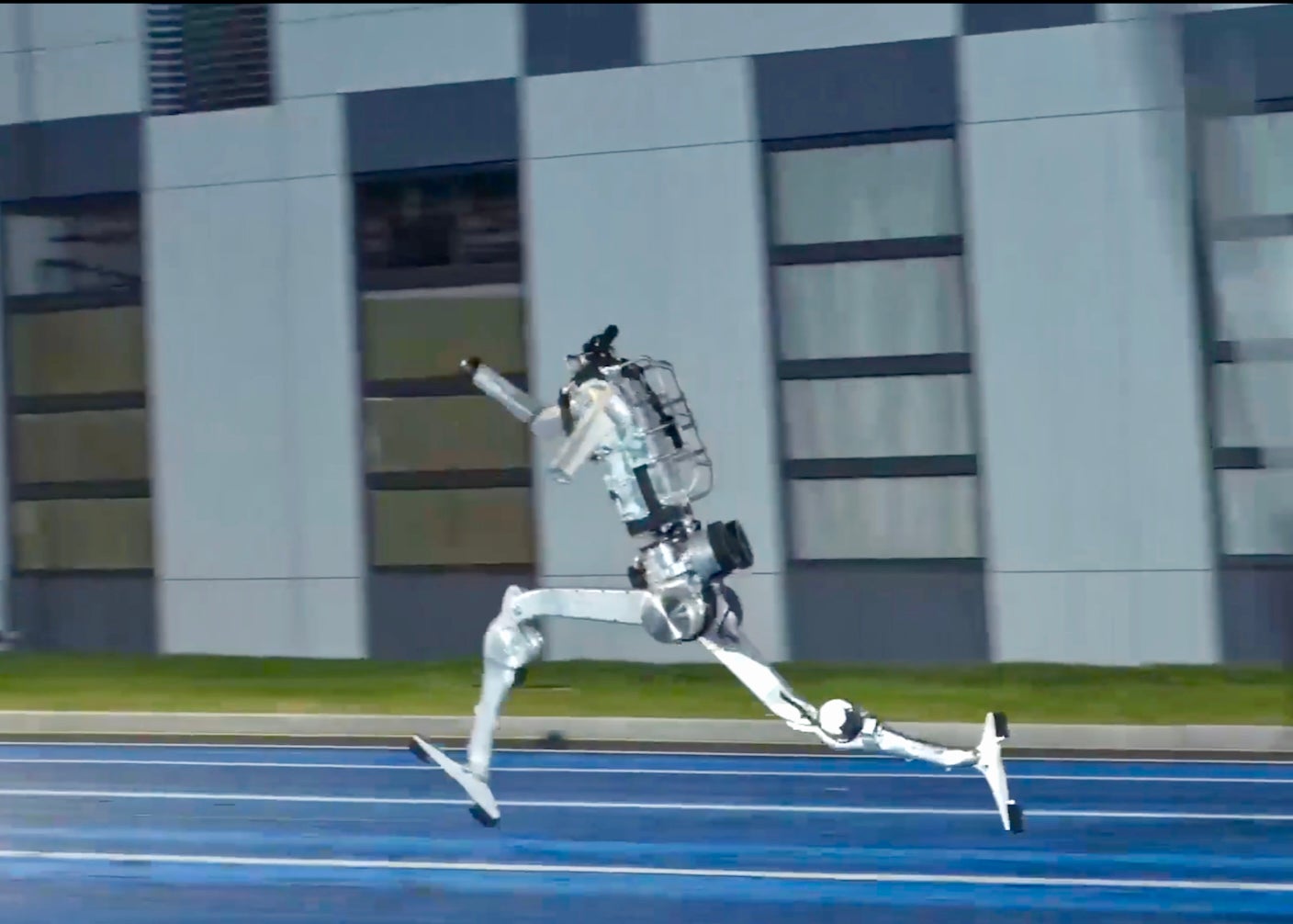
Increasingly, companies are building humanoid robots that perform impressive athletic feats to mark the field’s progress. Now, Chinese robotics company Unitree says its new “Superman” robot can run 12.66 meters per second, faster than Usain Bolt’s top recorded speed.
Getting a humanoid robot to run at all requires split-second control and has been a significant engineering challenge occupying roboticists for decades. That’s why sprinting, as well as jumping, have become popular targets for robotics companies keen to demonstrate their technology’s prowess.
Unitree’s latest demonstration pushes the boundaries by not only outrunning the fastest human ever, but also jumping around 6 feet 7 inches into the air from a standing start, a full foot more than the human record.
“This new machine has only been in development for a little over three months, with significant room for further improvement in the coming months,” Unitree said in an X post that accompanied a video of the accomplishments.
The records have not been externally verified, and the sprinting speed was a peak reading taken over a shorter stretch rather than a full 100 meters like Bolt’s record. The robot’s legs are also only 2 feet 9 inches long, according to Unitree, which results in an ungainly, arm-waving gait while running.
The effort is nonetheless impressive and adds to Unitree’s growing reputation as the company leading the pack of humanoid robot developers. And the timing of the announcement was no accident, coming just days before Unitree’s stock market debut and shortly before the World Humanoid Robot Games, which opened on August 22.
The company’s Shanghai IPO was a blockbuster, recording an initial 629 percent gain on the company’s first day of trading. It was briefly valued at around $66 billion before closing at a more modest $51 billion. However, some analysts have cautioned the excitement around the company’s technology may be getting ahead of market realities.
“The IPO is expensive, and the investment risk is already quite high,” Wang Zhuo, partner of Shanghai Zhuozhu Investment Management, told Reuters. “Unitree generates much of its sales from research and demonstrations, but wider application is still far away.”
But the company holds a dominant grip on the emerging humanoid market that may justify some of the hype. Chinese firms control roughly 90 percent of the global humanoid robot market, with Unitree alone shipping 5,500 of the 13,000 to 18,000 humanoids sold worldwide in 2025, the most of any manufacturer. In contrast, US humanoid champions Figure AI, Agility Robotics, and Tesla each shipped around 150 units.
China’s success is down to “a combination of policy support, public investment, mature supply chain, and advancements made in AI software and hardware,” Lian Jye Su, a tech analyst at consultancy firm Omdia, told Rest of World.
This is leading to an increasingly combative response from the US. On July 29 the Federal Communications Commission banned new imports of foreign-made humanoid and quadruped robots. The move was framed as a matter of national security, though it has also been seen as an attempt to give domestic developers a leg up.
Beijing predictably objected, with foreign ministry spokesperson Mao Ning telling a press conference that “protectionism does not make the US more competitive, and it will only hurt the interests of US companies and consumers.”
Given the rapid progress made by companies like Unitree, it seems likely it’s going to take more than trade barriers for the US to catch up. In the meantime, we might see more human athletic records fall to China’s leading humanoid developers.


