
Companies can expect consumer support for climate action — even from climate-skeptical Republicans — provided they talk about initiatives in the right way, according to a survey of 2,000 U.S. voters.
The Republican-Democrat split on climate is real but more nuanced than is sometimes assumed, the survey found. Around three-quarters of all respondents, for example, agreed that companies have a responsibility to limit their impact on climate and the environment. Support among Republican voters for that statement was lower, but not by much: more than two-thirds said they also agreed.
Voters of all stripes are also willing to support companies that back climate initiatives and punish those that don’t, said survey authors from the nonprofit Center for Climate and Energy Solutions (C2ES) and maslansky + partners, a communications agency.
Climate commitments
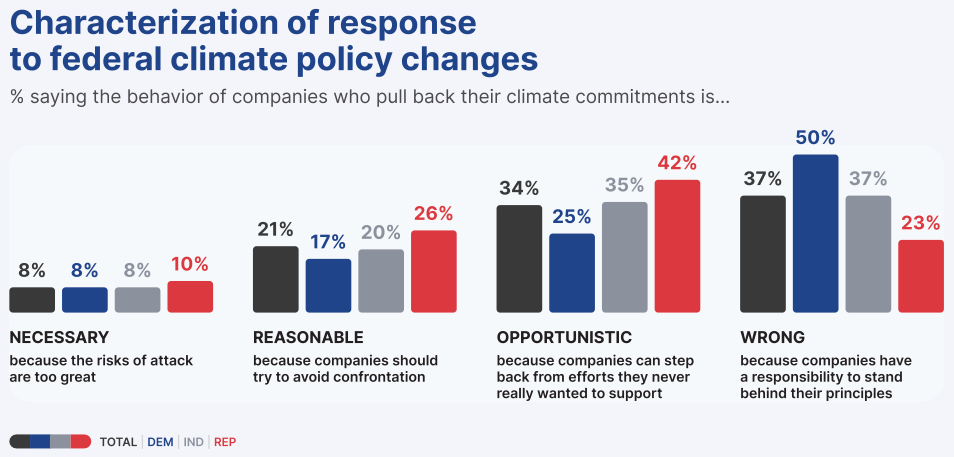
More than 60 percent of respondents said they would be more likely to buy products and services from companies that use more clean energy or reduce carbon pollution. And backtracking on climate initiatives in response to government pressure was described as “opportunistic” or “wrong” by 71 percent of all voters and 65 percent of Republicans.
“I was surprised by that,” said Nicholle Manners, a senior vice president at maslansky.
How to talk about climate action
Public opinions surveys often find a larger Republican-Democrat divide on climate issues, an apparent contradiction that may have its roots in how voters characterize climate initiatives. To win support, the survey suggests, companies should bear these key results in mind.
- Avoid the “political” label. Sixty-three percent of respondents said businesses should avoid engaging with politics, but climate action is not always characterized that way. Less than half of voters said companies that commit to using more clean energy were taking a political stand, for example.
- Emphasize practical considerations and avoid jargon. Asked whether companies should be “advancing responsible, long-term energy solutions” or “accelerating the net-zero transition,” for example, just over three-quarters of respondents chose the former.
- Focus on business arguments. Seventy percent of voters said companies should reduce climate impacts because it encourages long-term planning — including 71 percent of “climate-skeptical” Republicans, whom the survey defines as inclined to associate many climate terms with a progressive agenda.
“I did not expect climate skeptical Republicans to agree that this is smart business,” said Verena Radulovic, vice president for business engagement at C2ES. “That was really encouraging to see.”
The results provide positive food for thought for companies mulling climate communications strategies, but also contain a note of concern: All the climate actions covered in the survey were perceived as having become more political in recent years. Companies that decided to end the use of fossil fuels, for instance, were categorized as “taking a political stance” by 40 percent of Democrats in 2024 and by 55 percent in 2025.
The Potential Energy Coalition, a nonprofit marketing firm that promotes public demand for climate solutions, also contributed to the survey.


