
1
Verizon says its legacy telco turnaround is gathering pace, but that its bigger opportunity lies with AI infrastructure – connecting data centers, metro centers, and edge premises; starting with a big Google DCI deal already, and with more to come in 2027, possibly displacing its top-earning services in the mid-term. Meanwhile, its Q2 results show a leaner business and a sharper portfolio, it claims.
In sum – what to know:
AI growth engine – Demand from hyperscalers and enterprises for AI connectivity, dark fiber, and edge services, starting with a big DCI deal with Google, will generate multi-billion dollar revenues from 2027.
Metro inference – Investment in long-haul and metro fiber, plus conversion of offices into data centers, position Verizon to support AI from cloud to edge; margins will match / exceed old telco portfolio.
Value proposition – Simpler consumer offers, lower churn, stronger subscriber growth and AI-driven automation lifted revenue, cash flow and profitability in Q2; Verizon has raised guidance as a result.
Verizon chief Dan Schulman provided a handy overview of a jet-heeled new direction of travel for telcos with serious fiber footprints during a Q2 earnings call at the end of last week (July 24) – including detail of a $1 billion deal with Google to use its dark fiber to connect data centers, and mention of more to come in 2026 to drive its revenue growth by “multiple billions” in 2027. “This is just the beginning,” he said. “The build-out of AI infrastructure across the US is one of the largest capital cycles of our lifetime, and Verizon is uniquely positioned to participate in it.”
On the call, Schulman cited “other deals” to be announced “by year-end”. He said: “Taken together, [they] are expected to be worth multiple billions of dollars… over the next several years. These are long-duration, high-quality contracted revenue streams from some of the most demanding infrastructure customers in the world.” Besides, Verizon is retrofitting “many” of its central offices “into data centers” to run metro-edge inference workloads, he said. The firm is engaged in “multiple conversations” with partners to utilize its sites, he suggested.
All told, Verizon is looking at a net-new revenue stream, effectively, in 2027 – which will grow “substantially” over the next “five-to-10 years”. Revenue from straight mobile and broadband access services will “accelerate” through the rest of 2026, he suggested, topping out at around four percent year-over-year in the final quarter. But that is “independent of the incremental AI infrastructure revenue that begins to layer into our results starting in 2027” he said. “Our core business is accelerating and a new revenue growth vector arrives on top of it next year.”
He later described the margins for its so-called AI Connect suite as “meaningful”. The AI Connect portfolio covers its optical lit transport and custom dark fiber routes to link heavy-duty AI data centers and cloud regions, plus extended ecosystem elements like hosted edge data centers and private 5G, as well as its programmable API-driven network fabric and self-service tools. “These AI Connect revenues are on top of what is an accelerating core mobility and broadband business,” he said. They are also “equal to or greater than” its “existing margin structures”, he said.
He added: “This is a very different revenue growth profile than Verizon has had in a very long time.”
There was a note of serendipity in Schulman’s review of Verizon’s position in the developing AI infrastructure landscape. Schulman said: “We own one of the most extensive long-haul and metro fiber footprints in North America. We have spent decades building the kind of carrier-grade, low latency, highly resilient transport network that hyperscalers need to connect compute-to-compute, model-to-model, and region-to-region. We built that infrastructure for a different era, but it has turned out to be exactly the right asset for this one.”
Responding later to a question on the call from Michael Rollins, in the research division at Citigroup, he described the AI opportunity for telcos – right now, through 2026, going into 2027, as demand for high-end connectivity, still focused on inter-rack comms a year ago, has exploded between data centers and AI clusters, and also starts to register in transport and access networks closer to the edge. “[A year ago] it was clear that there was a kind of once-in-a-generation opportunity for Verizon to participate in the massive AI infrastructure build-out,” he said.
“As we talked to hyperscalers, alternative cloud providers, enterprises, there is a need for ever-increasing compute power. I mean, everybody knows that; everybody is hearing about it. And the way that compute power has moved over the last year or so is, at first, it was about optimizing racks, and then it was basically saying how do we combine racks within a data center to optimize compute power. And now it really is about how do you connect data center to data center to assure that you can optimize and maximize the ever-exploding need for compute.
“And while that data center connectivity demand is exploding, there’s an equal amount of desire and demand to power inference models and applications that need ultra low latency like robotics or remote surgery, autonomous driving and move that out into the edge as opposed to these big massive data centers. And clearly, our long-haul and metro fiber networks, whether that’s dark or lit, depends on the customer. Some of them want it dark, so they can do the electronics around it; some want it lit, so we do all of the servicing around it.”
He added: “But whether it’s dark or lit, our assets are kind of suddenly in tremendous demand for that data center connectivity. And we have thousands of central offices, many of which [we] were taking copper out of, and we are retrofitting them to be remote data centers that are power-ready, permitted, fully redundant infrastructure. We did a small trial on that and sold-out capability in 24 hours. So we’re seeing large demand for that as well.”
Besides, Schulman also spoke on the call about Verizon’s proposed 50/50 joint venture with UK-based BT Group, to combine their international operations as a new $4 billion global enterprise provider, serving around 3,000 customers across 180-odd countries. The deal, expected to close in 2027, will see the US firm pay $625 million into the bargain as an “equalisation payment”, but also deliver around $200 million in annual savings, said Schulman. It will combine “Verizon’s network strength and international enterprise wireline team with BT’s deep historic footprint”, he said.
“We are creating a stand-alone leader in the global connectivity market dedicated to supporting the digital future of multinational organizations.”
More presently, Schulman said Verizon’s “exceptional” Q2 results, for the three months ended June 30, show that its transformation is driving a “structural inflection” already since he took charge in October last year – with improvements across the board, in terms of higher subscriptions, lower churn, and higher cash flow. In particular, Schulman said the company’s new consumer proposition is paying off, and shifting the firm decisively away from the traditional telco model of attracting and retaining customers through complicated plans, promotions, and subsidies.
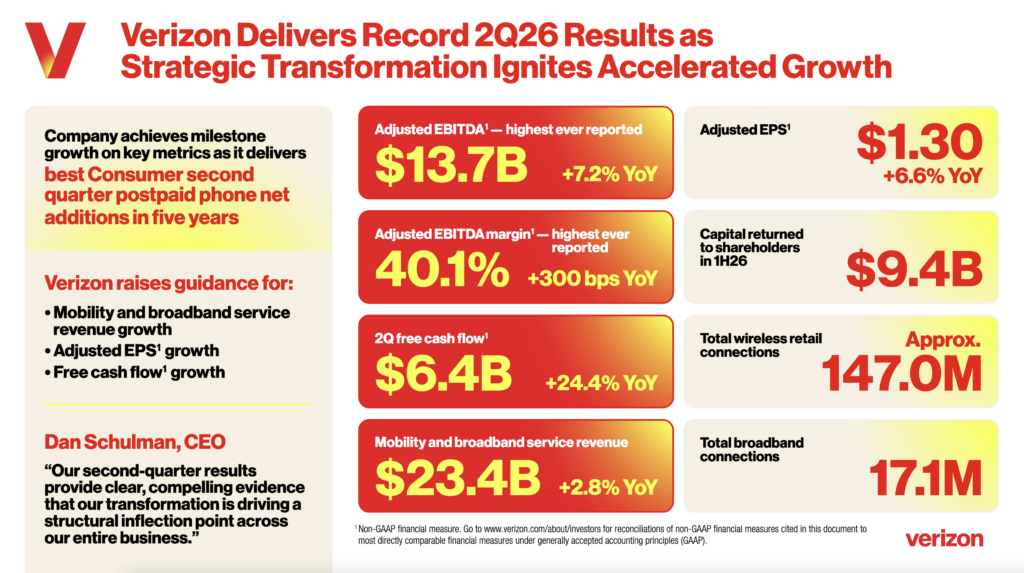
In sum: the operator delivered 184,000 postpaid phone net additions in the quarter – its strongest consumer second-quarter performance in five years and an increase of 193,000 year-on-year – while mobility and broadband net additions exceeded 550,000. Broadband momentum remained a key growth driver, with 348,000 net additions in the quarter (up 12.3% year-on-year), including 193,000 fixed wireless access and 155,000 fiber additions, taking Verizon’s combined fixed wireless and fiber broadband base to approximately 17.1 million connections.
He cited: a broader loyalty programme, which Verizon says is available to every customer without changing plans, including benefits such as cashback, rewards and the removal of activation and upgrade fees; a simplified flat-rate wireless offer (Simplicity) for $45, designed to remove complexity (“one plan, one price, no games”); and its new mobile and broadband package (Verizon One), which combines both services on a single $70 bill with integrated support (“one price, one bill, one call”). “This is what convergence is supposed to feel like for a customer,” he said.
Its new value proposition and loyalty program are designed to provide financial discipline, he suggested, and move the company beyond just chasing hopeful returns on expensive promotions. “They do not require us to spend our way to growth, and they are designed to compound the operating leverage you are already seeing. As I mentioned, our initial results are extremely encouraging across every metric.” Before the kickback from big-ticket new AI interconnect supplies kick-in in 2027, Verizon is already seeing better returns from its standard telco propositions.
Consumer postpaid phone churn fell to 84 basis points in the quarter (from 90 bps in Q1 and 95 bps in Q4 2025), which Schulman called a “step change” after years of deterioration. The company is adding customers more efficiently, he said, with promotional acquisition costs down by approximately 15 percent year-on-year and retention costs down by 17 percent, as it shifts away from heavily subsidised promotions towards its new offers. The company has returned to net new account growth over the past two months – so it is now growing both accounts and lines.
And all the operational discipline appears to have translated into stronger financial performance. Mobility and broadband service revenue increased 2.8 percent versus the year-ago period to approximately $23.4 billion, and from 1.6 percent growth versus the first quarter of 2026. Verizon expects growth to approach three percent next quarter, and four percent in Q4. Adjusted EBITDA reached a record $13.7 billion (up 7.2 percent year-on-year), with adjusted EBITDA margin expanding to 40.1 percent (from 37.1 percent).
Adjusted EPS rose to $1.30 (up 6.6 percent). Free cash flow reached $6.4 billion in Q2 (up 24.4 percent), contributing to first-half free cash flow of $10.2 billion (up 16 percent), prompting Verizon to raise its full-year free cash flow growth outlook to 9-10 percent, and increase its share buyback target to up to $4.5 billion. In the end, the line from Schulman is familiar in telco circles: networks for AI (as discussed), convergence (as above; per also its accelerated Frontier integration; per AT&T’s results last week), and also AI for networks.
The company said AI models are now helping identify and resolve network issues in minutes rather than hours.


