.png "Viettel Global Eyes First New Market in a Decade")
Hanoi-based Viettel Global recently caused a stir when it pledged to invest more than half a billion dollars in the Dominican Republic—its first overseas launch in a decade.
Since its establishment as Viettel Group, the telecoms division of Vietnam’s Ministry of Defence, in 1989, the organization has grown into one of the country’s largest telecoms operators, with a strong presence in the mobile, fixed broadband and fixed voice sectors via its Viettel Telecom unit.
Operating as Viettel Global outside of its domestic market, the company is formally known as Viettel International Investment Corporation and was established in October 2007 to manage Viettel Group’s many international telecoms businesses.
Here’s a look at Viettel’s existing international footprint and the organization’s options as it expands in the Dominican Republic—powered by data you can find in TeleGeography’s GlobalComms Database.
A current snapshot of Viettel Global
Viettel Global’s operations currently include: Viettel Cambodia (Metfone), in which it owns a 90% stake; Unitel in Laos (49%); wholly-owned Viettel Timor-Leste (operating as Telemor); Haitian operator Natcom (60%); Viettel Peru (Bitel), in which it holds a 100% stake; 70%-owned Movitel Mozambique; Viettel Cameroon, operating as Nexttel (70%); 85%-owned Viettel Burundi (Lumitel); 99.99%-owned Viettel Tanzania, trading as Halotel; and Myanmar National Tele & Communications (Mytel), in which it holds a 49% stake.
Over the years Viettel has expressed an interest in various international markets, including Cuba, Venezuela, Paraguay, Argentina, Slovakia, Cote d’Ivoire, the Democratic Republic of Congo (DRC), Ethiopia, Madagascar, Rwanda, Swaziland, Uganda, Nigeria, Malaysia, Indonesia and Senegal.
About Viettel Dominicana
Another oft-stated target market is the Dominican Republic but given its lack of overseas activity since entering Myanmar in 2018, it was something of a surprise when Viettel unveiled grand plans to invest USD560 million in the establishment of a new ‘overseas economic organisation’ called Viettel Dominicana. The investment, the group noted, will be carried out in line with Vietnamese regulations and the laws of the Dominican Republic.
The proposal was approved by the group’s board of directors on April 17th, but the development was not made public until the following month. The final corporate structure and any potential local partners will be determined at a later stage. In the first two years of operation, Viettel will prioritise investment in mobile and fixed broadband infrastructure, with nationwide rollouts on the cards. Further down the line the company plans to expand its operations to encompass data centres, cloud computing, cybersecurity, IT solutions and digital logistics.
Viettel’s options in the Dominican Republic
At this juncture, it is unclear if Viettel is eyeing an in-market takeover opportunity in the Dominican Republic, or whether it will prioritize a greenfield rollout. Altice Dominicana—the country’s second largest operator in terms of subscriptions—was deconsolidated by its cash-strapped parent company late last year and would represent a viable acquisition target. Additionally, market minnow Trilogy Dominicana (Viva) has also experienced financial strife in recent years and was blocked from bidding for 5G spectrum in 2024 after concerns were raised over its ability to pay its bills. In fact, the only company likely to be out of bounds would be Claro Dominicana, which is backed by regional heavyweight America Movil.
Alternatively, Viettel could opt to bid on frequencies in the country’s planned multi-band spectrum auction. Specifically billed as an ‘international tender’, the bidding process will encompass 5G-suitable frequencies in the 700MHz, 1700MHz/2100MHz (AWS), 2300MHz-2400MHz and 3500MHz-3700MHz bands.
The deadline for submitting bids is June 16, 2026, and the opening of the financial bids will take place on July 28, 2026, with the final licence awards taking place in August 2026. The tender stipulates that the winning bidders may carry out—in lieu of 30% of the total amount to be paid—digital divide development projects and universal service rollouts.
With the auction deadline looming, Viettel’s plans are likely to crystallize in the coming weeks.
A renewed focus on Latin America?
Although Viettel Global’s operational footprint is heavily focused on Asia and Africa, its businesses in Haiti (Natcom) and Peru (Bitel) represent crucial elements of its portfolio. For many years Viettel’s name was regularly floated as a likely bidder every time a spectrum auction was announced, or an asset came up for sale. With the group’s footprint remaining static for much of the last decade, Viettel has faded from view, but its plans to establish Viettel Dominicana will ensure that it becomes part of the wider conversation once again.
In Panama the National Public Services Authority (Autoridad Nacional de los Servicios Publicos, ASEP) recently unveiled a tender to attract a third operator, which will include a 20-year, 5G-suitable licence in the 3500MHz-3540MHz (3.5GHz) range.
Applicants must be able to demonstrate at least five years of experience in the mobile sector, serving a minimum of 500,000 active users – both obligations easily fulfilled by Viettel. Interested parties must submit prequalification documents to ASEP by 11 August.
Elsewhere, Madrid-based Telefonica is actively seeking a buyer for its business in Venezuela, as it moves to conclude its Latin American exit strategy, while Paraguay’s cash-strapped state telco Copaco is seeking a strategic partner to overhaul its operations and stop it from hemorrhaging cash.
With a history encompassing greenfield rollouts, opportunistic takeovers and strategic partnerships, Viettel is likely to be open to all possibilities as it seeks to expand its presence in Latin America.
Data on mobile markets, fixed broadband, fixed voice markets, and more
At TeleGeography, we’re the telecom data people— 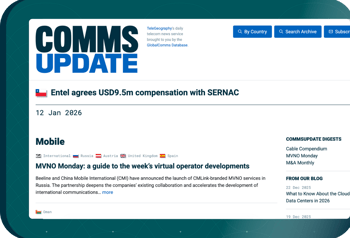 the experts from whom industry leaders get their data. You can get more analysis like this (and the data behind it) with a subscription to TeleGeography’s GlobalComms Database.
And with this subscription, you also get daily CommsUpdate emails: a curated telecom news service produced by our team.



.png&description=Viettel+Global+Eyes+First+New+Market+in+a+Decade)