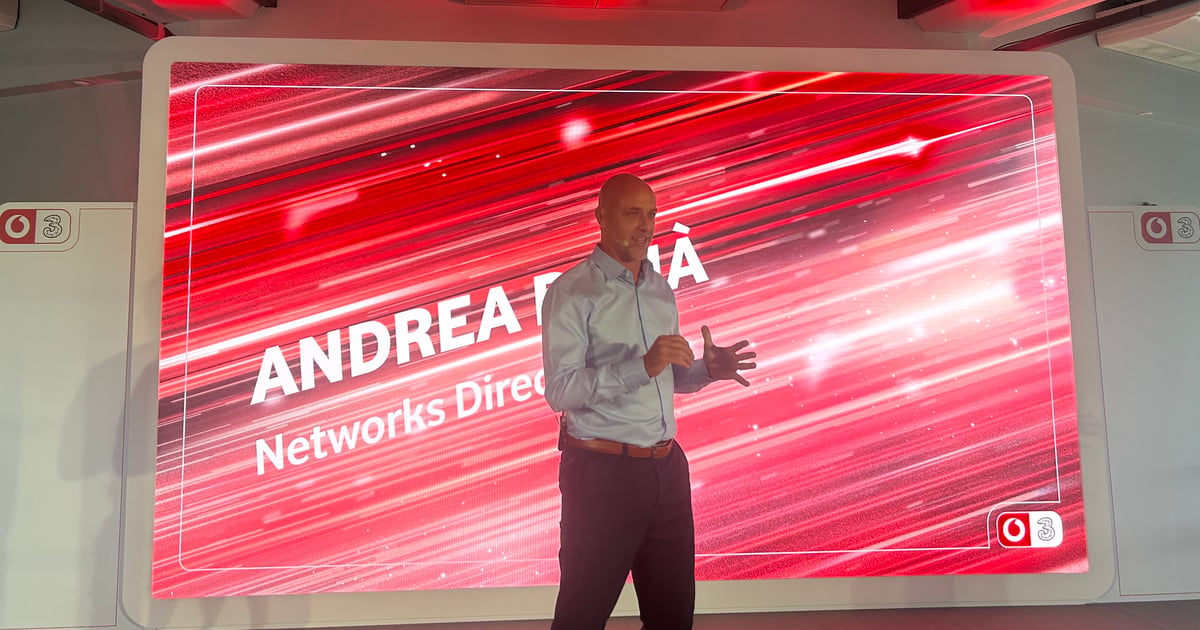
At Thruxton Circuit in southern England, where VodafoneThree this week took reporters and analysts for a speed-themed day, petrolheads can tear around the racetrack with no restrictions. The smartphone experience on the UK’s mobile networks is sometimes more like driving on a traffic-jammed road. Days after BT-owned EE opened a 5G “Fast Lane” for customers in a hurry and willing to pay a premium, VodafoneThree claims to have outmaneuvered its big rival with a new “SuperMobile” offer.
The update comes more than a year after the merger between Vodafone and Three that produced what is now the UK’s largest mobile network. By the time it has finished decommissioning unwanted sites, it will operate between 26,000 and 28,000 across the UK, giving it roughly 7,000 more than EE.
It is also licensed to use more spectrum than either EE or Virgin Media O2 (VMO2), the third player. In the 3.4GHz to 3.8GHz range, deemed a sweet spot for 5G, its holdings of 210MHz put it far ahead of EE, with 80MHz, and VMO2, with 100MHz. “Put simply, we have the strongest spectrum portfolio in the market,” said Andrea Dona, VodafoneThree’s chief technology officer, at the press conference held in Thruxton.
All that, say company executives, has allowed VodafoneThree to be much bolder in an activity the industry calls network slicing. UK operators first launched 5G using a version dubbed non-standalone, which hooked a new radio technology to the existing 4G core, the control center or brain of the system. That limited what they could do. But the recent gear shift into standalone, with its new 5G core, has brought versatility. Supported on VodafoneThree’s network by an Ericsson-built core, slicing lets the operator reserve capacity for a subset of users. Essentially, it opens a priority lane or track for customers signing up to the SuperMobile service.
Indeed, prioritization was one of the words Dona used in describing how the service works on VodafoneThree’s standalone network, marketed as 5G+. “Slicing allows us to dedicate part of the network to specific groups of users,” he explained. “Prioritization allows us to intelligently allocate resources when demand is highest, based on the type of customer and the type of traffic. On their own, they’re powerful. Combined, they create something unique.”
The move will partition VodafoneThree’s network into multiple slices – a SuperMobile slice for consumers, a national business slice for organizations and, next year, a critical infrastructure slice aimed at the emergency services and other such groups. That will obviously still leave the rest of the network as a wide but perhaps more congested track for everyone else.
If it all sounds remarkably akin to EE’s Fast Lane service, revealed on August 20, there is a notable difference – VodafoneThree’s promise to guarantee connectivity speeds of at least 15 Mbit/s for SuperMobile customers. EE’s equivalent offers no such speed guarantees, merely saying it will keep the 5G service “running smoothly when the network is busy.” Unimpressed VodafoneThree executives evidently spy an opportunity to make a louder noise about SuperMobile.
“We also ran some limited testing on our competitor’s latest product in the same London location as ours and I’m pleased and not surprised to say that our 5G+ fast track outperformed it on both speed differentiation and absolute speed,” said a punchy Dona at the VodafoneThree event.
Engine troubles
Many analysts, however, are dubious about network slicing as a consumer proposition. For one thing, the industry has so far broadly failed at getting consumers to spend more on supposedly higher-quality network services. In 2008, when Vodafone’s most advanced mobile network was still based on the maligned 3G standard, its average revenue per user (ARPU) for a postpaid customer was about £40 a month. Today, with 4G and 5G widely available, it earns less than £20.
Whether many customers will pay extra for a service they might already expect to receive is also uncertain. Rob Winterschladen, VodafoneThree’s consumer director, said the service would be “up to four times faster than our standard plans.” But the minimum guarantee of 15 Mbit/s sets a low bar judging by analyst assessments of the UK mobile experience. Accenture-owned Ookla last year reckoned the median download speed on Vodafone’s network in major cities was above 50 Mbit/s, “hitting that mark in 12 out of 16 markets.” That was before its merger with Three was completed.
The fast-track service was likened by Winterschladen to the security queues at airports, allowing customers who pay more to enter a priority boarding lane. As well used as those are, many travelers regard them with little enthusiasm, or even as a profiteering scheme by airlines. The analogy may look awkwardly accurate in another way, too. The more people in the priority lane, the slower it moves.
Because network capacity is finite, limited by the spectrum and IT resources in use at a given site, VodafoneThree could encounter the same problem of fast-track congestion. Dona, however, told Light Reading that VodafoneThree will discontinue the sale of SuperMobile in an area if the network reaches the point of not being able to guarantee 15 Mbit/s for every customer. One analyst said this would be a nice problem for the operator to have, feasibly allowing it to raise prices for SuperMobile in future.
Even so, telcos promising a supercar-like service based on network slicing seem to be risking a backlash. One Vodafone employee demonstrating network slicing at Thruxton Circuit acknowledged that it will not address coverage problems, including weak indoor signals in many communities. For some reporters, the train journey from London to Andover – the nearest station to the racetrack – was a reminder of how bad mobile coverage is along UK railways.
Explaining this to people outside the industry could be a challenge. Some customers promised minimum speeds of 15 Mbit/s might not appreciate why they still cannot obtain any mobile service in parts of the country. EE boasted 5G+ population coverage of just 78% when it announced its Fast Lane service. VodafoneThree’s 5G coverage lags at 70%, according to a recent update. Both companies, however, are now targeting 99% coverage by 2030.
Attracting business customers to a slice may be easier. Forthcoming offers will come with some form of service level agreement, and 15 Mbit/s would be more than enough for basic but essential business needs, such as guaranteeing connectivity for point-of-sale terminals.
If a degree of skepticism was on display at Thruxton, there was also some positivity about the new offer. “By charging extra, VodafoneThree is seeking a new way to monetize its expensive investment in the latest mobile technology,” said Kester Mann, an analyst with CCS Insight, in emailed comments. VodafoneThree has pledged to invest £11 billion (US$14.9 billion) in capital expenditure over the next few years as it continues to roll out 5G.
“Premium pricing hasn’t always been successful for operators, but our ever-growing reliance on staying connected, combined with new AI use cases and insatiable demand for content, suggests its approach will attract strong interest,” added Mann. “SuperMobile is also a welcome antidote to the cut-throat competition that is driving huge growth in the entry part of the mobile market.”
VodafoneThree reported a 0.7% year-over-year decline in mobile service revenue for the June-ending quarter. It will obviously not want that to be the never-ending story after its efforts to merge two networks. But an uptick in ARPU based on interest in a higher-quality network service would look unprecedented. Within VodafoneThree, fingers will be very tightly crossed.


