2
From the newsletter: Ericsson’s latest mobility trials with AT&T and MediaTek suggest faster, more reliable 5G handovers could become a key enabler for critical IoT, private 5G and emerging physical AI applications that depend on uninterrupted low-latency connectivity.
I was interested in this news release today about Ericsson’s work with AT&T and MediaTek to field-test something called Layer 1/Layer 2 Triggered Mobility (LTM) for critical IoT, ‘extended reality’ (groan; meaning VR and AR, plus combinations of both), and sundry ‘AI-driven’ (double-groan; anything that might be fairly attached to an analytics tool, which might be usefully marketed as AI) apps. I like the rangy industrial IoT space, as you know; it feels like it matters. I always liked the high-concept 3GPP talk about URLLC, which is really about full-fat IoT (if tractors and glasses, and everything except phones is a ‘thing’), and often about private 5G. This LTM feature looked like a fit.
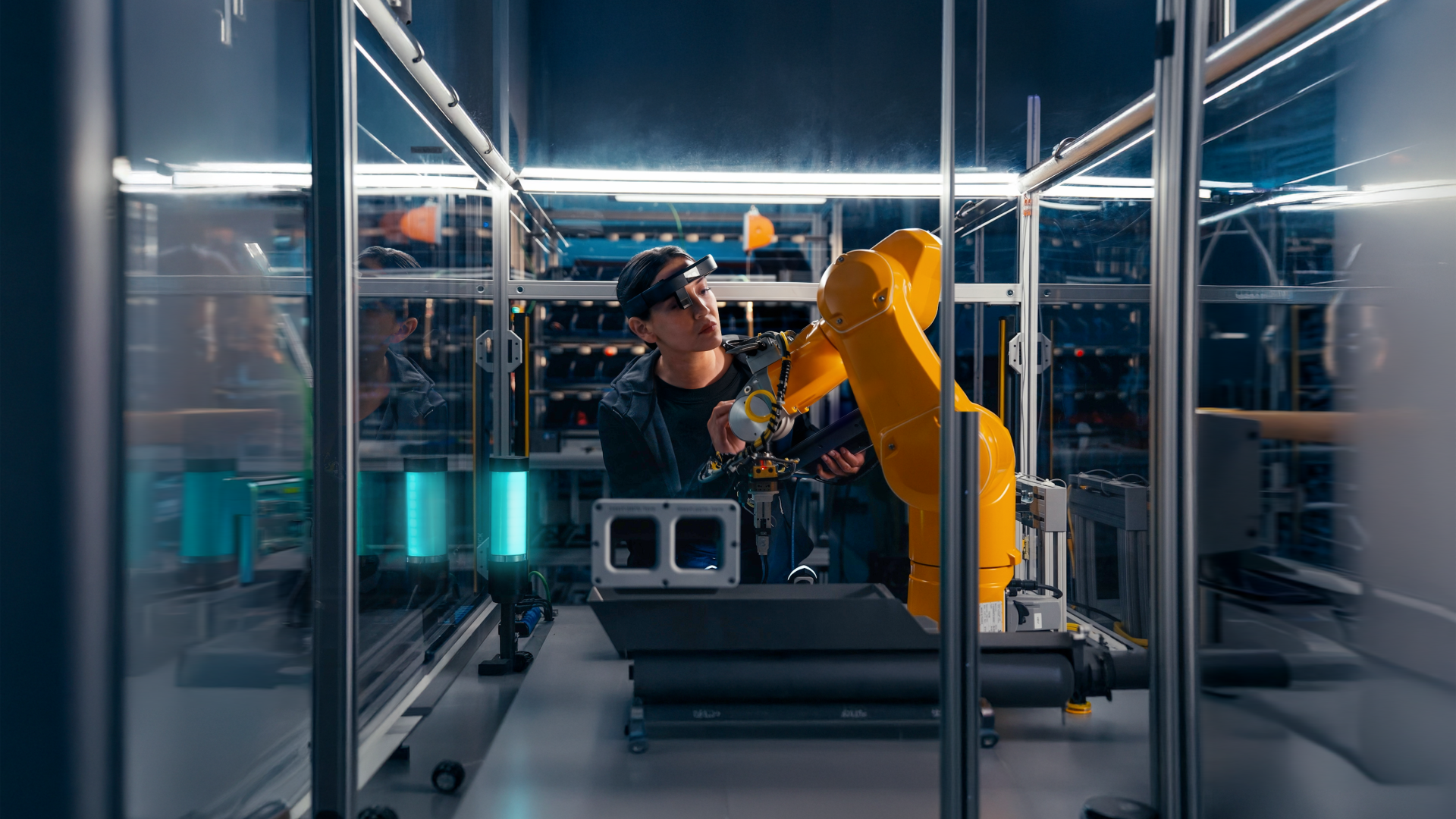
It is not quite; it is an advanced mobility feature, which nevertheless stands to help with handover between sundry 5G macro and edge sites to support low-latency low-jitter apps that might one day be running on URLLC-style slices and such. Continuous connectivity and predictable latency matter, of course, for emerging (AI-driven) applications on distributed infrastructure (AI comms grids) – such as for industrial edge systems, connected vehicles, and whatever XR shenanigans are in demand. Scene processing, say, whether for workers in RealWear (see image) roaming between cells on industrial campuses or punters moping about museums in modish Ray-Ban specs, hinges on good handover.
Disruptions are not going to fly – meaning the industrial fix is missed, and the plant blows a fuse, or the Monet is confused for the Manet. You get the idea. Ericsson says the LTM (nothing to do with LTE-M, for reference) trials have seen handover interruptions reduced by up to 25%, and handover failures, as important as latency reduction for service reliability, might be almost-eliminated. Ericsson explicitly links the tech to ‘physical AI’, of course – describing AI systems operating in the physical world through robots, vehicles, sensors, drones, and industrial equipment – which is stronger language than simply saying it supports woolly AI applications. So it is about all the things I like.
LTM is evolving from a latency optimization feature into a broader mobility enhancement that improves handover speed, reliability, and throughput consistency – capabilities increasingly viewed as prerequisites for critical (!!!) IoT and AI – and private 5G where vendors, operators, and integrators can be arsed to put in the work.


