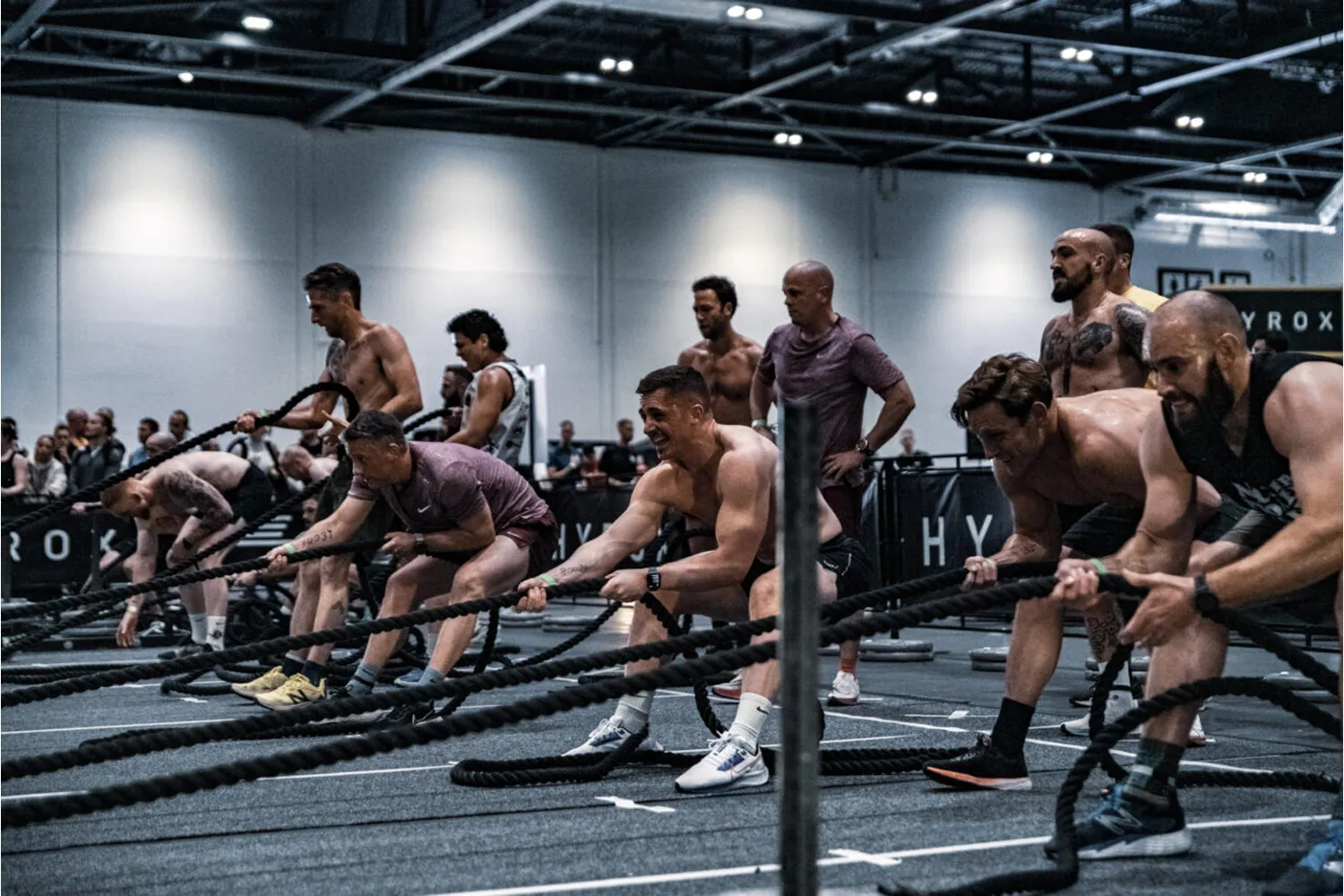
A few years ago, hardly anyone had heard of HYROX. And despite going all-in on fitness trackers, I hadn’t either. Now, it’s difficult to walk into a gym without spotting someone training for it. The giant yellow banners aren’t exactly subtle, either.
Today, dedicated HYROX classes are springing up everywhere, race weekends sell out months in advance, and social media is crammed with people proudly sharing their finish times – or crying through the final wall balls after discovering just how brutal they really are.
Part of the appeal, I think, is that HYROX is refreshingly simple. Unlike CrossFit competitions, the workout never changes. Instead, HYROX boils everything down to one deceptively straightforward challenge – run 1km, complete a workout station, and repeat until you’ve covered 8km and conquered all eight exercises (or curled into a ball screaming silently into the abyss).
So whether you’re thinking about entering your first race, or you’re simply wondering why everyone seems to be talking about hybrid fitness all of a sudden, here’s everything you need to know about HYROX.
What is HYROX?
HYROX is an indoor fitness race that combines running with functional strength exercises. Founded in Germany in 2017 by Christian Toetzke and two-time Olympic hockey gold medallist Moritz Fürste, it’s a fitness competition that combines the repeatability of endurance sport with the variety of functional training – all while remaining accessible to everyday gym-goers.
Unlike CrossFit, where workouts constantly change, HYROX is completely standardised. Whether you compete in London, Berlin, New York or Sydney, you’ll face the same challenge in the same order. Venue layouts may vary slightly, but every athlete covers the same distance, completes the same stations, and is judged against the same movement standards.
That consistency is likely one of the biggest reasons behind HYROX’s rapid rise. Your finishing time is comparable with previous races, your friends’ results or athletes on the other side of the world, all through HYROX’s official rankings.
What’s in a HYROX race?

Every HYROX race follows the same sequence:
- 1km run
- 1000m SkiErg
- 1km run
- 50m sled push
- 1km run
- 50m sled pull
- 1km run
- 80m burpee broad jumps
- 1km run
- 1000m row
- 1km run
- 200m farmers carry
- 1km run
- 100m sandbag lunges
- 1km run
- 100 wall balls
Connecting the running track to each workout station is an area known as the Roxzone. Unlike a transition area in a triathlon, the clock never stops, so moving efficiently between stations can make a noticeable difference to your overall time.
Judges positioned throughout the course also help ensure that every rep meets the official movement standards. If a rep doesn’t count, you’ll simply have to do it again before moving on. Good technique can, therefore, be just as important as outright speed.
Pacing also plays a huge role. HYROX itself advises against attacking the opening exercises too aggressively, because running after dragging heavy sleds or completing dozens of burpees is very different from running on fresh legs.
What are the eight HYROX workout stations?

Although every station is challenging, each one has been selected to focus on a different part of your fitness.
SkiErg (1,000m)
The race begins with 1,000m on the SkiErg. Using a movement similar to cross-country skiing, it quickly elevates your heart rate while fatiguing your shoulders, back, core and grip.
Sled push (50m)
Competitors push a heavily loaded sled across four 12.5m lengths, testing lower-body strength, leg drive and core stability.
Sled pull (50m)
After pushing comes pulling. Dragging the sled back using a rope places huge demands on your back, grip and posterior chain. Sitting or kneeling to pull isn’t allowed.
Burpee broad jumps (80m)
Welcome to my personal hell. Competitors perform a burpee before explosively jumping forwards, repeating the movement across 80m. This is often where first-timers realise they’ve started the race just a little too quickly.
Row (1000m)
The rowing machine offers a brief break from impact, but not from hard work. It challenges your aerobic engine while allowing your legs to recover slightly before the final strength stations.
Farmers carry (200m)
Carrying a heavy kettlebell in each hand for 200m sounds simple until your forearms begin screaming. Grip strength, posture and core stability are all pushed to their limits. You’re allowed to put the kettlebells down to rest, but no moving when you do. Or else.
Sandbag lunges (100m)
With a weighted sandbag resting across your shoulders, you complete alternating walking lunges for 100m. Every rep must finish with your rear knee clearly touching the floor, making technique just as important as endurance.
Wall balls (100 reps)
The race finishes with 100(!) wall balls. Competitors squat below parallel before throwing a medicine ball at a target mounted high on the wall. After almost 90 minutes of running and lifting, these final reps become a brutal test of both physical and mental resilience.
What are the different types of HYROX?

You don’t have to be an elite athlete to take part – though chances are you’d do pretty well on your first go. There’s a HYROX category for everyone, though, so your lack of medals is, unfortunately, no excuse.
HYROX Open
Open is the standard solo division and where most first-time competitors should start.
You’ll complete every run and every workout station yourself using the standard weights for your age group and gender. It’s still a demanding challenge, but considerably more approachable than the heavier Pro division.
HYROX Pro
The format doesn’t change, but the weights do.
Pro is aimed at experienced athletes looking for a tougher challenge, with substantially heavier sleds, carries, lunges and wall balls. Running still accounts for half the race by distance, but the increased loads make strength a much bigger factor.
HYROX Doubles
If tackling the whole race on your own sounds intimidating, Doubles is a popular alternative. Both athletes complete every 1km run together, but the workout stations can be divided however you like. One partner might handle most of the rowing, while the other takes on more wall balls or sled work.
Because the running is shared but not shortened, Doubles still feels like a proper HYROX race rather than a simple, easier version.
HYROX Relay
Relay is the most accessible format – teams of four split the course into eight run-and-station blocks, with each person completing two runs and two workout stations. It’s ideal for groups wanting to experience the atmosphere without committing to the full race individually.
HYROX also offers extensive age-group racing and Adaptive divisions, allowing athletes to compete against others in similar categories.
How long does HYROX take?

There’s no single answer because everyone’s different. For what it’s worth, HYROX says that many competitors spend around 90 minutes on the course.
As a rough guide, first-timers often finish in around 90 minutes to two hours, while regular gym-goers with solid running fitness may complete Open in roughly 75 to 95 minutes. Competitive athletes often aim for around 70 minutes or faster, while elite racers are now comfortably breaking the one-hour barrier.
It’s worth remembering that course layouts, Roxzone distances, and even the carpet beneath the sleds can influence finishing times slightly from venue to venue. And if you’re anything like me, that means plenty of excuses for justifying a shoddy time.
Is HYROX the same as CrossFit?
CrossFit competitions regularly feature Olympic weightlifting, gymnastics, rope climbs, handstand walking, and constantly changing workouts. Success depends on mastering a huge range of technical skills, while HYROX is deliberately more predictable.
The movements are familiar to most commercial gym users, and every competitor knows exactly what they’ll face before race day. Instead of testing adaptability, HYROX rewards pacing, consistency and the ability to perform well under fatigue – needless to say, this simplicity has undoubtedly helped fuel its rapid growth.
How should you train for HYROX?

One of the biggest mistakes beginners make is focusing almost entirely on the workout stations. In reality, running makes up half the race by distance, and it’s often where the biggest gains can be made.
A balanced training programme should include easy runs to build aerobic fitness, faster intervals or tempo sessions to improve race pace, regular strength training, and sessions that combine running with functional exercises.
Rather than attempting a full HYROX simulation every weekend, most coaches recommend gradually introducing combinations such as a 1km run followed immediately by sled pushes, wall balls or lunges. This teaches your body to cope with running under fatigue without leaving you completely exhausted after every workout.
Many gyms now also offer official HYROX-affiliated classes, which provide access to race-specific equipment such as SkiErgs and competition sleds. Even if your gym doesn’t, you can still build most of the required fitness through conventional strength training, rowing, carries and running.HYROX itself also stresses the importance of pacing, recovery, hydration and learning the official movement standards before race day.
And that’s pretty much all there is to know about Hyrox. Do you need to do it? Of course not. If you’re perfectly happy with your current routine (or, indeed, no routine at all), that’s absolutely fine. But if you’re spinning your wheels, bored, and/or simply want a new challenge, then there’s no harm in checking it out. Just don’t blame me for the aches and pains. Because there will be aches. And pains.




