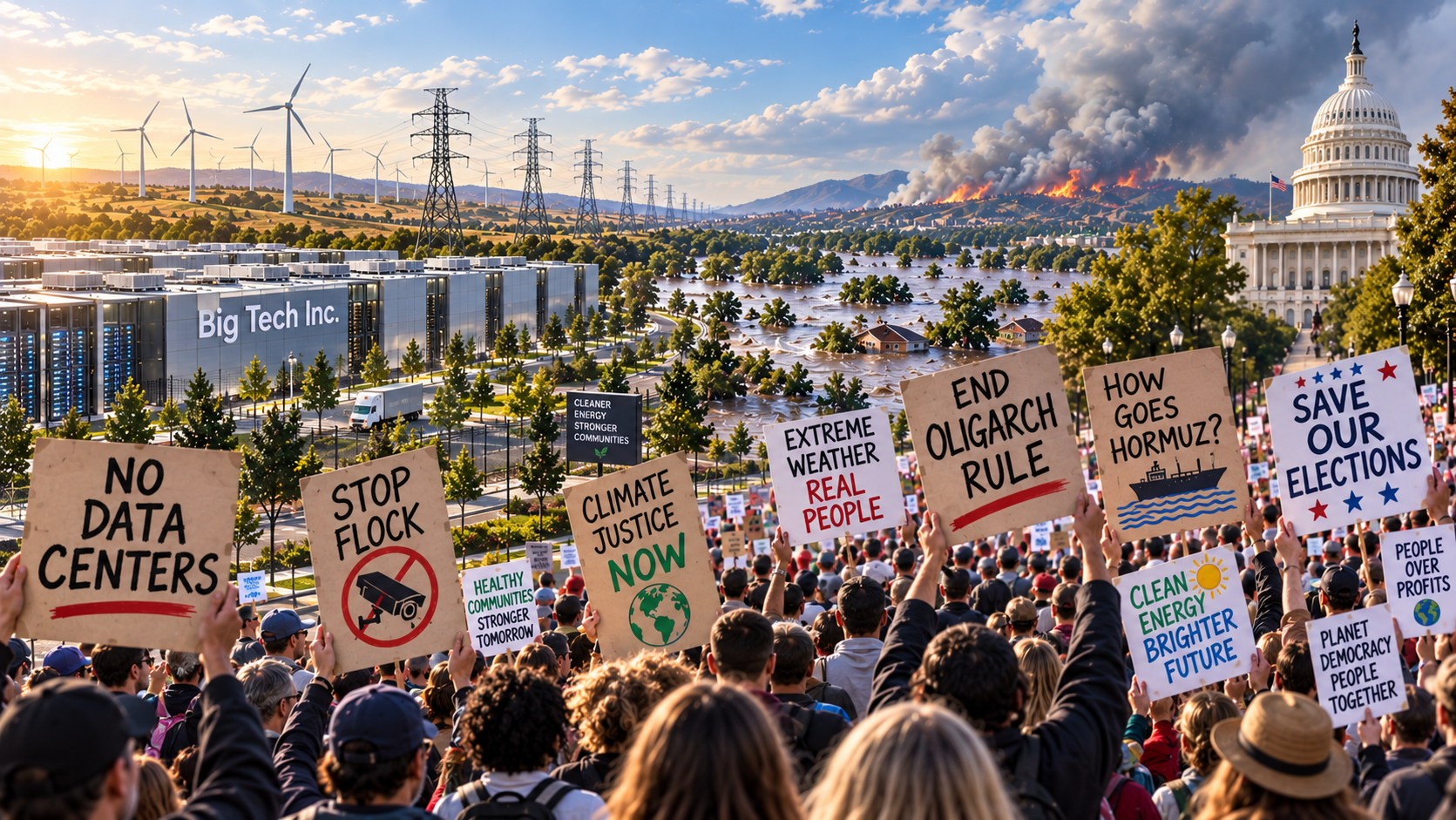
Data center pushback. Energy-price shocks tied to the Iran war. A possible Super El Niño. A surging anti-oligarch, anti-tech-bro sentiment. Threats to democratic norms. Flock license-plate cameras drawing sudden backlash in city after city.
Some of these are established trends. What’s new is the possibility that these issues could converge to produce a new movement, and the implications that would have for companies.
A few months ago, my co-host Solitaire Townsend and I did a “Two Steps Forward” podcast episode on “wild cards” — the unexpected, hard-to-model events that can reshape business, and sustainability, seemingly overnight. On this week’s episode, we came back to that idea with a more complex question: What happens when several wild cards present themselves at once?
History says this can go either way. There were the 1999 World Trade Organization protests in Seattle, which triggered a process where labor, environmental groups and business leaders found common cause on clean energy and led to the Blue Green Alliance, a campaigning nonprofit that endured for more than a decade.
In contrast, New York’s 2014 fracking ban had broad, cross-partisan support at first, then got recast within a few years as an radical-left policy that hurt working-class communities, so it largely faded away.
Unlikely alliances can form. They can also unravel.
Social license to operate
What might hold this one together, we agreed, isn’t the climate, data centers or any technology — it’s wealth inequality, at a level comparable to the conditions behind Victorian Britain’s Chartist movement and America’s Gilded Age. Both brought about changes in laws, customs and societal expectations.
Townsend also pointed to a relevant demographic wrinkle: Some of the most-watched political commentary aimed at rethinking capitalism, AI and other things is coming from creators in their late 20s and early 30s, who talk about “late-stage capitalism” as if it were a settled premise.
For companies, it’s all about their “social license to operate” — the ongoing acceptance and approval of an organization’s activities by its stakeholders and the general public. The term has been migrating across the economy, from fossil fuel and other extractive industries to tech and AI; it’s an open question where it goes next.
That means sustainability teams, which in the past have functioned as a company’s early-warning system (but more recently have been focused on measuring and reporting backward-looking data), need to tune up their antennae, track emerging issues and prepare to anticipate any number of seemingly unlikely but potentially disruptive scenarios.
It’s impossible to know whether some or all of these issues will coalesce into a social or political movement. Still, our advice for sustainability professionals is that is a moment to look forward — tracking, red-teaming and asking “what if” before an issue arrives at your doorstep.
Two Steps Forward is available wherever you get podcasts, including on Trellis.net. Find past episodes at twostepsforwardpodcast.com.


