Updated July 1, 2026 04:07PM
To go waterproof or non-waterproof? That’s a choice that every hiker now has to make when they step on the trail. Long ubiquitous in mid-cut boots, waterproof-breathable membranes like Gore-Tex are now making their way into trail runners, with major players like Altra and Topo now offering waterproof versions of their best-selling models. But that protection comes with a price: While footwear equipped with a membrane can keep out precip, mud puddles, and other sources of moisture, it doesn’t breathe nearly as well.
Just how big is that tradeoff, and how much does it matter? Backpacker Editor-in-Chief Adam Roy headed down to Denver, Colorado’s Outside Lab to talk to Lab Test Editor Adam Trenkamp about what our on-trail and in-lab testing found—and do a few experiments of our own.
Transcript
Adam Roy: Hi, I’m Adam Roy, Editor-in-Chief of Backpacker.
Adam Trenkamp: And I’m Adam Trenkamp, Lab Test Editor at the Outside Lab at CU Denver.
Adam Roy: So, when you’re picking footwear, waterproof or not waterproof is a big question. They both have benefits, and they both have drawbacks. So, learning to decide which one you need can make a big difference in your hike. They’re going to have real differences in how they perform even if they’re otherwise the same model. So Adam, tell me a little bit about how a waterproof membrane works and what some of the advantages and drawbacks to it are.
Adam Trenkamp: Yeah, so a waterproof membrane is sort of sandwiched in between other layers in the construction of the shoe. And what it does is it has really, really tiny micropores that allow air to escape or even moisture vapor times to escape when we talk about breathability. But the key thing it does is those pores are so small that actual water droplets cannot get through. So it keeps water from getting in. So if you’re hiking in the rain, trail running in the rain, or sloshing through puddles and creek crossings, this is what’s going to keep your foot dry. The downside to that membrane may not be how breathable it is when compared to a non-waterproof shoe.
Adam Roy: Adam, you have brought two almost identical shoes here. Do you want to tell us a little bit about the differences between them?
Adam Trenkamp: Yeah, so what we have here is the Altra Lone Peak 9 and the Altra Lone Peak 9 Gore-Tex. Conveniently labeled on the instep, Gore-Tex, so you know that it is the waterproof shoe of choice. The main difference you’re going to find here is that waterproof membrane, which adds about an ounce of weight to each shoe, so 2 ounces per pair, 1 ounce per shoe. And then the other thing you’re going to notice is that on the actual forefoot, it is a slightly different material construction, and I assume that has to do with them putting in the actual Gore-Tex membrane itself. Now, if we did run these under a sink, you would see the water just kind of bead and roll away from the Gore-Tex version, whereas on the non-Gore-Tex, some lighter droplets might bead up and run away, but it’s going to immediately start to soak into the material and then eventually through the material.
Adam Roy: What are some situations where I would specifically want a non-waterproof trail runner?
Adam Trenkamp: Yeah, so I am somebody living here in Colorado who prefers a non-waterproof trail runner for three seasons of the year. And a big benefit to that is when you’re in a drier climate or a more arid climate, it just breathes much better. It’s not to say waterproof shoes don’t breathe well, but without an extra membrane there trying to keep water out, it does allow more moisture vapor to escape. So if you get sweaty feet like me on the inside, it really lets that start to come out, and then they also dry much quicker. So if you do happen to come across that burst storm that is maybe 30 minutes, or you need to cross a creek and you just don’t feel like taking off your shoes, which is me most of the time, you’re pretty confident that by the end of the hike or a few miles in, your feet are going to be dry once again in a non-waterproof shoe.
Adam Roy: Do you want to talk a little bit about the situations that might lead you to reach for the waterproof shoe?
Adam Trenkamp: So, those shoulder seasons or even the winters here, if I’m sticking to the front range, if there’s not a lot of heavy snow on the ground, it’s more of light snow and I know I’m going to be walking through that all day where it’s wet, I would choose the waterproof shoe. And then those shoulder seasons as well, very early spring, sort of late fall, when we’re more prone to water sitting around after a storm. It’s not drying up as quickly out here. It’s going to kind of hang around on the ground, have some puddles, some wet vegetation as well to where my feet are just going to be getting soaked if I’m not in a waterproof shoe.
Adam Roy: So, when we say waterproof, obviously that’s not an absolute. You know, even waterproof jackets occasionally soak through, some kinds of waterproof jackets. Is this absolutely waterproof, or will it eventually soak through if you leave it underwater for long enough?
Adam Trenkamp: This will eventually soak through if you leave it underwater for long enough, but also if the water level is high enough. So you have to be conscious of the construction in your waterproof shoe to make sure where the tongue is sort of tied together, which you can see here on the Lone Peak. If you get water over above that point, it is just going to fold in around the tongue or, like you said, over top around the ankles as well.
Adam Roy: So Adam, we’ve got two shoes that are pretty similar, one waterproof, one not. I notice we have here the right waterproof shoe and the left non-waterproof, and that is because you are wearing their opposite numbers on your feet right now. Here’s the non-waterproof, there’s the waterproof. And we have a bucket of water or a container of water conveniently located here.
Adam Trenkamp: Convenient. I hear you put this here.
Adam Roy: No comment. Want to hop on in there?
Adam Trenkamp: Oh, yeah.
Adam Roy: So Adam, how are your feet doing?
Adam Trenkamp: Well, one’s pretty dry and feels like it did before. The other is, we’ll call it moist. Extremely moist.
Adam Roy: Well, it is worth mentioning there are benefits to a hiking shoe getting wet quickly. That generally means it’s light material, it’s breathable, and it’s probably going to dry out pretty quickly, too, once you get out of the water source. It’s also worth now taking a moment, while we wait to see if this Gore-Tex shoe soaks through, to talk about some of the practicalities of waterproof shoes. Generally speaking, you might think you want a waterproof shoe if you’re going to be doing things like creek crossings, that’s actually going to make it worse. It’s really, really hard, even with a mid-cut boot, to keep water from sneaking in over the cuff. So unless you’re going to be going through really shallow water, you’re probably going to get your feet wet one way or another. You might be better off just letting that footwear dry. On the other hand, if you’re dealing with sloppy weather—things like puddles, rainstorms, runoff, things like that—that’s where I would probably consider using something like this where it’s not deep water, but I might be splashing a lot or just getting wet incidentally. What about if you’re just standing in a bucket of water?
Adam Roy: Personally, I’d do that barefoot.
Adam Trenkamp: Oh, I wish I had known that beforehand.
Adam Roy: Well, we can’t show that.
Adam Trenkamp: I didn’t know that was an option.
Adam Roy: We don’t want to put that on the internet, man.
Adam Trenkamp: So now, while we wait for the Gore-Tex foot of mine to get wet, let’s talk about drying time since you mentioned that on the trail. What should happen is that the non-waterproof shoe should dry significantly quicker than your waterproof shoe, even when they’re the exact same model. That’s at least my personal experience on the trail. To test that, as opposed to waiting for me to step out of the water and then spend the rest of the day with a soggy foot, I actually soaked these shoes yesterday, took their weights both dry and then wet once they were fully soaked on the inside, including the waterproof shoe, so more or less just filled these up with water, dumped it out, took a weight, and then I recorded how long it took for each to dry. There is, in these particular shoes, about a 2-hour difference in the drying time. On trail, that may be exaggerated even more when you actually have your foot inside fully blocking any openings, and you’re on the go. With each step in the non-waterproof shoe, you’re going to be able to even squeeze out a little bit more moisture vapor and water because it’s not being held in by that membrane layer versus in the waterproof layer. So, if you do happen to top over shoes and get your waterproof shoe wet on the inside, it is going to take more time to dry than if you just went for it in your non-waterproof shoe.
Adam Roy: How are those feet doing? Still dry?
Adam Trenkamp: Still dry. And based on experience, it’s going to take, standing still, this shoe about 4 hours to dry and this foot’s going to take anywhere from 6 to 6 and a half hours to dry, and that sounds like a long, soggy day. So I’m going to hope water doesn’t come over the top.
Adam Roy: So we’ve determined that this shoe is not going to soak through in any reasonable amount of time, assuming you don’t overtop it. But there is another factor when it comes to comfort in wet environments in hiking shoes, and that is breathability. You want to make sure that you’re not sweating up the inside of the shoe. If you do that, it’s going to end up uncomfortable whether or not you end up with water in it. So, I understand we have a way to kind of demonstrate the difference in breathability here in the lab.
Adam Trenkamp: Why don’t we look at what we can see in terms of actual moisture vapor escaping the shoe?
Adam Roy: Adam, you’ve got a very unusual-looking device over here. Do you want to walk me through what it is and what it does?
Adam Trenkamp: Yeah, sure. So first, let’s start by saying when we test breathability, we would actually cut a sample out of the shoe upper and do it as our typical breathability test. For that, check out our other specific breathability video. In this instance, to help visualize what that looks like and letting that air out and that moisture vapor out, we’ve brought in the fun smoke machine smoke gun here. So, you know, if you’re going to have a cool concert you want to put on or, for me, I just do this everyday when I enter the lab. I turn this on and just come through. It keeps me amped for the day.
Adam Roy: Oh, you’re like a professional wrestler coming into the ring here.
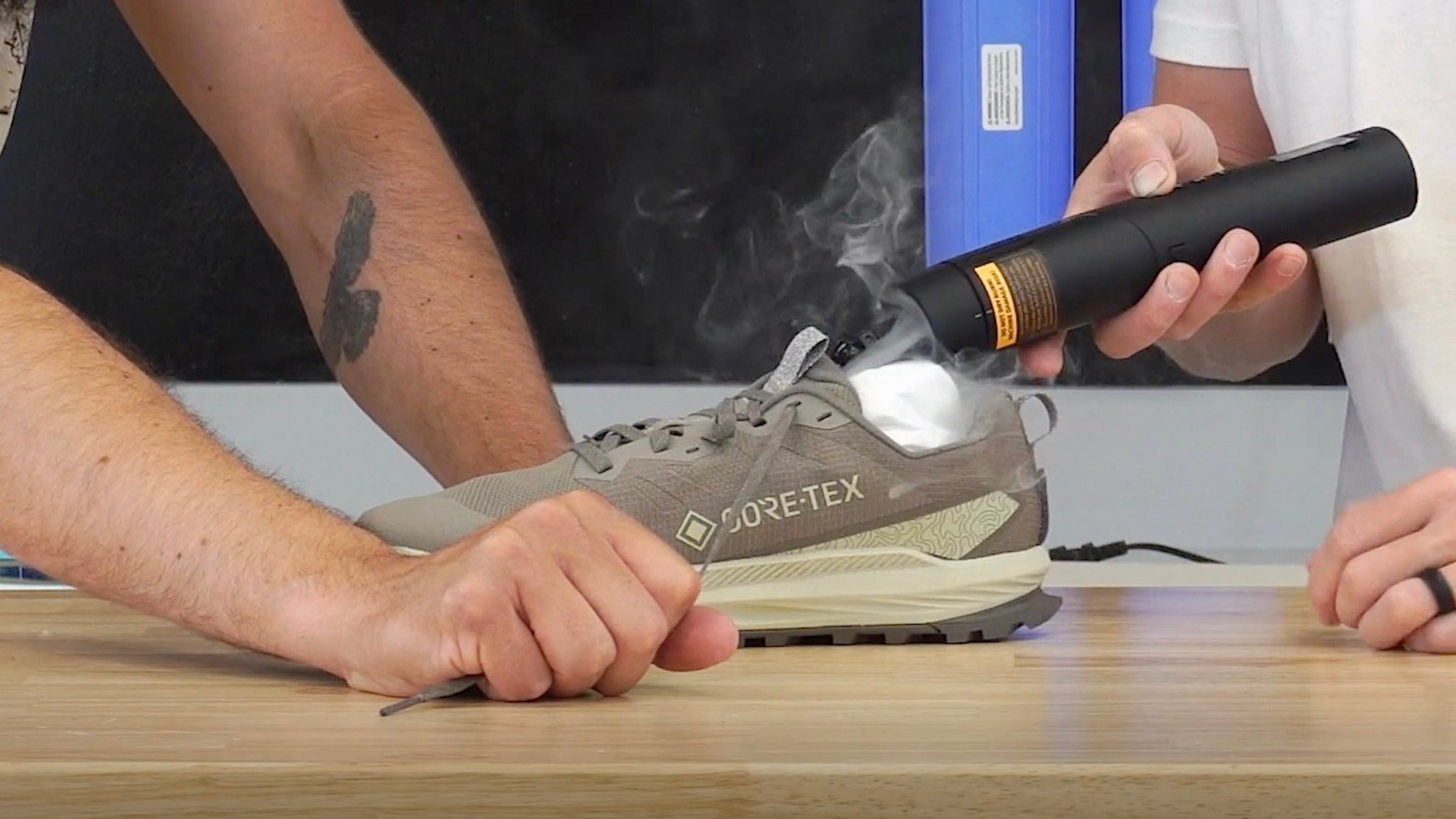
Adam Trenkamp: That’s how I like to look at it. I’m here to destroy some gear, and I need to set the tone from the minute I walk in the door. But to use this, we actually put an extension here on the front that allows us to point where the smoke is coming out. We will fully block up the back part of the shoe so we’re not getting the fog and smoke kind of exit through the heel cup. And then we can see where it’s breathing, if it’s breathing at all by letting some of this fog and smoke out. So we’re going to take this guy, get it down in the shoe. We can even point it directly at the toe box itself. And then let the magic happen. Let the puff the magic dragon happen.
Adam Roy: So we can already see how well this is letting the vapor escape. It’s coming out, yeah, you know, through the path of least resistance, which is around the tongue and through the lace holes, but I’m also seeing some come through the front right here in the upper, which you mentioned probably has to do with the difference between the upper fabrics on this waterproof version and the non-waterproof version. So this is breathing really well.
Adam Trenkamp: Yeah, yeah. And, you know, it’s a little bit of material difference and then also the fact that it doesn’t have that membrane in there as well. So it is trying to let that vapor out.
Adam Roy: What do you think it would look like if we did the same test on this Gore-Tex version of the shoe?
Adam Trenkamp: You know, I don’t think it’s going to let much if any smoke through as long as we properly block up the heel cup here. So let’s give that a try and let’s see if we do find any zones. And if we do, I’ll be a little bit surprised. Let’s run our test. Our visual test. And at this point on the non-waterproof shoe, we were already starting to see some of that vapor escape. Other than what’s pushing back out of the heel cup right now, we’re not seeing any vapor. We’re just starting to see a little bit come through by the laces, but significantly less than on the non-waterproof shoe.
Adam Roy: So does this mean the shoe isn’t breathing at all, or is there something to do with the smoke we’re using for the test versus the diameter of the water vapor droplets that would be coming out?
Adam Trenkamp: So it doesn’t mean it’s not breathing at all. It’s just breathing much less and maybe hard to visualize with this smoke. So this fog and smoke is still created in somewhat of a moisture vapor itself, different than sweat, so it’s slightly larger particles than what you see with sweat. That’s why sweat often isn’t visible, right, as you’re sweating. Sometimes you may see a little bit of steam in the right light, but it’s not quite as visible as the smoke. That means the droplets in the moisture vapor created in this fog are a little bit bigger, so it may not be getting through as easily. But it does give you a good reference then when comparing the waterproof shoe to the non-waterproof shoe of visually how well one breathes versus the other.
Adam Roy: Well, I can see just from this test these are, the difference is not slight. These are in totally different classes when it comes to breathability. So that really is an important decision you have to make. Do you value waterproofing more or breathability? You can have a little bit of both with this shoe, but not so much in the breathability side.
Adam Trenkamp: Depends on what environment you’re going to be in to what shoe is the right shoe for you, or at least to consider when you’re lacing up to head out the door and hit the trails.
Adam Roy: So, Adam, how are those feet doing?
Adam Trenkamp: Starting to, I think, wrinkle up a little bit. You know when your hands have been in the water for too long? I think I can feel that on my toes at this point.
Adam Roy: Gross. Well, if you want to learn more about the best shoes out there, waterproof and not, you can go to backpacker.com/gear. We also want to know what you’re doing with your gear. Tag us on Instagram at @backpackermag or go to the activity feed on backpacker.com to share your adventures with us. Until next time, I’m Adam Roy. I’ll see you out there.
Adam Trenkamp: Am I allowed out of the bucket yet?
Adam Roy: No, stay in there.


