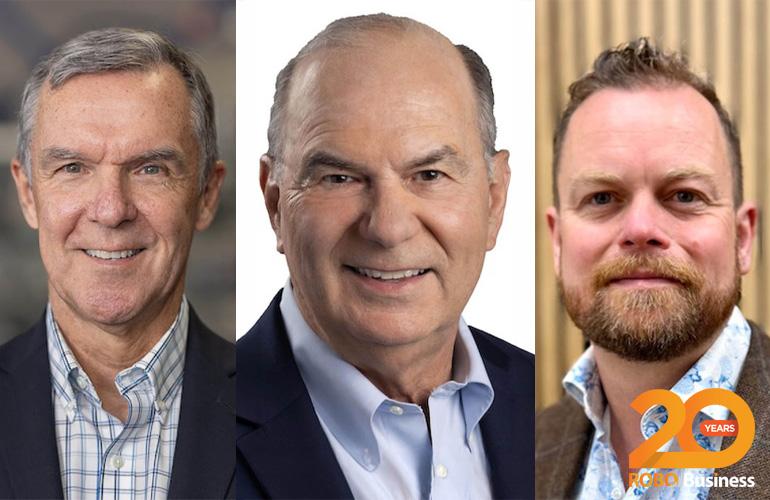
RaaS panelists, from left to right: Bill Booth, RoboWorx; Rick Faulk, Locus Robotics; Eric Linde, Aescape.
Robots as a service, or RaaS, has become one of the most closely watched business models in commercial robotics, and for good reason. By shifting automation from a large capital investment to a recurring operating expense, RaaS can make robotics more accessible to customers while giving providers a path to more predictable revenue and longer-term customer relationships.
But the RaaS model is also more demanding than it may at first appear. A successful RaaS business is not just a robot sold on subscription, nor is it simply a rental financing model. It requires careful decisions about pricing, financing, deployment, service coverage, uptime guarantees, customer success, and the operating costs that come with supporting fleets in the field.
Building a RaaS organization from the ground up requires a different strategy from a pure engineering OEM or CAPEX-based business. Successful services businesses understand product design, organizational structure, sales compensation, service-level agreements, and service delivery requirements.
Those questions will be front and center during “The RaaS Playbook: Pricing, Service, and Scale,” a RoboBusiness 2026 session scheduled for Oct. 20 from 3:30 to 4:15 p.m. PT in Room 207 of the Santa Clara Convention Center.
RaaS experts to participate in RoboBusiness panel
Mike Oitzman, senior editor at The Robot Report, will moderate the discussion. It will feature Rick Faulk, CEO of Locus Robotics; Bill Booth, technology sales, marketing, and business development at Roboworx; and Alex Linde, chief product officer at Aescape.
The panel will move beyond the high-level promise of recurring revenue to explore what it takes to make RaaS work in practice. Attendees can expect insights on structuring contracts, setting service-level expectations, defining customer success metrics, managing maintenance programs, and deciding when a RaaS model is the right fit compared with a traditional capital purchase.
For robotics founders and executives, the session offers a chance to pressure-test assumptions about unit economics, service obligations, and scale. For product, sales, and customer success teams, it will provide a clearer view of how RaaS changes the customer relationship after deployment. And for investors and end users, it will help clarify what separates a durable service business from a compelling pitch.
As commercial robotics companies continue to search for scalable paths to adoption, RaaS remains both an opportunity and an operational challenge. Anyone building, selling, funding, or evaluating robotics services should attend this session to hear directly from leaders who are working through those challenges in the market today.
Register now to attend RoboBusiness 2026.
 Register now and help us celebrate 20 years of RoboBusiness!
The post Why RaaS needs more than a subscription model appeared first on The Robot Report.


