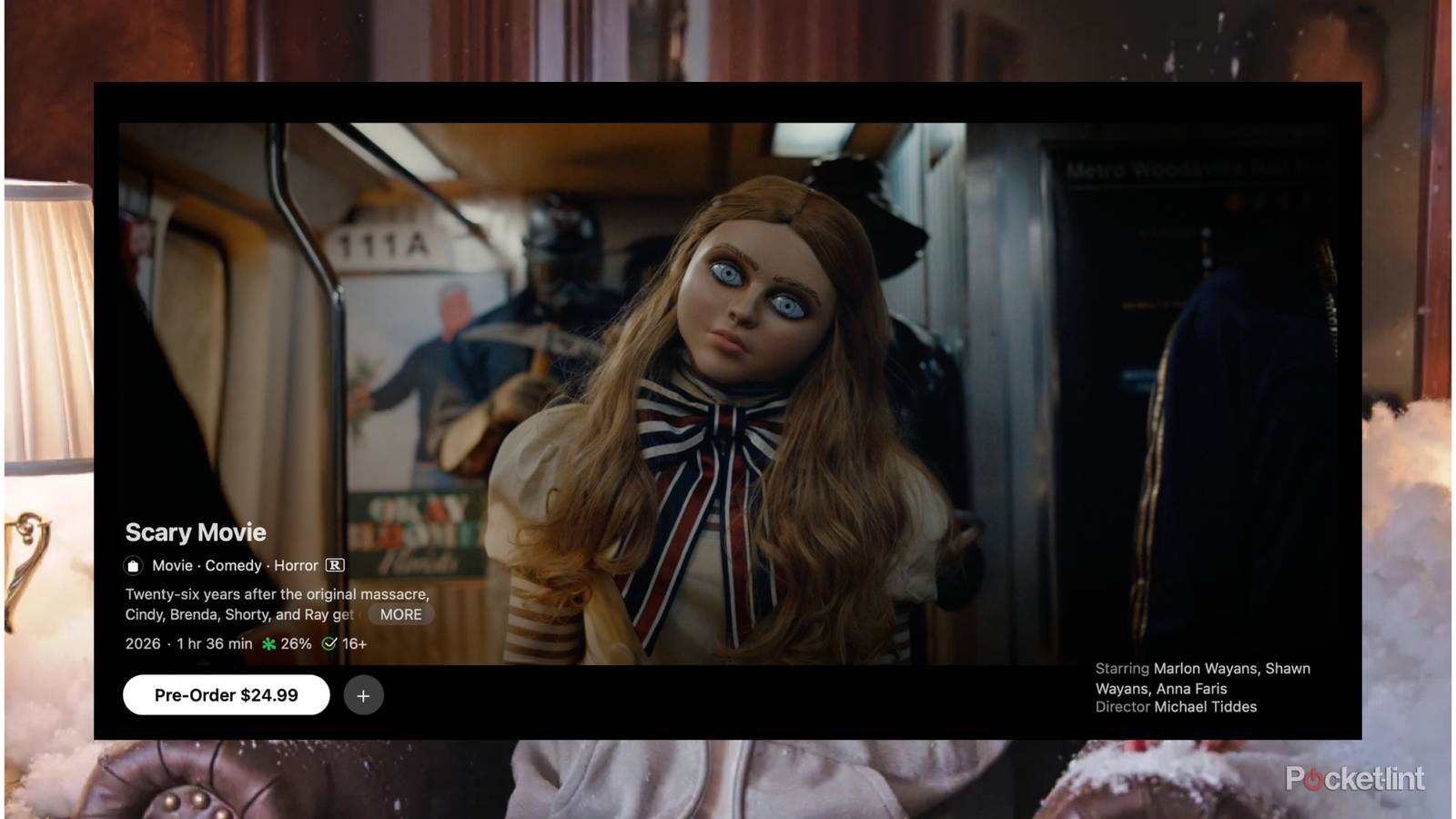
Paying $24.99 for a new release, settling in, and then noticing that your TV hasn’t thrown up its Dolby Vision badge may be a small problem, but it’s also a very specific feeling of deflation. The product page said Dolby Vision, but the film is playing in HDR10, the soundbar is reporting 5.1 rather than Atmos, and nothing about the transaction you completed ten minutes ago suggested you’d been sold anything less than the best version.
Whether you own the digital content you buy is the bigger question, though the format is the one that bites first, and it stings even when nothing has been taken away from you. It also complicates the digital versus physical price comparison, because $24.99 spent on a download and $24.99 spent on a disc are not buying you the same guarantee. What a digital purchase gets you is access to whichever version of that film the storefront can currently deliver to the specific device you’re currently holding, and in 2026, both of those variables have been moving.
Apple’s own support documentation is unusually frank about this, if you go looking. It tells buyers that a film purchased in HD might later gain 4K, HDR, Dolby Vision, or Dolby Atmos on a compatible device, and that if a high-quality version isn’t available now, it might be added later. In other words, your purchase is a pointer to a file the storefront maintains, not a copy of one you have.
That cuts both ways, in fairness. Apple has upgraded plenty of libraries to 4K for nothing, and waking up to find a film you bought in 2015 now carrying a Dolby Vision badge is a genuinely nice thing to have happen. But an entitlement that can improve without asking you is, by the same mechanism, an entitlement that can move in the other direction. Which it now has, publicly, and at scale.
How quickly a format can vanish
A patent fight in Europe is doing this in real time

Disney+ subscribers across much of the European Union have spent this year watching their picture quality descend downhill. InterDigital, which holds patents covering HEVC video encoding, won an injunction at the Unified Patent Court’s Mannheim division in June, and Disney responded by pulling Dolby Vision and 3D in the affected markets while hanging on to 4K and HDR10. A second injunction landed from the Düsseldorf division on July 23, spanning 11 EU countries including France, Germany, and Italy. By the end of July, 4K and HDR10 had gone as well, leaving a tier sold on Ultra HD delivering 1080p SDR at the full monthly price.
Then, on Aug. 4, Disney confirmed it had switched from HEVC to the VP9 codec and begun restoring 4K in Denmark. What makes that restoration stand out is how partial it is: VP9 isn’t widely supported, so 4K returned on Android TV and Google TV devices, Fire TV, LG sets from 2020 onward, Sky Glass, and Sky Stream – and did not return on Apple TV 4K, Samsung TVs, or games consoles. HDR is still missing, and Amazon, facing the same patent holder, simply signed a licensing agreement and moved on.
That’s a subscription service rather than a storefront, but note it’s a European problem rather than an American one. The UK isn’t affected, and neither is the US, but the plumbing underneath is identical to the plumbing under your purchases. Picture and sound reach you through a codec, the codec is licensed, and that license is a commercial arrangement between two companies you have no relationship with and no visibility for. When it breaks, what changes is how the content appears on your screen.
The same film, three different versions
Your account tier and your browser are part of the spec

You don’t need a court case for this, though. The version you get shifts depending on where you press play, and always has.
On Prime Video, Dolby Vision and Dolby Atmos have been restricted to the ad-free tier since February 2024, which costs an extra $2.99 a month on top of Prime. Stay on the ad-supported tier and the same titles arrive in HDR10+ and Dolby Digital 5.1 instead, and while that applies to Amazon’s subscription catalog rather than to films you’ve bought outright, t it establishes the principle plainly enough: your account tier is what determines the spec.
Browsers are the bigger and much less understood downgrade. Most services are still capped at 1080p or 720p in a browser because of content protection requirements, and Netflix only brought 4K to Chrome on Aug. 4, on Windows 11 alone, while Chrome on Linux remains stuck at 720p. Dolby Vision, HDR10+, and Atmos are app-only regardless, so a film that genuinely is a 4K Dolby Vision Atmos release can reach you as 1080p SDR stereo, entirely legitimately, because you opened a tab instead of an app. This is never flagged at checkout.
Layer those together, and a single purchase has perhaps half a dozen possible outputs.
The library itself can shrink
Sony is removing 551 purchased titles in September

Format is the everyday version of the problem, and the more severe example arrives on Sept. 1 when Sony removes 551 StudioCanal titles from purchased PlayStation video libraries in affected European markets, citing content licensing agreements. Terminator 2: Judgment Day, Hot Fuzz, and Apocalypse Now: The Final Cut are on the list, and no refunds have been announced.
Sony has done this before, pulling StudioCanal titles in Germany and Austria in 2022 and a tranche of Discovery shows the following year, some of which came back after enough people complained. It’s a useful reminder that the early-access rental economics and the ownership question are separate arguments that happen to share a common cause. Whatever the outcome for those particular customers, it’s a strange thing to watch a word like “purchased” get reinterpreted by a support notice.
What I’d check before buying another new release
Is a digital purchase still worth it?

None of this makes digital a bad buy. It’s cheaper, it’s instant, it doesn’t need a shelf, and for a film you’ll watch once, none of the above matters in the slightest. There are a few habits worth building, however.
- Buy according to your main device. If your living room runs on an Apple TV 4K, I’d buy from Apple, because the app most likely to render your purchase properly is the one built for the box you actually use.
- Check the badge on first play, not on the product page. The confirmation your TV throws up when the stream starts is the only honest one you get.
- Use the app, not the browser. This is the single largest avoidable downgrade in the whole chain, and it costs nothing to avoid.
- Link your libraries, but know the limits. Movies Anywhere now covers Disney, Sony, Universal, Warner Bros., and Lionsgate, which joined in June 2026, across roughly 10,000 films. Paramount and MGM are still absent, and it covers purchases only, never rentals.
Of course, a digital movie locker protects your access if a single storefront falls over, but it does nothing at all to protect the format, and it wouldn’t have helped a single PlayStation customer, because the studio agreement is what expired, not the store.
And for the handful of films you’d be genuinely annoyed to lose, like the ones you rewatch when you’re too tired for anything new, a disc remains the only version nobody can patch, downgrade, or license out from under you. That’s not a call to go back to physical media wholesale, and plenty of people quite reasonably collect discs without owning a dedicated player, but it’s just that a disc is the one copy where the spec printed on the box is the spec you’ll be watching five years down the line.
The format listed on a store page has become a statement of intent rather than a specification, and knowing that before you spend $24.99 is what lets you avoid a genuinely annoying movie night. If you care enough about picture and sound to have bought a TV that can show the difference, you’ll want to know which video formats actually hold their quality over time.
-

- Simultaneous streams
-
3
- # of profiles
-
6
- Originals
-
Yes
- Live TV
-
Limited (some add-on channels offer live TV)
- Price
-
$8.99 per month by itself or $14.99 per month as a part of Prime
Amazon Prime Video is the commerce giant’s contribution to the streaming world. Featuring movies and TV shows across a variety of genres as well as its own original content, there’s always something to watch.
-
- Price
-
$13 per month
- Free trial
-
7 day free trial and 3 months free if you buy an Apple device
- Simultaneous streams
-
6
- # of profiles
-
6
- Originals
-
Yes
- Live TV:
-
Limited (There are live sports and some add-on channels offer live TV)
Apple TV+ is a global streaming service which offers on-demand access to a growing list of exclusive content, including Severance, Ted Lasso, Slow Horses, and much more.




