
As the 2026 FIFA World Cup kicks off and brands activate around a highly visible cultural moment, new GlobeScan data points to an important strategic opportunity: Soccer fans are not only highly engaged audiences, but are also more inclined than the general public to adopt sustainable shopping behaviors that align closely with the kinds of choices brands can influence at venues, in retail environments and across fan experiences.
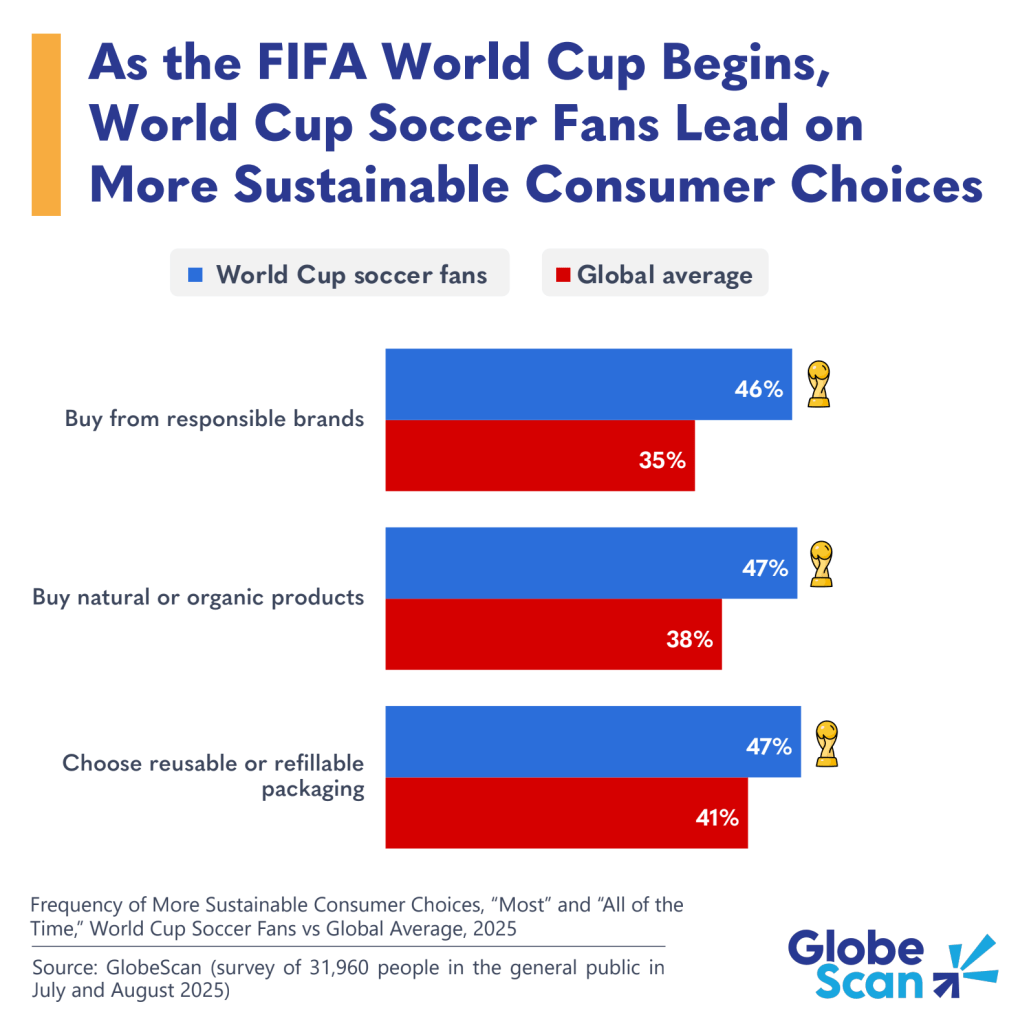
Globally, self-identified FIFA World Cup fans report higher participation across the sustainable shopping behaviors shown in this analysis. Nearly half say they buy products in returnable, reusable or refillable containers most or all of the time (47 percent, compared a 41 percent global average) and the same share say they often buy natural or organic products (47 percent vs. 38 percent). Fans are also significantly more likely to say they try to buy from responsible brands or companies (46 percent vs. 35 percent). Taken together, these results suggest that soccer fans are not simply an attentive audience for sustainability messaging, but that they may be more behaviorally receptive to more sustainable product and brand choices than the general public.
The contrast is even more pronounced in the U.S., where the World Cup will generate intense commercial and cultural attention. American soccer fans are almost twice as likely as the general public to say they try to buy from responsible companies (61 percent vs. 32 percent), while also over-indexing strongly on other emerging sustainable consumption behaviors, including buying natural or organic products (55 percent vs. 30 percent) and choosing reusable or refillable packaging (50 percent vs. 33 percent). This suggests that World Cup activations need not treat sustainability as a peripheral communications layer. For a meaningful subset of fans, greener choices may already align with how they want to shop and consume.
What does this mean?
For brands, the implication is not simply that soccer fans care more, but that the World Cup creates a rare convergence of attention, identity and action in which more sustainable options may be more visible, more relevant and more likely to be chosen. That creates room for brands, retailers, sponsors and venue operators to move beyond messaging alone and make more sustainable choices easier, more attractive and more normal during the fan journey itself, whether through refill and reuse formats, more responsible product assortments or clearer signaling around responsible sourcing and brand practices.
More broadly, the findings highlight the role that major sporting events can play in accelerating behavior change. The World Cup is not only a media platform, but also a social occasion in which norms are made visible and shared. If brands use that moment well, soccer fans could become an influential audience for helping more sustainable consumption feel mainstream, aspirational and part of the excitement of participation, rather than a trade-off that sits outside the event experience.
Based on a representative online survey of more than 31,000 people in the general public in July and August 2025.


