
The “speed to power” aspirations of Amazon, Google and Microsoft — fueled by their collective investments of roughly $750 billion in data center expansion in 2025 and 2026 alone — are upending their climate goals.
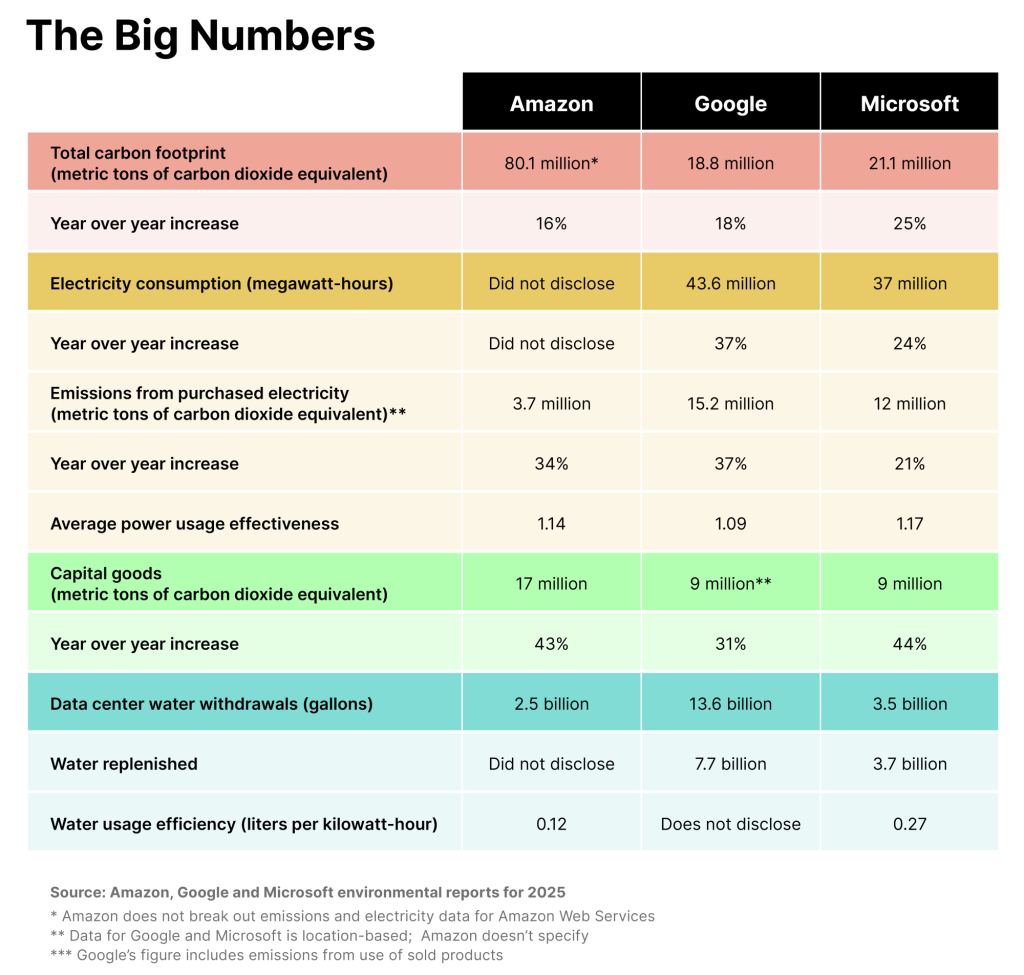
All three reported double-digit emissions increases in their 2025 environmental sustainability updates, largely driven by electricity: Reported emissions for power consumption leapt by more than one-third at Amazon and Google, and by more than 20 percent for Microsoft.
Insatiable power appetites
Google’s electricity consumption surged by 37 percent in 2025 to 43.6 million megawatt-hours — the biggest single-year increase in its history and roughly enough to power the state of Washington for a year.
“As the rapid evolution of AI is increasing our energy needs, the shift to clean energy is hitting major bottlenecks — like long delays in connecting new energy projects to the grid, fragmented power grids, and a shortage of reliable, around-the-clock clean power,” Google said in its 2025 environmental report, published June 30.
Since 2019, Google’s power consumption has risen 250 percent. Its location-based electricity emissions, which fall under Scope 2 of the Greenhouse Gas Protocol’s carbon accounting rules, rose 37 percent from 2024 to 2025.
Location-based emissions are calculated using regional grid market averages; market-based emissions inventories include factors such as green tariffs or renewable energy certificates.
Microsoft reported a 21 percent increase in location-based Scope 2 emissions; its overall electricity consumption rose 24 percent to 37 million megawatt-hours.
Amazon didn’t disclose its overall electricity consumption in its 2025 environmental report, published July 1. The company reported a 34 percent increase for its Scope 2 emissions, but it doesn’t say whether that information is location-based, i.e., based on regional grid market averages; or market-based, which includes factors such as green tariffs or renewable energy certificates.
Amazon also didn’t break out emissions data directly related to Amazon Web Services, although it publishes other metrics such as power usage effectiveness, which measures the power a data center uses for cooling versus running computing equipment. The closer to zero the better.
Amazon’s average usage effectiveness across its data center fleet is 1.14. Google’s ratio is 1.09, and Microsoft’s is 1.17.
What to watch next
Despite their voracious energy appetites, Amazon, Google and Microsoft stand behind emissions reduction commitments pegged to 2030 and beyond.
Here’s why: Over the past decade, the three companies have signed contracts to put more than 115 gigawatts of renewable energy, mostly solar and wind power, onto the global electric grid.
The companies are planning on investments in nuclear energy as a linchpin. Amazon contracted for almost 2 gigawatts of nuclear power last June and signed deals for two new nuclear projects in 2026. Microsoft is backing several next-generation fusion technologies and Google has committed to capacity in Ohio. None has been as bullish as Meta, which has deals for up to 7.7 gigawatts.
Big battery investments will also play a role. At the end of 2025, Amazon had 15 solar energy projects paired with energy storage, approximately 2.3 gigawatts in capacity. Google has made several bets on long-duration batteries, to extend the value of solar and wind contracts. (This is also a priority for Meta.)
Expect also a sharper focus on Asia.
Amazon supports roughly 2.2 gigawatts of clean energy in the Asia Pacific region, still largely tied to fossil fuels. (For perspective, its overall portfolio globally is about 40 gigawatts.) Google explicitly lists Asia as a sticking point for “carbon-free” electricity purchases, although it signed deals last year in Malaysia and Japan. Microsoft is funding the Southeast Asia Clean Energy Facility, which has so far put $230 million into early-stage projects.


