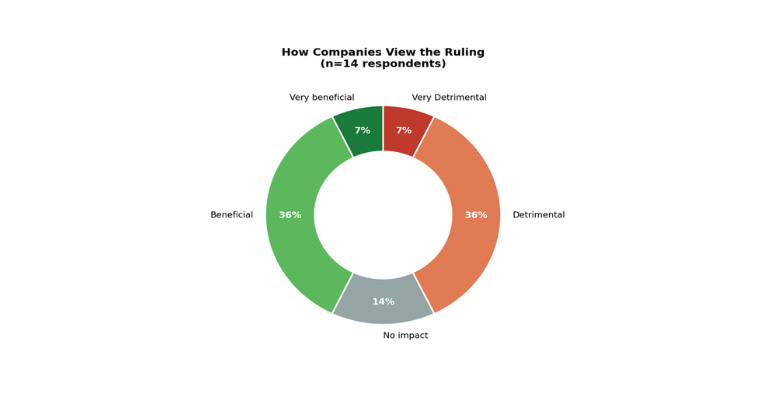
Respondents were evenly split between favorable and unfavorable views of the FCC robotics ban. Source: MassRobotics
In July 2026, the Federal Communications Commission, or FCC, said it has determined that foreign-made “advanced robotic devices,” including certain mobile robots and humanoids, could create supply chain vulnerabilities and pose cybersecurity risks. It banned new models of such devices, with exceptions for federal purchases and companies that obtain waivers through the U.S. Department of War or DoW.
The rule covers ground-based, connected robots that weigh more than 4.4 lb. (1.9 kg), have environmental sensors such as lidar or cameras, include connectivity of at least 200 kbps, and rely on navigation and perception software. The FCC has also said that 65% of the total cost of a robot’s components must be domestic-made to qualify as U.S.-produced. It plans to increase that threshold to 75% in 2029.
The policy initially caused confusion among some robotics suppliers and users. While it applies to imports from any country, it was widely understood to address competition from China, which has installed more than half of the world’s industrial robots.
Along with potential tariffs on robotics, the FCC restrictions also highlighted the need for a national robotics strategy, noted industry advocates. Since the initial announcement, various organizations have been trying to figure out how to respond to these policies and inform the community about them. The Association for Advancing Automation (A3) hosted a webinar with DLA Piper for its members.
MassRobotics finds an even split among member organizations
Last month, MassRobotics surveyed its resident startups, corporate sponsors, and the robotics ecosystem to get feedback on the FCC ban. The Boston-based organization said it spoke with 14 companies ranging “from solo-founder teams to organizations with 200+ members.”
MassRobotics reported that 43% of companies viewed the FCC ruling as “beneficial” or “very beneficial,” with the same percentage calling it “detrimental” or “very detrimental.” Fourteen percent said they expected “no impact.”
“Sentiment tracks closely with a company’s manufacturing footprint,” observed MassRobotics. “Companies already producing domestically tend to view the ruling as a competitive advantage; companies with foreign-dependent supply chains, even partially, tend to view it as a costly disruption.”
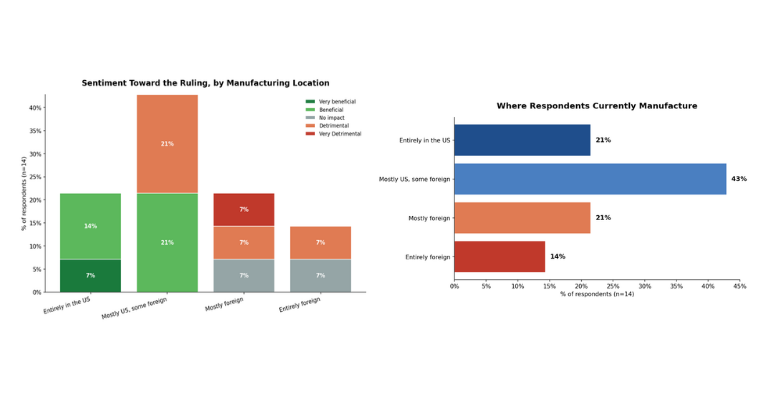
Sentiment toward the FCC ban depended on where a company has its production. Source: MassRobotics
When asked how the FCC ruling would affect their fundraising plans and product roadmaps, respondents also said they expected benefits or disruptions. However, one company said it expected “a severe positive boost,” while another complained that it would have to relocate its headquarters to the U.S.
Twenty-nine percent of those surveyed said they have onshoring plans but have yet to start them.
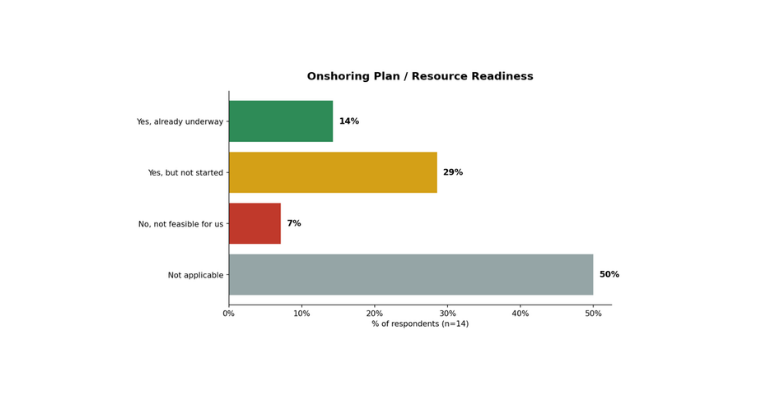
The FCC policy has prompted some companies to examine their supply chains, says MassRobotics.
Companies want clarity, vetted onshoring networks
In open-ended responses, several companies noted that components such as motors, sensors, power supplies and DC/DC converters, and robot arms are largely supplied by East Asia. Some also wondered about the DoW’s “conditional approval” process, which can take four to eight weeks, and worried about the potential for regulatory whiplash around U.S. midterm elections.
In addition, MassRobotics found that companies were concerned about retaliation from China and being outmaneuvered by foreign companies that already have an American footprint. “Vetted onshoring supply networks” were the single most-requested form of support, said the nonprofit organization.
“Messaging and support should be tailored by manufacturing footprint rather than treated as a single industry position,” noted MassRobotics, which is one of the top robotics clusters and accelerators in the country.
Since the initial ruling, the FCC has also banned new consumer robot vacuum cleaners. Proponents of the trade restrictions have noted that offshoring the drone industry weakened U.S. industry and national security.
In a related dispute, North Reading, Mass.-based Teradyne Robotics has sued the German subsidiary of Chinese force- and power-limited robot supplier JAKA for infringing the patents of its Universal Robots unit.
Editor’s note: Reshoring production with automation will be the topic of a panel discussion at RoboBusiness 2026, which will be on Oct. 20 and 21 in Santa Clara, Calif. Register now to attend.
 Register now and save on your pass to RoboBusiness 2026
The post MassRobotics shares member survey results around FCC restrictions appeared first on The Robot Report.


