Part 1 of 2, Physical AI: The DARPA Legacy & the Road Ahead. What the DARPA Robotics Challenge Actually Built—and Why It Still Matters
In March 2011, a massive earthquake and tsunami triggered a nuclear disaster at the Fukushima Daiichi power plant in Japan. Radiation and structural damage made parts of the facility too dangerous for people to enter, yet the available robots could do little more than observe from a distance.
The falls became internet entertainment. The deeper legacy was less visible.
1. The First Lesson: There Was No Winning Body Plan
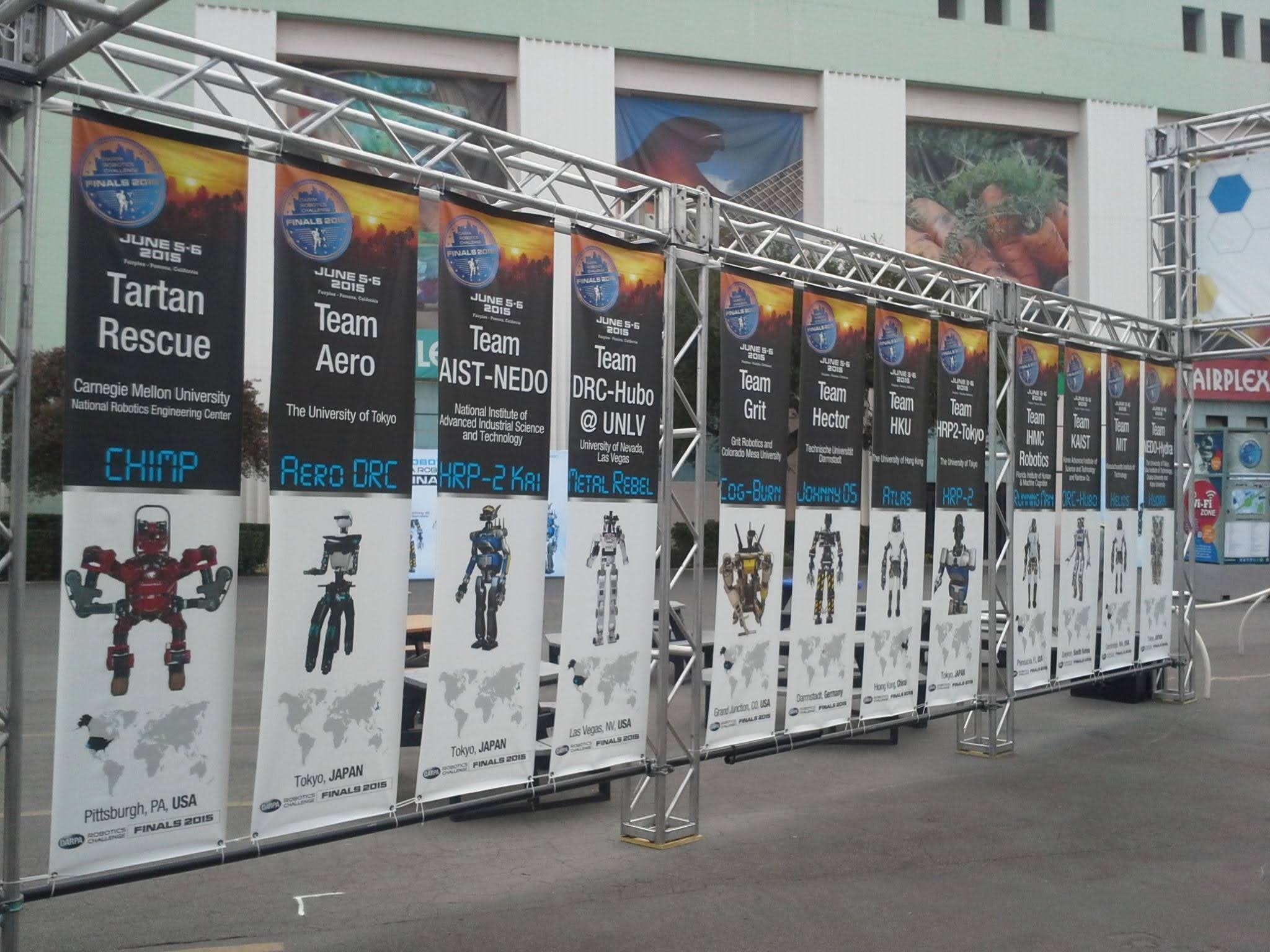
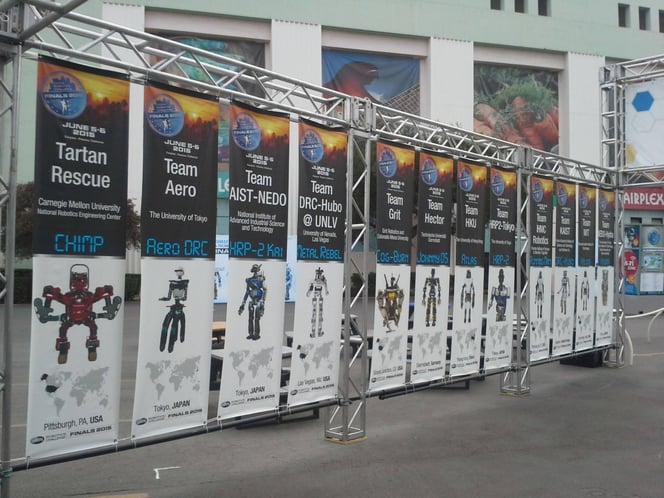
The three leading teams represented three very different engineering philosophies.
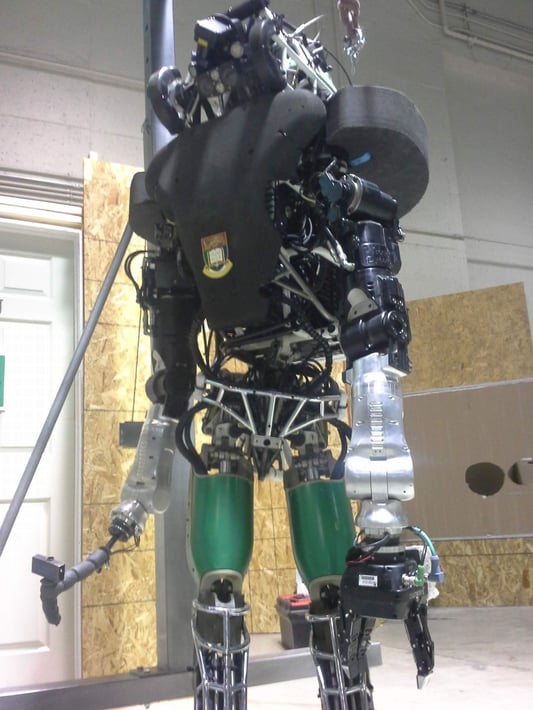
IHMC, which finished second, used Boston Dynamics’ Atlas—a conventional biped without wheels or tracks. IHMC’s achievement was demonstrating that a large humanoid could complete all eight tasks through a combination of sophisticated balance control, footstep planning, whole-body motion and an effective operator interface.
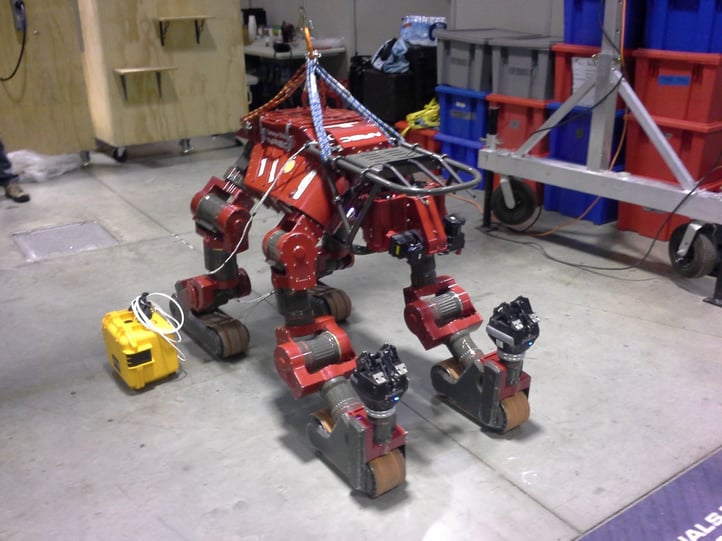
Tartan Rescue, which finished third, took the opposite approach. Carnegie Mellon’s CHIMP moved on tracks built into its four limbs and was designed to remain statically stable rather than continuously balance like a person. It also completed all eight tasks, in 55 minutes and 15 seconds.
The competition therefore did not identify one universally superior morphology. It demonstrated that reliability comes from matching the machine’s physical architecture to its task and controlling the resulting risks.
A biped can move through spaces built for humans. Wheels can make common surfaces faster and safer. Tracks and multiple contact points can reduce the consequences of a loss of balance. The right answer depends on terrain, speed, payload, fall tolerance and the cost of failure.
That remains true today. The question is not whether every robot should look human. It is which parts of the human form create economic value for a particular job.
2. The Manipulation Lesson: Dexterity Is Worthless Without Reliability
The DRC also served as a severe test of robotic hands.
A disaster-response robot has to grasp irregular objects, hold vibrating tools, manipulate controls built for human fingers and survive collisions or falls. These demands created a difficult trade-off.
Anthropomorphic hands offered greater theoretical dexterity, but they also introduced more actuators, joints, cables, sensors and possible failure points. Simpler grippers offered fewer grasp configurations but were easier to control, repair and protect.
The result was not the disappearance of dexterous hands. It was a stronger appreciation for underactuation, mechanical compliance and modularity.
Eight of the 25 qualifying teams for finals planned to use our three-finger adaptive gripper — a fact I still think about. MIT researchers later emphasized the qualities they valued during the competition: durability, underactuation and the ability to regulate fingertip force.
The iRobot i-HY hand, another prominent DRC end effector, was designed around a similar compromise: enough dexterity to perform useful tasks, but with underactuated mechanisms intended to be durable and relatively economical. Atlas teams were provided with hand options developed by iRobot and Sandia National Laboratories.
Mechanical compliance mattered because it reduced the precision demanded from software. When a finger could passively conform around a valve, handle or tool, the perception and control system did not need a perfect geometric model of every contact.
This remains an important principle for physical AI:
Intelligence does not have to live entirely in software. It can also be embedded in the geometry, compliance and mechanics of the machine.
Today’s dexterous hands are returning with better tactile sensors, actuators and learning methods. That does not invalidate the DRC lesson. It raises the bar. Additional dexterity must produce enough useful capability to justify its cost, fragility and control complexity.
3. The DRC Was a Shared-Autonomy Challenge
Descriptions of the DRC sometimes imply that the robots autonomously understood the environment and completed tasks on their own.
They did not.
DARPA intentionally reduced communications quality so operators could not continuously joystick every movement. But humans still played a central role. They interpreted sensor data, selected objects and goals, approved actions and intervened when plans failed.
The robots handled pieces of the problem locally: maintaining balance, generating footsteps, planning trajectories and controlling joints. The operator handled ambiguity, strategy and exception management.
IHMC called its approach coactive design: instead of treating the robot as either autonomous or teleoperated, the team designed the human, interface and robot as one operational system.
This may be the most relevant DRC lesson for current physical AI deployments.
The near-term alternative to full autonomy is not necessarily crude remote control. It is a graduated system in which:
- the robot executes known skills autonomously;
- a person gives goals or resolves ambiguous situations;
- remote assistance handles exceptions;
- the system records interventions as training data;
- autonomy expands as recurring exceptions are learned.
4. What Was Still Missing in 2015
Perception was geometric and task-specific
Behaviours were engineered more than learned
Data was scarce and fragmented
Contact sensing was limited
Recovery remained difficult
A robot could complete an impressive planned action and still be defeated by a small deviation. A foot could land several centimetres away from its expected position. A tool could shift in the gripper. A door could resist differently than anticipated.
Modern physical AI often focuses on task success. Production systems will increasingly be judged by something harder: whether they can detect failure, recover and continue without human intervention.
5. What DARPA Actually Created in Industry
DARPA did not single-handedly create the humanoid industry. ROS existed before the DRC. Rainbow Robotics had already been founded. Boston Dynamics and many of the participating laboratories had decades of prior work.
What the DRC created was an industrial acceleration mechanism.
It aligned researchers and suppliers around a public benchmark, funded shared infrastructure, made failure visible, trained complete systems teams and gave companies evidence that the technology could eventually leave the laboratory.
A common humanoid development platform
DARPA funded Boston Dynamics to develop Atlas as a shared platform for several teams. Seven teams emerging from the Virtual Robotics Challenge received Atlas robots, allowing researchers to work on a common machine rather than each spending years building a humanoid from scratch.
For the 2015 Finals, Atlas was upgraded with onboard power, wireless operation, improved limbs and greater durability. The robot became a development platform on which numerous teams advanced state estimation, whole-body control, manipulation and operator interfaces.
That lineage continues. Boston Dynamics’ current electric Atlas is a fundamentally new commercial machine, not the hydraulic DRC robot. But it inherits the accumulated organizational knowledge of building, controlling, falling, repairing and operating full-sized humanoids. In 2026, Boston Dynamics announced initial product deployments with Hyundai and a research collaboration with Google DeepMind.
The direct legacy is not one unchanged robot. It is more than a decade of embodied engineering knowledge.
Open-source simulation infrastructure
The Virtual Robotics Challenge required teams to develop and test robot software in simulation. DARPA’s contract with the Open Source Robotics Foundation helped establish the organization now known as Open Robotics and funded several years of work on Gazebo and related infrastructure. Open Robotics itself describes the DRC as a catalyst for the organization’s formation and growth.
The DRC did not create ROS. What it did was strengthen the institutions and simulation tools around the open-source robotics ecosystem.
That contribution was strategically important. Shared simulation lowered the cost of entry, let geographically distributed teams reproduce scenarios and helped establish simulation as part of the normal robotics-development workflow.
Modern GPU simulators are vastly more capable. They support parallel environments, photorealistic rendering, domain randomization and reinforcement learning. But the organizational model—shared robot descriptions, common interfaces and repeatable virtual tests—was already visible in the DRC.
Validation for a new generation of robotics companies
The competition also acted as a credibility engine.
Rainbow Robotics was founded by KAIST researchers in 2011, before the DRC. The 2015 victory did not create the company, but it gave the team an internationally visible proof point. Rainbow later commercialized collaborative and mobile robots, listed publicly in South Korea and became strategically tied to Samsung, which increased its ownership position to 35 percent.
NASA’s Valkyrie program created another important talent and technology lineage. Apptronik describes its humanoid Apollo as rooted in experience accumulated through Valkyrie and more than ten previous robot platforms developed by its team.
IHMC’s work on Atlas helped form a continuing lineage in legged robotics, including Boardwalk Robotics and its electric humanoid Alex. The important industrial transfer was not a single algorithm; it was a group of people experienced in integrating controls, mechanics, interfaces and field operations under pressure.
SCHAFT, created by alumni of the University of Tokyo’s JSK laboratory, dominated the 2013 Trials before withdrawing from the Finals to focus on commercial development. Its acquisition by Google was an early signal that advanced humanoid capabilities had become strategically interesting to major technology companies.
A talent network spanning academia and industry
DARPA challenges concentrate exceptional researchers around a common deadline. After the event, those people disperse—but they carry shared experience, relationships and technical assumptions with them.
Gill Pratt, the DRC program manager, later became chief scientist at Toyota and CEO of the Toyota Research Institute. Russ Tedrake, who led Team MIT, became vice-president of robotics research at TRI. Scott Kuindersma, a key member of Team MIT, went on to lead robotics research at Boston Dynamics.
In 2024, Boston Dynamics and TRI announced a collaboration combining TRI’s large behaviour models with the electric Atlas platform. The project reunited several researchers with direct Team MIT and DRC lineage, including Tedrake, Kuindersma, Pat Marion and Lucas Manuelli.
That is how challenge programs influence industry. They create cohorts of people who have already solved difficult integration problems together and who later recombine inside companies, laboratories and startups.
A commercial component ecosystem
The DRC also demonstrated that advanced robotics did not require every team to build every component.
Teams incorporated common robot platforms, commercial grippers, cameras, force sensors, computers and open-source middleware. Suppliers received unusually demanding field feedback. Researchers learned which components survived impact, vibration, electrical noise, calibration errors and repeated integration.
This helped move robotics toward a more modular industrial ecosystem. The same pattern is now visible in physical AI: foundation-model builders, robot manufacturers, actuator suppliers, gripper companies, simulation providers and deployment specialists can each own a layer of the stack.
A culture of useful public failure
Perhaps DARPA’s most important contribution was making failure acceptable—and informative.
Most industrial demonstrations are designed to hide uncertainty. The DRC did the opposite. Robots failed in public, under a common set of rules, with no marketing edit.
A fall exposed weaknesses in balance and recovery. A dropped tool exposed problems in grasping and perception. A stalled robot exposed weaknesses in power, communications or operator workflow.
Because every team confronted similar tasks, the failures became comparable. The field could see which problems were individual implementation mistakes and which represented broader technological limits.
6. The Real Connection to Today’s Physical AI
The current physical AI wave is not simply placing neural-network brains inside DRC-era bodies.
The hardware is changing. Electric actuators are improving. Sensors are cheaper. Compute is denser. Simulation can generate millions of training episodes. Models can connect language, vision and action. Robot fleets can collect data and improve over time.
But the DRC’s systems lessons remain intact:
- Embodiment matters.
- Mechanical design can reduce the learning problem.
- A complete system is limited by its weakest subsystem.
- Human supervision is not binary; it can be designed and progressively reduced.
- Recovery matters as much as nominal task execution.
- Simulation is essential, but reality remains the final test.
- Reliability is created through integration, not through one breakthrough model.



