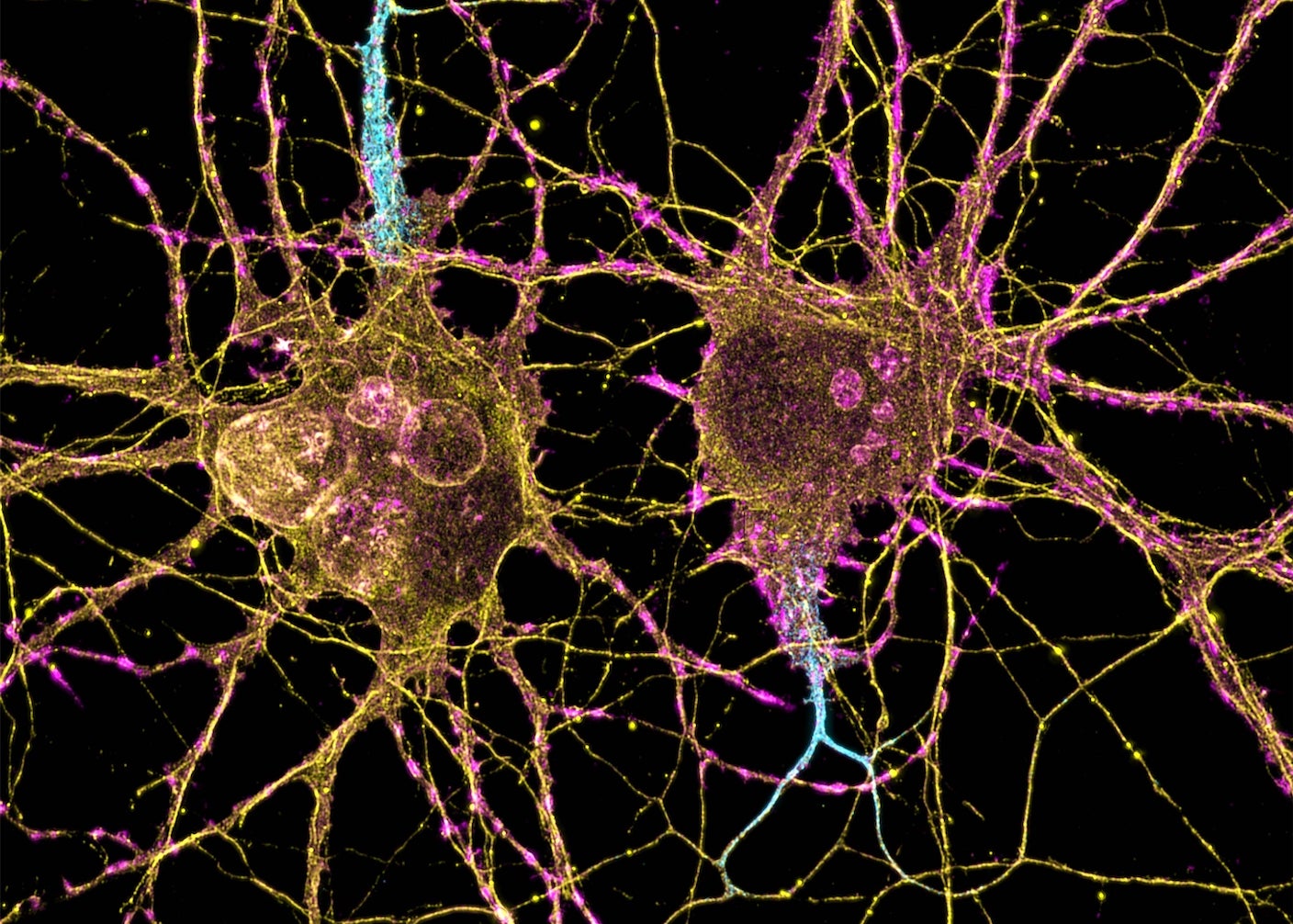
The Alzheimer’s brain faces a double whammy. Toxic protein clumps build up inside and outside neurons to torpedo normal function and destroy delicate structures. Eventually, the cells die. The adult brain has an extremely limited ability to grow new neurons. Once gone, they’re rarely replaced. Over time, the brain withers, taking learning, memory, and cognition with it.
But there might be a sneaky workaround. The brain is packed with star-shaped cells called astrocytes that keep neurons healthy. They’re also shape-shifters. Under certain conditions, astrocytes can shed their identity and transform directly into mature neurons. In other words, they could be an abundant, untapped source of replacement neurons.
A team at the University of South Carolina has now taken advantage of this quirk. They engineered a tiny molecular cage and filled it with antibodies. Once inside astrocytes, the antibodies released a protein “brake” that normally keeps the cells’ identity stable. Free from this constraint, astrocytes in lab dishes and human brain organoids adopted the molecular signatures of neurons and eventually sparked with electrical activity.
In mice modeling Alzheimer’s disease, the treatment increased the number of neurons in the hippocampus, a brain region crucial for learning and memory and one of the first to falter in the disease. Treated mice resumed normal behavior and performed similarly to healthy mice on tests of learning and memory in a maze.
The approach fundamentally differs from existing methods and could “unlock previously inaccessible regenerative mechanisms,” wrote the team. If it proves safe and effective in clinical trials—and that’s a big if—the approach could one day tackle diseases beyond Alzheimer’s, such as Parkinson’s or amyotrophic lateral sclerosis (ALS).
Born Identity
The quest to treat Alzheimer’s has often been called the “graveyard of dreams.” The most common form of dementia, the disease affects roughly 24 million people worldwide and slowly eats away at thinking, memory, learning, and emotional regulation. Experts still debate Alzheimer’s root cause, but they largely agree that clumps of misshapen proteins called amyloid beta and tau exacerbate the disease.
Current FDA-approved treatments have had limited success. Antibodies that clear clumps offer only modest benefits to cognition and carry the risk of serious side effects. Other drugs, such as memantine, alter brain chemicals to protect damaged cells, rev up faltering brain circuits, and ease symptoms. But they don’t halt degeneration. As the disease progresses, benefits fade.
The central problem is frustratingly clear. Neurons die faster in Alzheimer’s than the brain can replace them. That’s why a landmark study nearly two decades ago made waves. Scientists once thought mature astrocytes were set in their fate. But the study showed the cells could be reprogrammed into neurons that generated electrical activity and formed connections with neighboring neurons in lab dishes to form working circuits.
Scientists later found a protein called PTBP1 that prevented this conversion. In 2020, a team injected an RNA-targeting form of CRISPR into the brains of mice modeling Parkinson’s disease. This reduced PTBP1 levels, which in turn, triggered the production of new neurons. The treatment restored the mice’s balance and motor skills, although some experts were skeptical.
While promising, CRISPR-based approaches can have unintended effects, and brain surgery is a tall order for any treatment. So, the team developed another way to release the PTBP1 brake.
Erase, Rewind
They turned to a duo of technologies that transport antibodies inside nanoparticle cages to degrade specific proteins inside cells. In this case, they used antibodies targeting PTBP1 and packaged the concoction in a biocompatible gel injected into the bloodstream.
Because of their large size, antibodies can’t usually cross the blood-brain barrier, a tightly sealed wall that keeps many molecules out of the brain. But the nanoparticle system helped ferry the antibodies across the blockade, nixing the need for brain surgery.
The team first tested the drug, called TN-PTBP1, on astrocytes grown in lab dishes. Within days, the cells lost their star shapes and began growing long, willowy branches characteristic of neurons. Their molecular profile also shifted, and the cells eventually burst with electrical signals.
The team recorded similar results in brain organoids, or “mini brains,” grown from human stem cells. Given a small electrical zap, the converted neurons responded in synchrony with neighboring neurons, suggesting they had integrated into existing neural circuits.
“The new neurons can become mature and survive,” said study author Peisheng Xu in a press release.
Next, they tested the drug in a mouse model of Alzheimer’s disease. By eight months, the mice showed clear signs of the disease. Their brains were highly inflamed and littered with toxic protein clumps. Neurons in the hippocampus had also substantially died off, similar to the loss seen in moderate to severe Alzheimer’s in humans.
The mice struggled with everyday behaviors, such as foraging for material to build nests. And they consistently performed poorly on a classic memory test where they had to find a location using visual cues (a bit like remembering where you parked your car).
Half the mice received TN-PTBP1 for two weeks; the others received saline. As expected, the drug reliably slashed PTBP1 levels in the brain. Over the course of the trial, treated mice increasingly improved on tests of cognition and memory, eventually performing at levels similar to healthy peers. Mice treated with saline showed no improvement.
“After just two injections, these mice became smarter,” said Xu. “Even after one injection, we already saw these mice’s behavior differ from that of the nontreated ones.”
The team found broader benefits too. The drug reduced inflammation and, surprisingly, the number of toxic protein clumps, suggesting it may have helped restore some of the brain’s ability to rid itself of waste. Neuron density also increased throughout the brain, and the treatment boosted production of proteins involved in maintaining the blood-brain barrier, which is often damaged in Alzheimer’s.
One unexpected, and welcome, effect was neurogenesis, the birth of new neurons in the hippocampus and another brain region. Neurogenesis declines with age, and whether it exists at all in adult humans is hotly debated. How TN-PTBP1 triggered it in mice remains a mystery. It’s also unknown how much the new neurons contributed to the animals’ recovery versus the direct conversion of astrocytes into neurons.
Still, it’s clear the drug boosted neuron numbers and “successfully reversed Alzheimer’s disease progression” in the mice, wrote the team.
The approach has a long road ahead. Many promising treatments in mice have failed in clinical trials. In the next few years, the team hopes to test the approach in monkeys, dial in the dose, and assess long-term safety. Astrocytes perform many tasks that keep the brain humming, and forcing them to abandon their identity could have unexpected consequences. There’s also the possibility newly converted neurons could scramble existing brain circuits rather than integrating safely, causing more harm than good.
But with rigorous testing, the drug could offer new hope.


